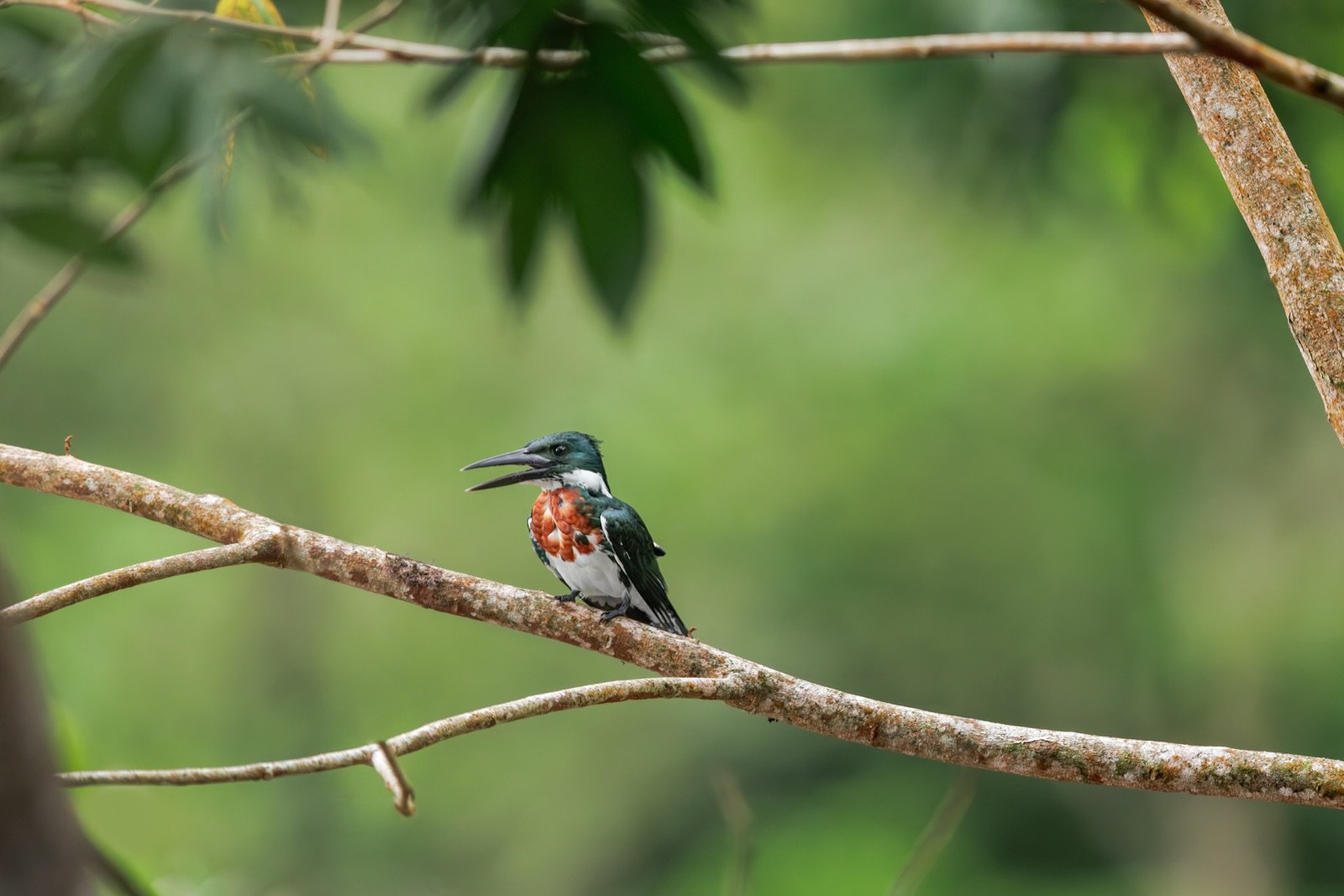
 Amazon Kingfisher
Family Alcedinidae
Amazon Kingfisher
Chloroceryle amazona
In Spanish: Martín Pescador Amazónico
- Resident
Big green-backed kingfisher of rivers, lagoons and mangrove channels
The Amazon Kingfisher is the largest of the green-backed kingfishers, about 29 cm long, and in Costa Rica it lives across much of the country near rivers, pools and lakes. A Costa Rican natural history entry calls it a common resident, especially along rivers.
It is a bird of open water rather than dense forest. Look along a river for a shaggy-crested figure sitting on a branch, watching the surface for a fish.
On a trip we build, boat outings are the natural way to meet it. Boat trips on the Tárcoles River on the Pacific side and the Río Frío near La Fortuna have both turned it up for birding groups, often alongside the Ringed and Green Kingfisher.
How to find it
Scan branches that overhang the water along rivers, mangrove channels, estuaries and lagoon edges. It is often seen perched there before it dives for a fish. Watch for it returning to the perch to beat its catch before swallowing it. Mornings and afternoons are when it hunts. Listen for shrill whistles and rattles, which often come before the sighting. A boat helps: a photographer on the Río Frío found the kingfishers much less skittish than the Belted Kingfisher at home, and the boat got surprisingly close.
How to recognise it
Start with size. This is the largest of the green-backed kingfishers, about 29 cm long.
The upperparts are dark glossy green. The bill and feet are black, and a white collar circles the neck. The crest is shaggy and the bill is long and heavy.
Males have a broad rufous chest band and white underparts with some green streaks on the flanks. Females have no rufous and show green patches on the sides of the chest instead.
Juveniles show buff spots on the upper wing and a yellow patch on the bill.
What it sounds like
Recording: Eduardo Luis Beltrocco, CC BY 4.0, source, read 4 Nov 2026.
Behaviour and diet
It is usually alone or in pairs. It perches on a branch over the water, then dives for fish, sometimes after hovering above the surface. It often returns to a nearby perch, beats the fish on a branch and swallows it head first.
Only about 30 percent of dives succeed. It hunts mainly in the morning and the afternoon. Across its range it nests in a horizontal tunnel dug into a river bank, up to 1.6 m long, where the female lays three, sometimes four, white eggs.
Where it lives
In Costa Rica it lives across much of the country near rivers, pools and lakes, below about 1200 m elevation. A natural history entry describes it locally on both coasts, from sea level up to roughly 900 m.
Look over slow or fast rivers, mangrove channels, estuaries and lagoon edges. Across its range it prefers open landscapes to dense forest, using large rivers, wooded lake shores, freshwater and brackish lagoons, mangroves and tidal estuaries.
When to see it
A Costa Rican natural history entry says breeding runs from January to March.
Similar birds
It looks like the Green Kingfisher but is much larger, about three to four times as heavy, and lacks that species' white wing markings. A male Belted Kingfisher can be mistaken for a female Amazon, but a male Amazon's rufous upper breast settles it. Ringed is far bigger. In poor light size is hard to judge, so take your time. Green-and-rufous Kingfisher is a similar size but prefers shady places.
Names and lore in Costa Rica
The Costa Rican name is Martín pescador amazónico. Elsewhere in Latin America it is called pechicanelo in Nicaragua and matraquero in Colombia and Venezuela.
Status and conservation
It is listed as a resident (R) on the AOCR list, and the IUCN rates the species Least Concern, though a decline is suspected.
Photography tips
Photographers get it perched on a bare twig and in flight. The San Carlos River is one place where it has been photographed this way. A boat lets you approach closely, and the birds tend to be calm.
How we know this 23 sources, each read on the date shown
- Universidad de Costa Rica repository (AvesTikas) read 2026-11-04
https://repositorio.iiarte.ucr.ac.cr/handle/123456789/10994 - Birds Outside My Window read 2026-11-04
https://www.birdsoutsidemywindow.org/2026/02/18/kingfisher-sweep-in-costa-rica/ - iStock photo captions read 2026-11-04
https://www.istockphoto.com/photos/amazon-kingfisher-chloroceryle-amazona - JungleDragon read 2026-11-04
https://www.jungledragon.com/specie/192/amazon_kingfisher.html - Animalia.bio read 2026-11-04
https://animalia.bio/amazon-kingfisher?taxonomy=802 - Ecos del Bosque (quoting Guía de Aves de Costa Rica) read 2026-11-04
https://ecosdelbosque.com/fauna/chloroceryle-amazona - Birda species guide read 2026-11-04
https://app.birda.org/species-guide/10645/Amazon_Kingfisher - Bird Watching Costa Rica read 2026-11-04
https://www.birdwatchingcostarica.com/ave/amazon-kingfisher/ - Spanish Wikipedia read 2026-11-04
https://es.wikipedia.org/wiki/Chloroceryle_amazona - Rutas Chile bird guide read 2026-11-04
https://www.rutaschile.com/Guia-Aves-Detalle.php?N=martin-pescador-amazonico - Sistema de Información de Biodiversidad (Argentina) read 2026-11-04
https://sib.gob.ar/especies/chloroceryle-amazona - Eagle-Eye Tours read 2026-11-04
https://www.eagle-eye.com/blog/costa-rica-2024-trip-report-feb-28-mar-15-2024/ - Wingspan Bird Tours read 2026-11-04
https://www.wingspanbirdtours.com/blog/costa-rica-tour-day-4-c207fbf3-d455-4061-83fe-722f31a4658c - Two Weeks in Costa Rica read 2026-11-04
https://www.twoweeksincostarica.com/cano-negro/ - Linda Murdock Photography read 2026-11-04
http://gustaviatex.com/blog/2019/10/23/costa-rica-finding-the-river-birds - Tripadvisor (traveler review) read 2026-11-04
https://www.tripadvisor.com/Attractions-g858541-Activities-c55-Tarcoles_Tarcoles_District_Garabito_Municipality_Province_of_Puntarenas.html - Guía de Aves de Misiones read 2026-11-04
https://guiadeavesdemisiones.com/martin-pescador-mediano-chloroceryle-amazona/ - Historia Natural de Costa Rica (via Flickr caption) read 2026-11-04
https://www.flickr.com/photos/jobando/35670818915 - Birds for Beer (Turrialba) read 2026-11-04
https://birdsforbeer.com/2021/05/20/belted-kingfisher-our-only-migrant-kingfisher/ - Viewing Nature with Eileen read 2026-11-04
https://viewingnaturewitheileen.blogspot.com/2010/04/costa-rica-kingfishers.html - Birds of Colombia (Costa Rica pages) read 2026-11-04
https://www.birdsofcolombia.org/costarica/Chloroceryle.html - Nicoya Peninsula Costa Rica read 2026-11-04
https://nicoyapeninsula.com/wildlife/motmot.php - Envato Elements read 2026-11-04
https://elements.envato.com/amazon-kingfisher-chloroceryle-amazona-perched-on--R2BLZ3Y