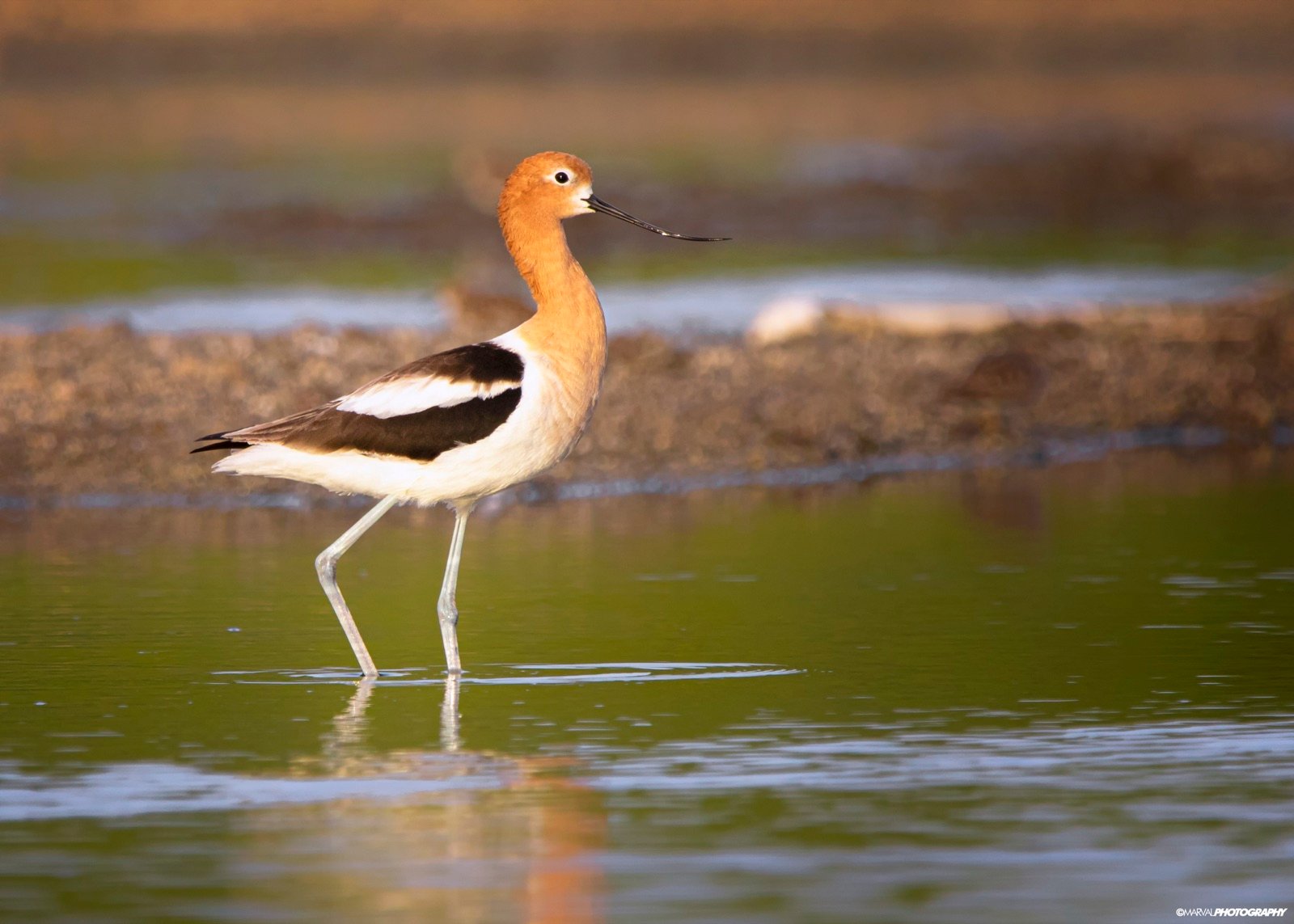
Family Recurvirostridae
American Avocet
Recurvirostra americana
In Spanish: Avoceta Americana
- Migrant
A rare winter wader with an upturned bill, recorded in the northwest lowlands.
The American Avocet is a large, slender wader with a thin black bill that curves upward. In Costa Rica it is a casual winter visitor and not a regular one, so any sighting is a real find rather than something to plan around.
Records come from the northwest lowlands, around the Tempisque River basin and the Gulf of Nicoya. The country sits at the far southern edge of the avocet's non-breeding range, which is why it turns up only now and then.
For a beginning birder it is a fine bird to keep in mind while scanning shallow pools, because the upturned bill sets it apart from every other wader there.
How to find it
Concentrate on salt works and freshwater marshes in the northwest lowlands, around the Tempisque basin and the Gulf of Nicoya. Scan shallow water and mud for a pale wader walking with head and neck stretched forward. Watch for the side to side sweep of the upturned bill. Check flocks of Black-necked Stilts and yellowlegs, because a vagrant avocet has been reported sharing the mud with them, along with Wilson's Plovers. Treat any sighting as a bonus, since one turns up every so often but not every year.
How to recognise it
This is a large, slender wader about 46 cm long. Look for these marks:
A thin black bill that curves upward, the quickest clue.
Long blue-gray legs, which earn it the English nickname "blue shanks".
A black and white chevron pattern on the back and wings.
A pale gray head and neck, cinnamon in the breeding season. In winter the head and neck are grayish white.
It is the only avocet with separate breeding and non-breeding plumages, so a bird seen here in winter will usually show the paler look.
What it sounds like
Behaviour and diet
The avocet walks through shallow water with its head and neck stretched out. It sweeps its bill from side to side over mud or the surface to catch water insects, small crustaceans and seeds.
It is solitary or in small groups. It glides through the shallows and is often seen resting on one leg.
Where it lives
In Costa Rica it is listed from salt works and freshwater marshes. These are lowland wetlands in the northwest of the country. Records come from the Tempisque River basin and the area around the Gulf of Nicoya, and a range database lists it as a non-breeding bird in Guanacaste and Puntarenas provinces.
When to see it
The Costa Rican species account mentions four reports, all between December and May. One bird reported in November 2023 shows that autumn arrivals are possible, though that was a single bird and not a pattern.
Similar birds
The Black-necked Stilt is the common look-alike in Costa Rica, and the two often feed together outside the breeding season. The stilt is shorter and daintier, with a shorter, straighter bill, where the avocet's is longer and turns upward. The stilt keeps a black neck all year, while the avocet's winter head and neck are grayish white.
Names and lore in Costa Rica
Costa Rican Spanish names are Avoceta Americana, the name on the official AOCR list, and Alcaraván americano. English speakers nickname it "blue shanks" for its long pale legs. The Black-necked Stilt, its look-alike, is Cigüeñuela Cuellinegro, nicknamed Soldadito.
Status and conservation
The AOCR list marks it M, and the Costa Rican species account calls it a casual winter visitor that is not regular here.
How we know this 16 sources, each read on the date shown
- Flickr (reposts Costa Rican species account, Mata Redonda National Wildlife Refuge) read 2026-11-04
https://www.flickr.com/photos/jobando/39701947190 - Cornell Birds of the World read 2026-11-04
https://birdsoftheworld.org/bow/species/ameavo/cur/introduction - All About Birds, Cornell Lab of Ornithology read 2026-11-04
https://www.allaboutbirds.org/guide/American_Avocet/species-compare/ - All About Birds, Cornell Lab of Ornithology read 2026-11-04
https://www.allaboutbirds.org/guide/American_Avocet/id - All About Birds, Cornell Lab of Ornithology read 2026-11-04
https://www.allaboutbirds.org/guide/American_Avocet/overview - Avibase read 2026-11-04
https://avibase.bsc-eoc.org/species.jsp?avibaseid=8EB0C1FABC1D725A - Hotel Rivel blog read 2026-11-04
https://hotelrivel.online/a-shockingly-elegant-visitor-the-american-avocet-in-costa-rica/ - NatureServe Explorer read 2026-11-04
https://explorer.natureserve.org/Taxon/ELEMENT_GLOBAL.2.100007/Recurvirostra_americana - Birding Craft read 2026-11-04
https://birdingcraft.com/wordpress/2023/11/ - iNaturalist guide (Wikipedia summary) read 2026-11-04
https://www.inaturalist.org/guide_taxa/1196545 - Birding Craft read 2026-11-04
https://birdingcraft.com/wordpress/2023/11/26/5-things-learned-from-chasing-american-avocets-in-costa-rica/ - Birding Craft read 2026-11-05
https://birdingcraft.com/wordpress/2014/11/ - NatureServe range data (via Audubon Art page) read 2026-11-05
https://www.audubonart.com/product/audubon-1st-ed-octavo-pl-353-american-avocet/ - Avibase read 2026-11-05
https://avibase.bsc-eoc.org/checklist.jsp?region=CRgu - Wikipedia, List of birds of Costa Rica read 2026-11-05
https://en.wikipedia.org/wiki/List_of_birds_of_Costa_Rica - Lista Oficial de las Aves de Costa Rica (AOCR) read 2026-11-05
https://listaoficialavesdecostarica.wordpress.com/lista-oficial/lista-oficial-online/