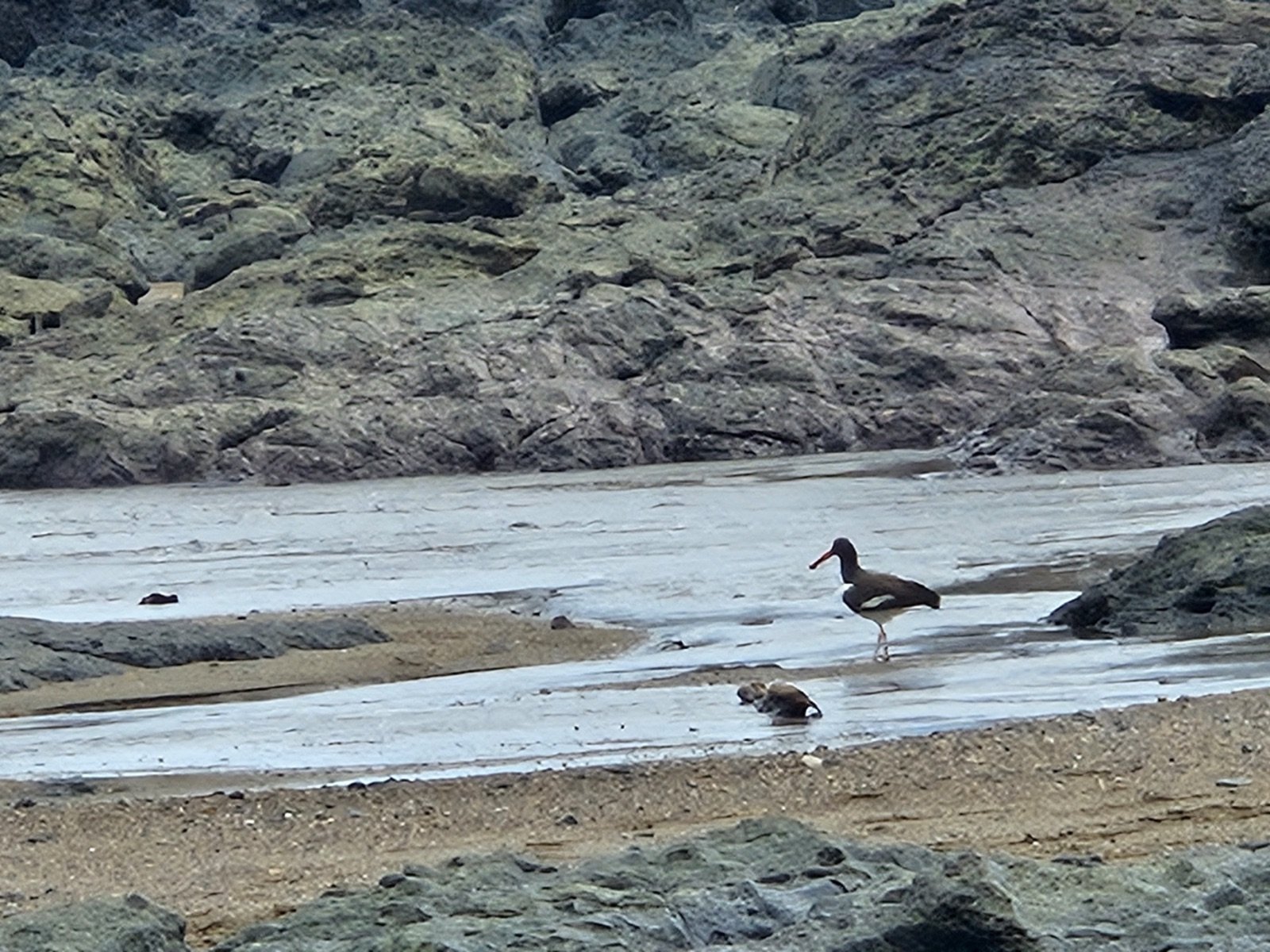
Family Haematopodidae
American Oystercatcher
Haematopus palliatus
In Spanish: Ostrero Americano
- Resident
Costa Rica's only oystercatcher, a rare bird of quiet Pacific beaches and islands.
The American Oystercatcher (Ostrero Americano) is the only oystercatcher species that reaches Costa Rica, so any oystercatcher you see here should be this bird. The identification is easy, even if the finding is not.
In Costa Rica it is described as a rare resident on remote Pacific beaches and offshore islands. It is most numerous, though still rare, on the northwest coast from Cabo Blanco northward.
For a beginning birder it is a rewarding target, because its size and bold look make it easy to pick out among gulls, terns, plovers and sandpipers. The trick is choosing a quiet beach and the right moment in the tide.
How to find it
Check a tide chart first. At high tide the birds often leave for remote roosts, and they return to feeding grounds as the tide falls and exposes their prey. Plan your time on the sand around that falling tide. Costa Rica's busiest tourist coast overlaps the bird's main range here, and oystercatchers are often seen on the main beaches only outside the tourist season. Quieter, remote beaches are the better bet. Listen for the loud, piping whistle, then scan mixed flocks of gulls, terns and sandpipers for the larger, bolder bird.
How to recognise it
Start by scanning a mixed shorebird flock. The American Oystercatcher stands out among gulls, terns, plovers and sandpipers because of its size and bold look.
The field marks, in plain terms:
Head and breast: blackish.
Underparts: white. The white belly is what separates it from the all-dark Black Oystercatcher of the Pacific coast of North America.
Eye: yellow.
Bill: red-orange.
Legs: pink.
In flight: white inner wing feathers flash.
These plumage and colour details describe the species across its range, and they match what you will see on a Costa Rican beach.
What it sounds like
Recording: Zac Peterson, CC BY 4.0, source, read 4 Nov 2026.
Behaviour and diet
The oystercatcher eats mostly shellfish such as mussels, clams and oysters. It either stabs its bill into a slightly open shell to cut the muscle, or hammers the shell until it breaks.
Its day follows the water. It feeds on sand and mud flats exposed by the tide and rests on beaches, dunes or marsh islands. At high tide the birds often leave for remote roosts, and they return to the feeding grounds as the tide falls and exposes their prey. These habits describe the species across its range rather than Costa Rica alone.
Where it lives
Across its range the American Oystercatcher is strictly coastal and rarely goes inland. It uses sandy beaches, river mouths, estuaries, mudflats, headlands, salt ponds and other flats, and rests on beaches, dunes or marsh islands.
In Costa Rica it lives mainly along the Pacific coast, on remote beaches and offshore islands. The northwest coast from Cabo Blanco north holds the most birds. It is also reported from the north Pacific coast and the Gulf of Nicoya, with smaller numbers on the Caribbean coast.
When to see it
Costa Rica lies within the primary wintering range of the species, and birds are described as migratory on both coasts because they breed in the cooler northern part of the range. Resident birds are here too, so it is not only a seasonal visitor.
Similar birds
Within Costa Rica nothing similar should confuse you, because this is the only oystercatcher species that reaches the country. Along much of the Pacific coast of North America the all-dark Black Oystercatcher replaces it. The American has a white belly, which separates the two.
Names and lore in Costa Rica
The AOCR name is Ostrero Americano. Other Spanish names used for the species, though not specifically Costa Rican ones, are ostrero, ostrero común, ostrero pardo, caracolero and pilpilén. Mexico and Costa Rica may use different Spanish names for the same bird.
Status and conservation
The AOCR lists it as a resident and migrant (R,M), it is described as a rare resident in Costa Rica, and the IUCN lists the species globally as Least Concern.
Photography tips
Its size and bold look make it easy to pick out in a mixed flock. Quiet, remote beaches outside the tourist season are the better bet, and the falling tide brings the birds back to feed on exposed flats.
How we know this 12 sources, each read on the date shown
- Global assessment of the conservation status of the American Oystercatcher (Clay et al. 2014) read 2026-11-04
https://amoywg.org/wp-content/uploads/2014/09/Clay-et-al_2014_global-status-American-Oystercatcher.pdf - Hotel Rivel blog read 2026-11-04
https://hotelrivel.online/un-toque-de-color-en-la-costa-costarricense-el-ostrero-americano/ - Dreamstime photo caption read 2026-11-04
https://www.dreamstime.com/birds-costa-rica-american-oystercatcher-haematopus-palliatus-junquillal-beach-guanacaste-couple-walking-sand-image172540908 - The Nature Admirer read 2026-11-04
https://thenatureadmirer.com/2018/09/18/american-oystercatcher-haematopus-palliatus/ - All About Birds, Cornell Lab of Ornithology read 2026-11-04
https://www.allaboutbirds.org/guide/American_Oystercatcher/overview - Diversidad y un poco de todo read 2026-11-04
https://www.diversidadyunpocodetodo.com/ostrero-pio-americano-american-oystercatcher-haematopus-palliatus/ - American Oystercatcher Working Group read 2026-11-04
https://amoywg.org/american-oystercatcher/distribution/ - iNaturalist guide (Birds of the World summary) read 2026-11-04
https://www.inaturalist.org/guide_taxa/34650 - iNaturalist Mexico read 2026-11-04
https://mexico.inaturalist.org/taxa/4840-Haematopus-palliatus - Go Visit Costa Rica read 2026-11-05
https://www.govisitcostarica.com/region/city.asp?cID=5 - Birds of the World (Cornell) read 2026-11-05
https://birdsoftheworld.org/bow/species/ameoys/cur/introduction - Bird Watching Costa Rica read 2026-11-05
https://www.birdwatchingcostarica.com/ave/american-oystercatcher/