Family Motacillidae
American Pipit
Anthus rubescens
In Spanish: Bisbita Americana
- A
A very rare winter visitor that walks and wags its tail on open ground
The American Pipit (Bisbita Americana, Anthus rubescens) is a small, plain songbird, about 16 cm long, that is often seen running on the ground. In Costa Rica it is a bird for the patient birder, not for the checklist chaser.
The nominate form breeds in northern Canada, Greenland and the northeastern US, and winters in Central America. Costa Rica is on the list of countries where it turns up as a rare winter visitor, and the official AOCR list gives it the status code A.
For a beginning birder it is a good lesson in reading shape and behaviour rather than colour: a slim bird, a walking gait, a wagging tail and a thin call overhead.
How to find it
Scan open fields and sandy or bare ground for small, slim birds walking steadily and wagging their tails. Because wintering birds usually feed in flocks, one sighting may mean several birds. Listen overhead for the thin pip calls, as flocks are often heard before they are seen, or as they lift off from bare fields. Check the edges of very shallow water too. When a flock flushes, look for the white outer tail feathers.
How to recognise it
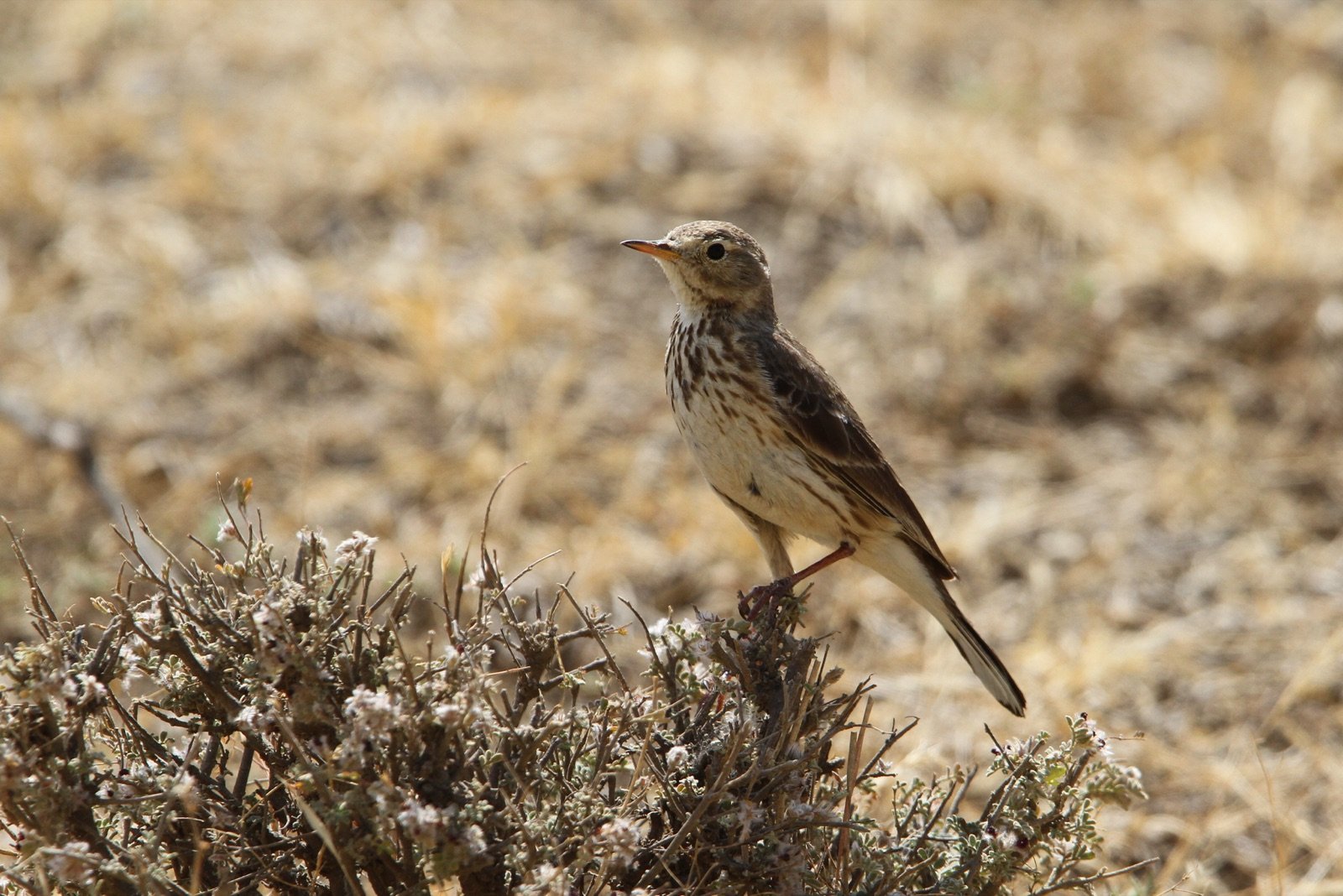
The American Pipit is a small songbird, about 16 cm long and 22 g, and it looks plain. Learn it by these marks:
Shape: slim, with a long tail.
Bill: thin.
Legs: long.
In flight: white outer tail feathers that show clearly.
On the ground: it runs or walks with jerky movements and often wags its tail.
That walking, wagging habit is often the quickest way to pick it out on bare ground.
What it sounds like
Recording: Thomas Koffel, CC BY 4.0, source, read 4 Nov 2026.
Behaviour and diet
Outside the breeding season it usually feeds in flocks. It finds prey by walking and scanning, then pecks or gleans, sometimes running toward the food first. It picks insects from the ground or low plants and sometimes wades in very shallow water. Flocks often stalk grasshoppers on the ground with bobbing tails and hop up to catch one as it jumps.
Where it lives
The species favours open fields and sandy ground. It breeds in northern Canada, Greenland and the northeastern US, and winters in Central America. Costa Rica is among the countries where it is a rare winter visitor, and one Costa Rican birding blogger describes the brushy fields where it may occur as hard to search.
When to see it
The only dated Costa Rican record we found is from January 2005, when one pipit was resting on a sandbar near a river mouth on Cocos Island.
Similar birds
Sparrows look similar but are unrelated. The pipit separates from them by its thin bill, slim shape and long legs. Any pipit in Central America needs good documentation, since first-winter birds are hard to identify, and only two pipit species have been recorded in the region: American Pipit and Red-throated Pipit.
Names and lore in Costa Rica
The Spanish name used in Costa Rica is Bisbita Americana. Other Spanish names for the species include bisbita de agua, bisbita norteamericano and bisbita pechianteado.
Status and conservation
The official AOCR list, updated June 2026, gives the American Pipit the status code A, as the only member of its family on the list.
Photography tips
Pipit flocks flush easily when approached. A photographer elsewhere found they kept moving away while calling, just out of camera reach. Stopping and letting them settle may help.
How we know this 16 sources, each read on the date shown
- Wikipedia, List of birds of Costa Rica read 2026-11-04
https://en.wikipedia.org/wiki/List_of_birds_of_Costa_Rica - Wikipedia, American pipit read 2026-11-04
https://en.wikipedia.org/wiki/American_pipit - Cornell Birds of the World read 2026-11-04
https://birdsoftheworld.org/bow/species/amepip/cur/introduction - Audubon Field Guide read 2026-11-04
https://www.audubon.org/field-guide/bird/american-pipit - Birds Colombia read 2026-11-04
https://birdscolombia.com/2022/12/09/bisbita-alpina-american-pipit-anthus-rubescens/ - frwiki.wiki (Spanish version of the French Wikipedia article) read 2026-11-04
https://es.frwiki.wiki/wiki/Pipit_d'Am%C3%A9rique - ResearchGate (Red-throated Pipit first record paper) read 2026-11-04
https://www.researchgate.net/publication/329660726_First_record_of_Red-throated_Pipit_Anthus_cervinus_in_Central_America - Birding Craft (Costa Rica Birding Update, Jan 2018) read 2026-11-04
https://birdingcraft.com/wordpress/tag/sunbittern/ - Avibase read 2026-11-04
https://avibase.bsc-eoc.org/species.jsp?avibaseid=CDA2E56B - Mendocino County RCD read 2026-11-04
https://mcrcd.org/willits/the-american-pipit-one-of-our-fall-and-winter-visitors - Bolsa Chica Land Trust read 2026-11-04
https://bclandtrust.org/blog/bird-of-the-month-february-2020-is-american-pipit/ - Avibase Cocos Island checklist read 2026-11-05
https://avibase.bsc-eoc.org/checklist.jsp?region=CRpuco - Oiseaux-Birds read 2026-11-05
https://www.oiseaux-birds.com/card-buff-bellied-pipit.html - Lista Oficial de las Aves de Costa Rica (AOCR) read 2026-11-05
https://listaoficialavesdecostarica.wordpress.com/lista-oficial/lista-oficial-online/ - Avibase read 2026-11-05
https://avibase.bsc-eoc.org/species.jsp?avibaseid=8F26868274C1EE0A - Bulletin of the British Ornithologists' Club read 2026-11-05
https://bioone.org/journals/bulletin-of-the-british-ornithologists-club/volume-138/issue-4/bboc.v138i4.2018.a9/First-record-of-Red-throated-Pipit-Anthus-cervinus-in-Central/10.25226/bboc.v138i4.2018.a9.full