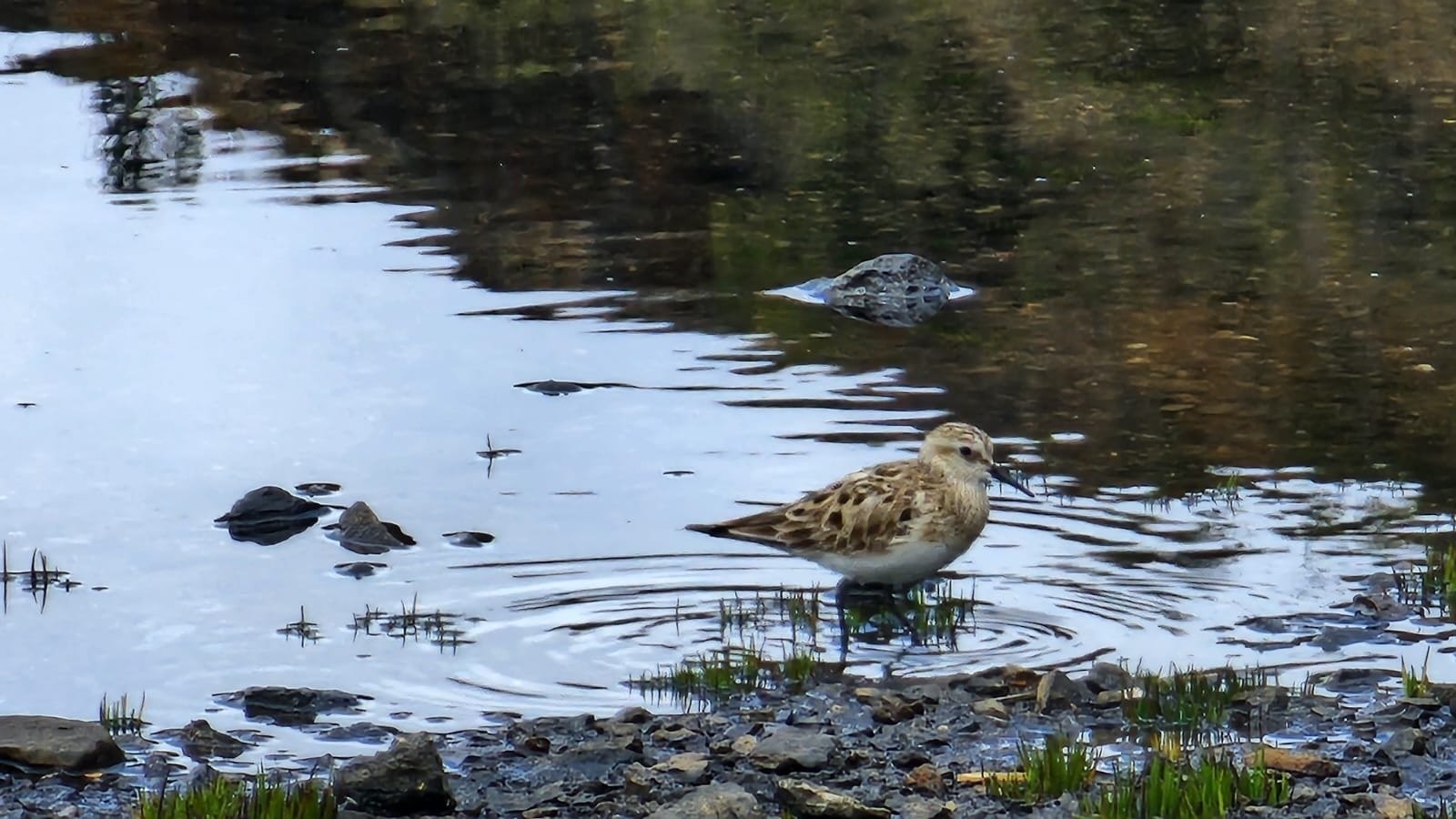
Family Scolopacidae
Baird's Sandpiper
Calidris bairdii
In Spanish: Correlimos de Baird (Patudo, Becacina)
- Migrant
A buff, long-winged Arctic sandpiper that stops over in Costa Rica.
Baird's Sandpiper (Correlimos de Baird) is a small shorebird on a very long journey. It breeds in the Arctic tundra from far eastern Siberia to western Greenland, and it winters in western and southern South America, from Peru to Tierra del Fuego. The IUCN lists Costa Rica as a passage area, where the bird is a migrant.
One writer counts it among four "grasspipers" that pass through the country and says that, unlike some of the others, it does stop here. That makes it worth looking for on a muddy edge, a wet field or a highland wetland.
It is also one of the more recognizable small sandpipers, thanks to its warm buff and brown plumage and its very long wings.
How to find it
Start with wet areas high in the mountains above treeline, where more birds seem to pass than on the coast. Check temporary mudflats too, since a few turned up on one in the Caribbean lowlands. In the Central Valley, exposed mud flats are the draw, because the birds were absent on a day when water hyacinth covered the water. Scope flocks of waders carefully and pick out the slightly larger, buff bird with wingtips projecting well past the tail. Listen for the low, grating kreep.
How to recognise it
Baird's is a small, elongated sandpiper. These are the marks to look for:
Black legs.
A short, straight, fine dark bill.
Wingtips that reach beyond the tail tip at rest, the longest wings of the small sandpipers. Among the Costa Rican peeps, they reach well past the tail and give a long, tapered rear end.
Warm buff and brown plumage, softer than the grayish brown of many other sandpipers.
Slightly larger size than Least, Western and Semipalmated Sandpipers when seen together, which helps when you scan a mixed flock.
What it sounds like
Recording: Richard Littauer, CC BY 4.0, source, read 4 Nov 2026.
Behaviour and diet
Baird's mainly eats insects, plus some small crustaceans. One birder who found a few on a temporary mudflat in the Caribbean lowlands watched them feed a bit like dowitchers.
In Costa Rica it is a bird of passage, a migrant that stops on the journey between the Arctic and South America.
Where it lives
Across its range, migrants stop at lake and river edges, wet fields, pastures and rice fields. In the tropics they also use marshes, lagoons, mudflats, beaches and estuaries. On migration and in winter it regularly uses lake shores and sparse grassland at very high altitude in the Andes, up to 4,700 m.
In Costa Rica, more seem to move through the highlands than along the coast. It has also turned up on a temporary mudflat in the Caribbean lowlands, at wetlands near Ciudad Neily and in the Central Valley.
When to see it
A September birding report expected more Baird's Sandpipers at suitable Costa Rican sites over the following two months. That points to autumn passage in September and October.
Similar birds
The look-alike to know is White-rumped Sandpiper, which also has wings that extend past the tail. It has a white rump patch, which Baird's lacks. Baird's also shows no pale eyebrow stripe and, in young birds, no V-shaped marks on the back.
Names and lore in Costa Rica
Costa Ricans call sandpipers in general "correlimos", which one writer reads as roughly "little runners". The AOCR name for this species is Correlimos de Baird, with Patudo and Becacina also listed. Other Spanish names include correlimos unicolor, playerito unicolor and playero patinegro.
Status and conservation
The AOCR lists it as a migrant (M), and globally the IUCN rates it Least Concern with a stable population.
How we know this 14 sources, each read on the date shown
- Vorstman's Guide to the Birds of North America read 2026-11-04
https://www.vorstman.com/vogelgids-nam/en/species/baird-s-sandpiper.html - All About Birds (Cornell Lab) read 2026-11-04
https://www.allaboutbirds.org/guide/Bairds_Sandpiper/overview - Birda read 2026-11-04
https://app.birda.org/species-guide/6705/Baird's_Sandpiper - SEO/BirdLife read 2026-11-04
https://seo.org/ave/correlimos-de-baird/ - All About Birds (Cornell Lab) read 2026-11-04
https://www.allaboutbirds.org/guide/Bairds_Sandpiper/lifehistory - Wikipedia read 2026-11-04
https://en.wikipedia.org/wiki/Baird's_sandpiper - IUCN Red List read 2026-11-04
https://www.iucnredlist.org/species/22693404/261755965 - 10,000 Birds read 2026-11-04
https://www.10000birds.com/hoping-for-grasspipers-in-costa-rica.htm - Birding Craft read 2026-11-04
https://birdingcraft.com/wordpress/tag/wedge-rumped-storm-petrel/ - Birding Craft read 2026-11-04
https://birdingcraft.com/wordpress/2021/09/ - Birding Craft read 2026-11-04
https://birdingcraft.com/wordpress/tag/pied-puffbird/ - Greg in San Diego read 2026-11-04
https://sandiegogreg.blogspot.com/2017/11/bairds-sandpiper-at-imperial-beach.html - iNaturalist Mexico (Spanish Wikipedia text) read 2026-11-05
https://mexico.inaturalist.org/taxa/3851-Calidris-bairdii - Audubon Field Guide read 2026-11-05
https://www.audubon.org/field-guide/bird/bairds-sandpiper