Family Troglodytidae
Banded Wren
Thryophilus pleurostictus
In Spanish: Soterré de Costillas Barreteadas
- Resident
A bold-browed, barred wren of the dry northwest with a rich song.
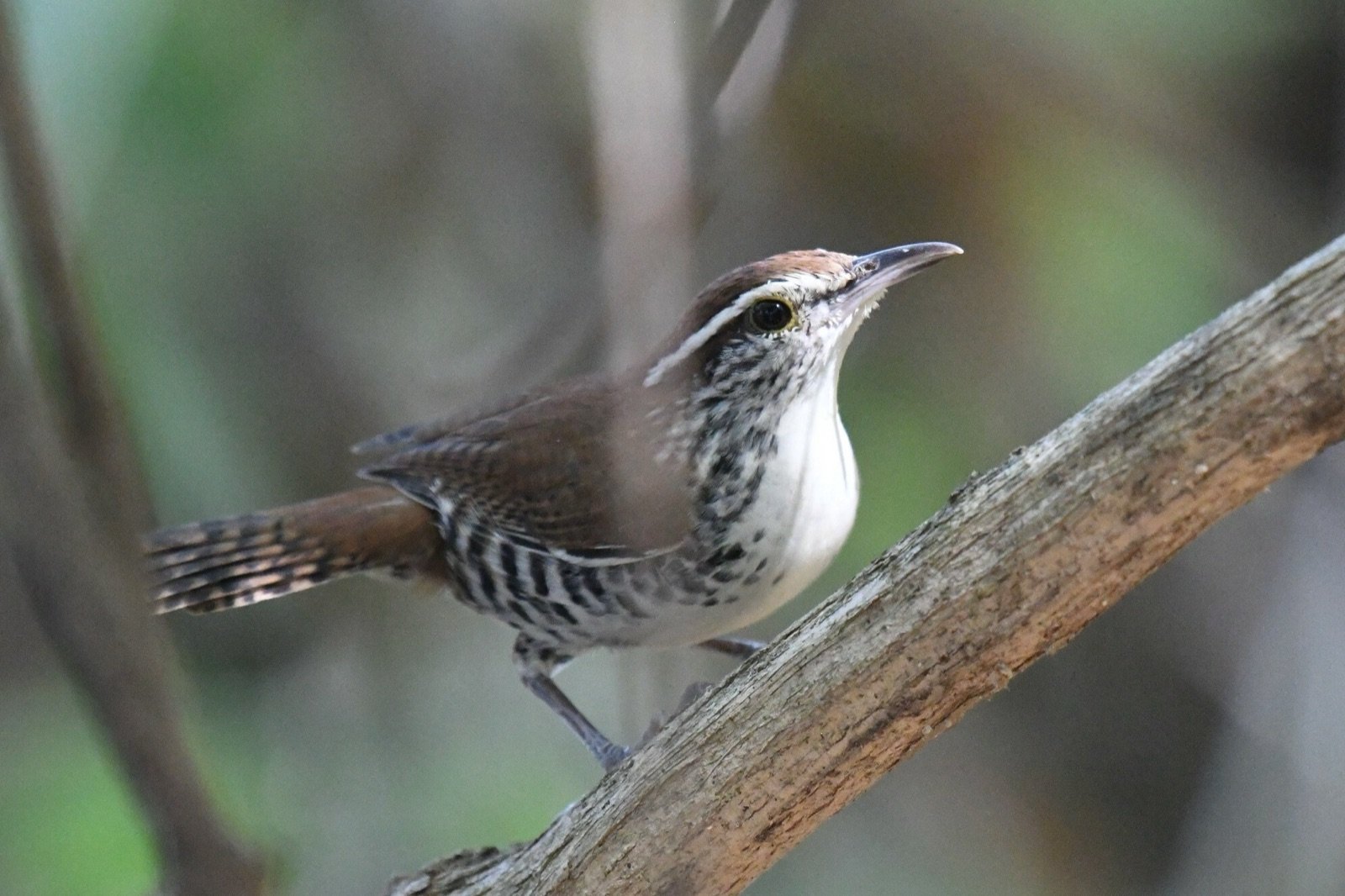
The Banded Wren (Soterré de Costillas Barreteadas) is a small chestnut wren with a bold white eyebrow, and in Costa Rica it belongs to the dry Pacific northwest. It is considered one of the best singers in its group of wrens.
A Costa Rican field guide says it stays at low to mid levels, often in fairly open spots, which makes it easier to see than many skulking wrens.
On a trip we build through Guanacaste, it is a bird to watch for at Santa Rosa National Park, Palo Verde Biological Reserve and Rincon de la Vieja, especially on early-morning roadside walks.
How to find it
Bird Guanacaste early, from about 5:30 to 8:00 in the morning, because midday is slow in the heat and wooded areas get busy again in the late afternoon. In Guanacaste the best birding is usually in the more forested riparian zones, where it shares space with Little Tinamou, Long-tailed Manakin and Painted Bunting. Roadside birding at dawn can turn up most dry forest species, this wren included. Named spots include the road to Chomes, the Guacimo Road, the lower slopes of Rincon de la Vieja and areas near Playa Hermosa and Playas del Coco. Scanning dry-forest thickets near wasp nests in Guanacaste may help locate it.
How to recognise it
This is a small wren, about 13.5 cm long. Look for these marks:
Chestnut-brown upperparts.
A bold white eyebrow.
A brown eye stripe.
Black streaks on white cheeks.
A dark whisker mark, shown on the field guide plate.
White underparts with heavy black barring on the lower belly and flanks.
Wings and tail barred with black.
Young birds are duller above and mottled below, so a plainer, spotty wren at the edge of a family group may simply be a youngster.
What it sounds like
Behaviour and diet
It forages busily in low vegetation, and sometimes on the ground, in pairs or family groups. In Costa Rica it pokes among curled dead leaves, bark crevices, roots and spiny palm leaves, and flips fallen leaves aside with its bill. The nest is a flask shape with a long entrance tube pointing down, set 1 to 2.5 m up in a thorny tree or shrub, often next to a wasp nest. Those wasps protect eggs and chicks from predators. It breeds from May to August.
Where it lives
In Costa Rica it lives in lowlands and foothills from sea level to about 800 m, though one field guide says it reaches 1200 m and that its range is expanding south and inland. The habitat is open or scrubby woodland, forest clearings and second growth. It is fairly common in dry habitats such as arid scrub and deciduous tropical forest, and is sometimes found in mangroves. It occurs mainly on the Pacific side of the central mountain ranges, in the northwest. The Museo Nacional also lists it among the dry Pacific birds of the greater San José area.
When to see it
One Costa Rica birding writer says Banded Wrens will sing from the woods if it is dry enough, which hints at the dry season.
Similar birds
Rufous-and-white Wren is a similar-sized wren with a lovely song, but it favours riparian zones and moist forest on the Pacific slope, whereas Banded Wren is a common dry forest species. Plain Wren lives in both humid and nearby dry forest in the Guanacaste Conservation Area, so it overlaps with Banded Wren there. At Santa Rosa a birder heard Banded and Cabanis's (Plain) Wrens in one short stop, so learn the songs apart.
Names and lore in Costa Rica
In Costa Rica the bird is called Soterrey de Costillas Barreteadas. Other Spanish names include Ratona Rayada, Chivirín Barrado and Cucarachero Ventribarrado. In Nicaragua it is Charralero Fajeado, and in Honduras Cucarachero Rayado.
Status and conservation
The AOCR list treats it as a resident species in Costa Rica, and it is fairly common to common on the northern Pacific slope.
Photography tips
Santa Rosa's Universal Trail has good light, which suits photographers used to dim rainforest understory, and Banded Wrens are among the birds expected there. Because the species stays at low to mid levels, often in fairly open spots, it is easier to see than many skulking wrens. At Playa Hermosa, birds came in to investigate a screech owl call.
How we know this 22 sources, each read on the date shown
- Wikipedia read 2026-11-04
https://en.wikipedia.org/wiki/Banded_wren - BirdWeather (Wikipedia text) read 2026-11-04
https://app.birdweather.com/species/banded-wren - Flickr (natural history notes by Jorge Obando) read 2026-11-04
https://www.flickr.com/photos/jobando/34455875825 - Wikipedia (Spanish) read 2026-11-04
https://es.wikipedia.org/wiki/Thryophilus_pleurostictus - Birds of the World read 2026-11-04
https://birdsoftheworld.org/bow/species/banwre1/cur/introduction - Museo Nacional de Costa Rica read 2026-11-04
https://www.museocostarica.go.cr/nuestro-trabajo/investigaciones/historia-natural/gam/aves/ - YouTube recording read 2026-11-04
https://www.youtube.com/watch?v=bK3MqQVffA4 - ACG Bosque Seco virtual read 2026-11-04
https://www.acguanacaste.ac.cr/bosque_seco_virtual/bs_web_page/paginas_de_especies/polistes_sp.html - Birdwatching in Costa Rica (AOCR list) read 2026-11-04
https://birdwatchingincostarica.com/bird-lists/ - Birdingcraft read 2026-11-04
https://birdingcraft.com/wordpress/tag/banded-wren/ - Birdingcraft read 2026-11-04
https://birdingcraft.com/wordpress/2014/04/24/where-to-see-birds-in-guanacaste-costa-rica/ - Costa Rica Focus read 2026-11-04
https://www.costaricafocus.com/birding-guanacaste-costa-rica-a-complete-guide/ - Birdingcraft read 2026-11-04
https://birdingcraft.com/wordpress/2014/08/14/big-cool-wrens-of-costa-rica/ - Dan Mennill's Bird Songs of Costa Rica read 2026-11-04
https://web2.uwindsor.ca/courses/biology/dmennill/CostaRica/CRSongs.html - Birds of Costa Rica (Princeton field guide) read 2026-11-04
https://dokumen.pub/birds-of-costa-rica-9780691243351.html - Birds of the World (es) read 2026-11-04
https://birdsoftheworld.org/bow/species/banwre1/cur/introduction?lang=es - Birding Craft read 2026-11-04
https://birdingcraft.com/wordpress/category/dry-forest/ - Exotic Birding read 2026-11-04
https://www.exoticbirding.com/costarica/paloverde/checklist.html - IUCN Red List read 2026-11-04
https://www.iucnredlist.org/species/22711447/137606568 - The Wilson Journal of Ornithology (Plain Wren duet paper) read 2026-11-04
https://doi.org/10.1650/8234.1 - Birding Craft read 2026-11-04
https://birdingcraft.com/wordpress/2024/06/07/costa-rica-birding-a-whole-lot-of-wrens-going-on/ - Meadowhawk blog read 2026-11-04
https://meadowhawk.wordpress.com/2017/05/31/santa-rosa-national-park/