Family Tityridae
Barred Becard
Pachyramphus versicolor
In Spanish: Cabezón Ondeado
- Resident
A tiny highland becard, found by ear and watched for in mixed flocks.
The Barred Becard (Cabezón Ondeado) is the smallest becard in its genus, about 12 to 13 cm long, and in Costa Rica it belongs to the highland forests. Its range here is patchy, and the San Gerardo de Dota valley is named as the most reliable place to see it.
On the classic highland trips we build, it turns up at Tapantí National Park, where it is a named target, and it is also listed for Cerro de la Muerte and the Savegre Valley. A Costa Rica guide says he usually finds it by ear, because it vocalizes a lot.
This page covers how to recognise it, how to hear it and where to look, so a first trip to the mountains has a few good chances of adding it to your list.
How to find it
Start by listening. Tune in for the plaintive whistled song from forest edges, and keep listening after dawn, since it sings through the day. Check exposed dead snags at forest openings, and watch for movement in mixed-species flocks, especially those passing roadside forest. One guide sees it on nearly every visit to humid forest above 1,500 m. Be patient: on a Savegre Valley tour, a group heard one along the road many times, but it came into view only once or twice. It can be a hard bird to see well.
How to recognise it
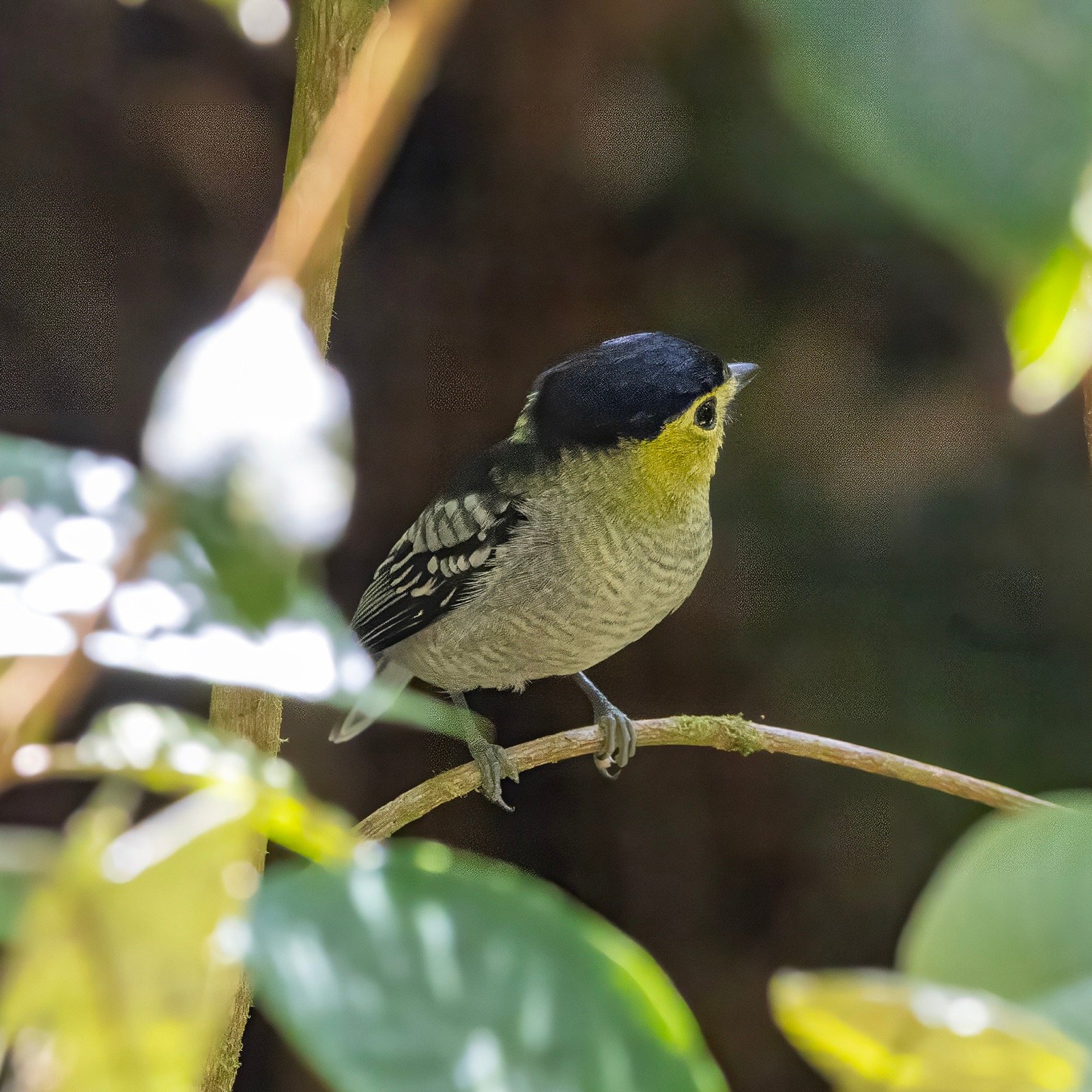
This is a very small becard, about 12 to 13 cm long, and the smallest in its genus. It is the only becard with narrow black barring on the underparts.
The male is mostly black above.
The female combines yellow underparts, a gray cap, a green back and chestnut wings. She also shows rufous wing coverts and a clear eye-ring. The yellow cheeks recall the larger Green-backed Becard.
One Costa Rica guide notes that it may seem to lack bars at all, because the bird is tiny, stays high in the trees and has faint barring. That is worth knowing before you start doubting your identification.
What it sounds like
Behaviour and diet
Barred Becards are often in pairs or family groups. They join mixed flocks only for short periods, and a Costa Rica guide notes that hearing one tells you a mixed flock is close, as it is rarely seen away from foraging flocks.
They eat insects and spiders, mostly taken from foliage, plus small fruits. They also take berries, especially from melastome plants.
Food is taken while perched, while hopping along branches, in short sallies and in brief hovers at the end of a sally. They forage from mid-story to canopy and go lower at forest edges.
Where it lives
In Costa Rica it lives at about 1,500 to 2,300 m (4,900 to 7,500 ft) elevation, in humid mountain forest.
Across its range it uses the middle and upper levels of highland forest, and it comes lower along forest edges and in nearby semi-open country.
In Costa Rica its range is patchy, from the Tilarán Cordillera in southern Alajuela Province south toward western Panama. Cloudbridge Nature Reserve also lists it on its bird species list.
When to see it
One site says it can be seen year-round, but is most active and vocal from April to June, during the breeding season, and that birds move down slightly in the wet season. Breeding in Costa Rica includes May and June, and another source gives March to July, peaking in April and May.
Similar birds
The female can fool you. A Costa Rica birder at first mistook one for a tyrannulet or spadebill, so look for the gray cap, rufous wing coverts and clear eye-ring. The yellow cheeks recall the larger Green-backed Becard. Narrow black barring below is the feature no other becard shows.
Names and lore in Costa Rica
The official Spanish name on the Costa Rican bird list is Cabezón Ondeado. Cabezón is the Spanish group name for becards. Other countries use Cabezón Barrado or Cabezón Veteado for the same bird.
Status and conservation
The official Costa Rican bird list shows it as a resident species (R), it is called fairly uncommon here, and IUCN rates the species Least Concern.
Photography tips
A Costa Rica guide calls this bird sneaky: he heard several singing at dawn at one highland site but did not see them during the day. Dawn is the time to hear them. Pairs and family groups join mixed flocks only briefly, so scan flocks that pass roadside forest. Because it stays high and looks small, a good look often needs patience and a flock that lingers.
How we know this 20 sources, each read on the date shown
- Wikipedia read 2026-11-04
https://en.wikipedia.org/wiki/Barred_becard - Costa Rica Focus read 2026-11-04
https://www.costaricafocus.com/bird-species/barred-becard/ - Cloudbridge Nature Reserve read 2026-11-04
https://www.cloudbridge.org/wp-content/uploads/2020/04/Bird-Species-List-Costa-Rica-13-April-2020.pdf - Bird Watching Costa Rica read 2026-11-04
https://www.birdwatchingcostarica.com/ave/barred-becard/ - Lista Oficial de las Aves de Costa Rica (AOCR) read 2026-11-04
https://listaoficialavesdecostarica.wordpress.com/lista-oficial/lista-oficial-online/ - Birding Craft read 2026-11-04
https://birdingcraft.com/wordpress/2012/06/04/where-to-see-becards-when-birding-in-costa-rica/ - Birding Craft read 2026-11-04
https://birdingcraft.com/wordpress/tag/barred-becard/ - Field Guides trip list 2017 read 2026-11-04
https://fieldguides.com/triplists/cos17.html - Birds of the World read 2026-11-04
https://birdsoftheworld.org/bow/species/barbec1/cur/introduction - Birds for Beer read 2026-11-04
https://birdsforbeer.com/2016/07/19/barred-becard-cabezon-ondeado/ - Field Guides Classic Costa Rica itinerary read 2026-11-04
https://fieldguides.com/itineraries/cos26-ITIN.pdf - Fatbirder trip report 2023 read 2026-11-04
https://fatbirder.com/wp-content/uploads/2025/09/Costa-Rica-Escape-2023-Trip-Report.pdf - Field Guides trip list 2019 read 2026-11-04
https://fieldguides.com/triplists/cr119.html - Birding Club of Costa Rica read 2026-11-04
https://birdingclubcr.org/bccr-adventures-new/highlands.html - Birding Craft read 2026-11-04
https://birdingcraft.com/wordpress/tag/birding/page/21/ - Avibase read 2026-11-04
https://avibase.bsc-eoc.org/species.jsp?avibaseid=69B72BD02EE412F0 - Avibase read 2026-11-04
https://avibase.bsc-eoc.org/species.jsp?avibaseid=A5ADD0AB572EBEE4 - Field Guides tour report read 2026-11-04
https://fieldguides.com/triplists/cos18.html - Exotic Birding read 2026-11-04
http://www.exoticbirding.com/costarica/cerro-de-la-muerte/checklist.html - Wikipedia read 2026-11-04
https://en.wikipedia.org/wiki/Barred_Becard