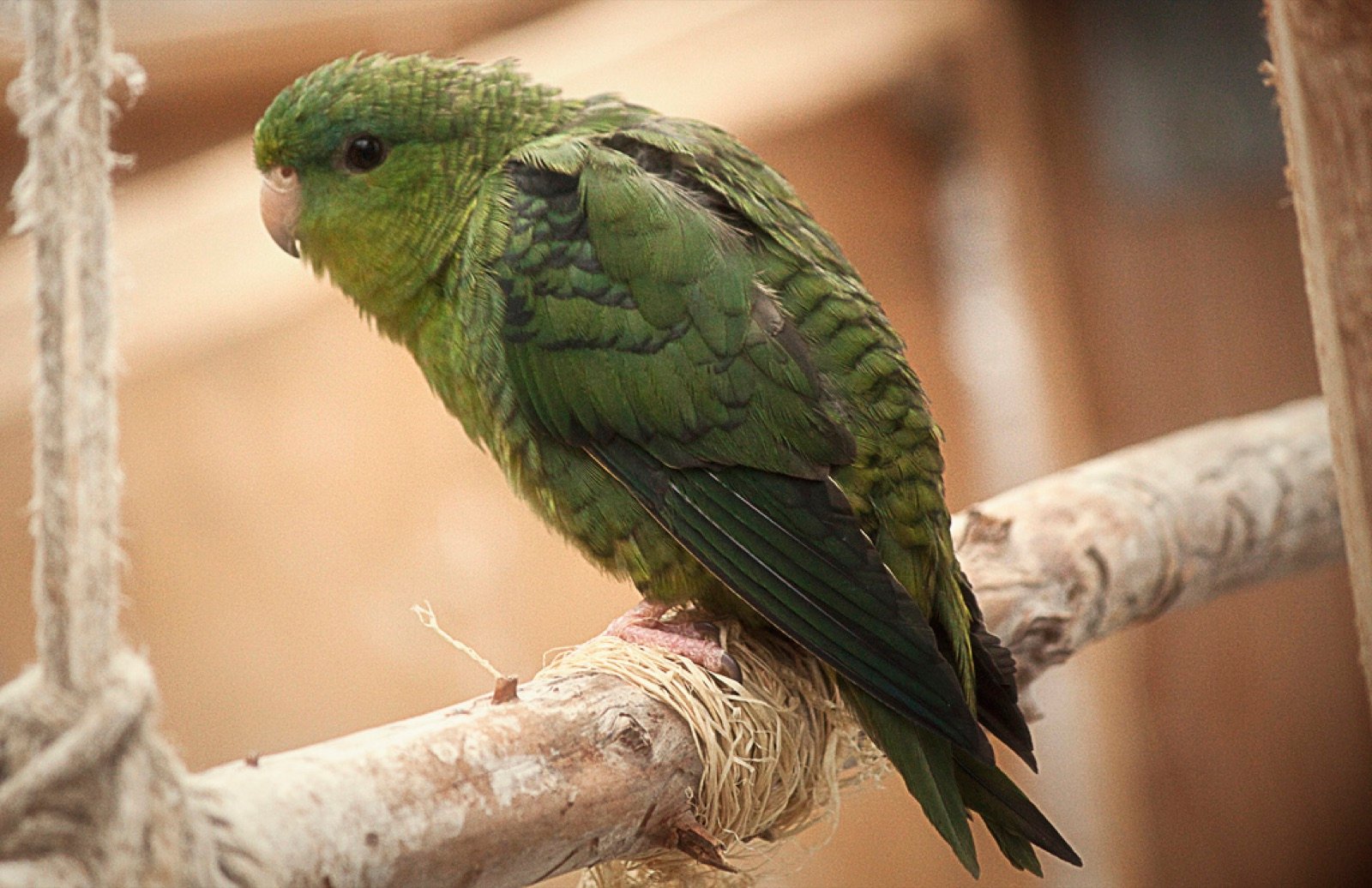
Family Psittacidae
Barred Parakeet
Bolborhynchus lineola
In Spanish: Perico Listado
- Resident
Small green highland parakeet, usually a flyover, tied to seeding bamboo.
The Barred Parakeet (Perico Listado) is a small, mostly green parrot, about 16 cm long, and the official Costa Rican bird list gives it the status R, a resident species. It is also one of the harder parrots to see well. A Costa Rica bird guide says nearly all his looks are of small silhouettes buzzing overhead.
In Costa Rica it is tied to seeding highland bamboo. When bamboo on the flanks of Poas seeded, trips there and to Varablanca found Barred Parakeets, and an afternoon on the Lagunillas Road gave flyover birds.
That makes it a bird of patience and timing: listen, scan the ridges and the bamboo, and be glad of a flyover.
How to find it
Look for seeding highland bamboo, because good numbers of Barred Parakeets are treated as a sign that bamboo is seeding. Barred Parakeets, Slaty Finch and Peg-billed Finch may turn up together there. A seeding bamboo patch on the road to Volcan Barva was suggested as a place to check. Scan moving bamboo for perched birds, as a pair at Tapanti was found that way. Listen overhead too, since many records are flyovers. Early morning or late afternoon are best. Montserrat de Coronado is off the main birding routes, a good area to explore with a local guide.
How to recognise it
Think small, green and plain.
Size: about 16 cm long.
Upperparts: dark bars across the back and wings, except the top of the head.
Bill: pale peach.
Underparts: olive-green with very dark green stripes on the sides.
Wings: black shoulder, and some blue showing on the underwing.
Tail: dark green, fairly short and pointed.
Young birds: paler, fainter barring than adult females.
Most looks are of silhouettes, so shape counts. A Costa Rican birder describes it as plain and short-tailed, which helps when it zips past.
What it sounds like
Behaviour and diet
The species is generally inconspicuous. It is most often seen in flight in small flocks, so you may notice it overhead before you see it perched. It is usually in pairs or small, often quiet flocks.
It is nomadic, and its movements may follow bamboo seeding. Perched views are rare because the birds feed in dense, often fog-shrouded forest, where they are very hard to locate. A perched pair at Tapanti preened each other, and the birder said they blended in like owls.
Where it lives
Range wide, the Barred Parakeet lives in highland forests of tropical Latin America, in separate patches from southern Mexico to Panama and also in the Andes. It favours humid montane forest.
In Costa Rica it is reported as locally abundant in the Talamanca mountains. A Costa Rican birder says that above 2,000 m in the Central or Talamanca ranges, small, plain, short-tailed parakeets that call and zip over ridges are probably this species. It has also been recorded below 600 m in the country, and it occurs at Monteverde.
When to see it
Nesting is probably in the dry season in Costa Rica. Outside breeding, birds may drop to lower forest.
Similar birds
The Red-fronted Parrotlet may overlap with it at certain times of year, but the parrotlet shows red and yellow in its plumage. The Barred Parakeet is plain and short-tailed. In the Andes it can be confused with the Andean Parakeet.
Names and lore in Costa Rica
In Costa Rica the bird is called Perico Listado or Periquito Listado. Elsewhere you will hear Perico Rayado in Mexico and Honduras and Chocoyo Listado in Nicaragua.
Status and conservation
The official Costa Rican bird list gives the Barred Parakeet the status R, a resident species.
Photography tips
Your best chance of a perched view is a seeding bamboo patch. Early morning or late afternoon are the best times. A parrot tour operator says the species is very rarely photographed in the wild, so a flyover record is a fair result.
How we know this 16 sources, each read on the date shown
- Lista Oficial de las Aves de Costa Rica (AOCR) read 2026-11-04
https://listaoficialavesdecostarica.wordpress.com/lista-oficial/lista-oficial-online/ - Wikipedia read 2026-11-04
https://en.wikipedia.org/wiki/Barred_parakeet - World Parrot Trust read 2026-11-04
https://parrots.org/encyclopedia/barred-parakeet/ - Peru Aves read 2026-11-04
https://www.peruaves.org/psittacidae/barred-parakeet-bolborhynchus-lineola/ - Animalia.bio (from Wikipedia) read 2026-11-04
https://animalia.bio/barred-parakeet - Zeledonia via Dialnet read 2026-11-04
https://dialnet.unirioja.es/servlet/articulo?codigo=8907273 - Birdingcraft read 2026-11-04
https://birdingcraft.com/wordpress/2025/04/21/birding-in-costa-rica-recent-sightings-of-interest/ - Birdingcraft read 2026-11-04
https://birdingcraft.com/wordpress/2011/09/05/seeding-bamboo-on-the-road-to-volcan-barva/ - Birdingcraft read 2026-11-04
https://birdingcraft.com/wordpress/2013/04/ - Mascotarios read 2026-11-04
https://www.mascotarios.org/en/catita-barrada/ - Birding Craft read 2026-11-04
https://birdingcraft.com/wordpress/tag/parakeets/ - Birding Craft read 2026-11-04
https://birdingcraft.com/wordpress/2016/09/07/a-morning-at-tapanti-national-park/ - Birdquest read 2026-11-04
https://www.birdquest-tours.com/birding-tours/costa-rica-ultimate/ - Wild Parrots Up Close read 2026-11-04
https://www.wildparrotsupclose.com/costa-rica-2026.html - Field Guides trip list read 2026-11-04
https://fieldguides.com/triplists/cos24.html - Birds of the World read 2026-11-04
https://birdsoftheworld.org/bow/species/barpar1/cur/introduction