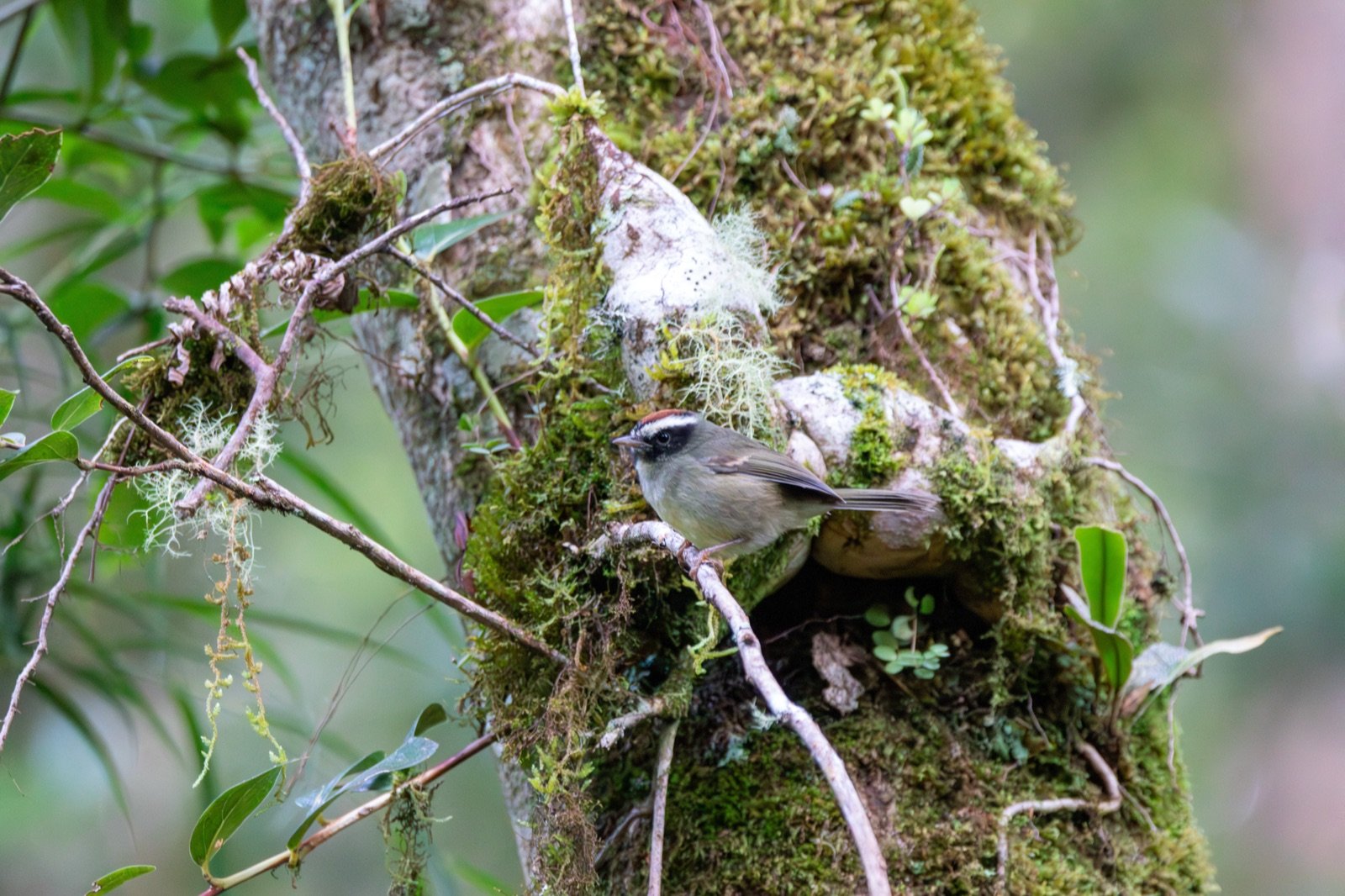
 Black-cheeked Warbler
Family Parulidae
Black-cheeked Warbler
Basileuterus melanogenys
In Spanish: Reinita Carinegra
- Resident
- Regional endemic
A rufous-capped warbler of highland oak and bamboo, found only in the Talamancan mountains.
The Black-cheeked Warbler (Reinita Carinegra) is endemic to the Talamancan mountains of Costa Rica and western Panama, so seeing it means heading up into the highlands.
It is a small warbler with a rufous crown, a long white eyebrow stripe and black cheeks. In Costa Rica the nominate form lives in the central and southern parts of the country.
On a trip we build, you meet it in the Talamanca highlands, which run from Cerro de la Muerte down to San Vito and cover much of La Amistad International Park. A guide lists this warbler among the birds often found there, and a day given to high-elevation species is the one to plan around.
How to find it
Check mixed flocks in highland oak forest, since the warbler often travels with them outside the breeding season. Watch for flocks led by the Sooty-capped Chlorospingus. One birding group walking a highland oak forest entrance road met a mixed flock as soon as they left the bus, and this warbler was among the birds seen. Look low, in bamboo and in the tangle left by fallen trees. Views can be brief, as one tour found along the Providencia Road, though they were good. Learn the song and call beforehand, because the bird can be hard to see.
How to recognise it
Look first at the head, then at the body.
- Crown: rufous.
- Eyebrow: a long white stripe.
- Cheeks: black.
- Back: dull olive.
- Breast: olive-grey.
- Belly: yellowish white.
Males and females look alike, so there is no need to sort the sexes in the field. Young birds are browner above, with a dull eyebrow, a greyer breast and two cinnamon wing bars. A plainer, brownish warbler in the same bamboo tangle may therefore be a youngster of this species rather than something different.
What it sounds like
Recording: keesgroenendijk, CC BY 4.0, source, read 4 Nov 2026.
Behaviour and diet
This warbler eats mainly insects, spiders and other small invertebrates, and it takes them low down in the undergrowth. That is why you scan the lower tangle rather than the canopy.
Outside the breeding season it often joins mixed flocks, especially flocks led by the Sooty-capped Chlorospingus. On the Quebrada trail at Savegre, a small group was seen foraging low through the tangle left by a big fallen tree. Birders who have met it near Cerro de la Muerte describe it moving through branches and being hard to see.
Where it lives
The Black-cheeked Warbler is usually found in oak forest with a dense bamboo understory in the Talamancan highlands. Across its range this habitat runs from about 2500 m up to the timberline, and sometimes as low as 1600 m.
In Costa Rica the nominate form lives in the central and southern parts of the country. The Talamanca highlands run from Cerro de la Muerte down to San Vito and cover much of La Amistad International Park. The species has also been recorded in the Savegre Valley and at Cloudbridge Nature Reserve.
Similar birds
The Rufous-capped Warbler is a related species and the two are said to sound alike. The Rufous-capped lives in coffee fields, dry forest and second growth, while the Black-cheeked lives in highland bamboo thickets, so habitat helps. The Costa Rican Warbler, also endemic, has olive-brown upperparts, a dark cheek and black and white head striping.
Names and lore in Costa Rica
The Spanish name used in Costa Rica is Reinita Carinegra. Another Spanish name listed for the species is Chiví de Mejillas Negras.
Status and conservation
The AOCR list marks it R-END, a resident endemic, and it is listed as Least Concern.
Photography tips
Work the lower tangle and bamboo rather than the canopy, and check mixed flocks, which the warbler often joins. Fallen-tree tangles along trails such as the Quebrada trail at Savegre have held foraging groups. Expect hard-to-see, brief views, and learning the voice first helps you find the bird in thick cover.
How we know this 21 sources, each read on the date shown
- Beauty of Birds read 2026-11-04
https://beautyofbirds.com/black-cheeked-warblers/ - Wikipedia read 2026-11-04
https://en.wikipedia.org/wiki/Black-cheeked_warbler - Beauty of Birds read 2026-11-04
https://beautyofbirds.com/blackcheekedwarblers/ - Cloudbridge Nature Reserve bird list read 2026-11-04
https://www.cloudbridge.org/wp-content/uploads/2020/04/Bird-Species-List-Costa-Rica-13-April-2020.pdf - Flickr (Jerry Oldenettel) read 2026-11-04
https://www.flickr.com/photos/jroldenettel/3407331861 - Dibird read 2026-11-04
https://dibird.com/species/black-cheeked-warbler/ - Wikipedia read 2026-11-04
https://en.wikipedia.org/wiki/Basileuterus_melanogenys - 10,000 Birds read 2026-11-04
https://www.10000birds.com/may-warblers-costa-rican-style.htm - Birds of the World read 2026-11-04
https://birdsoftheworld.org/bow/species/blcwar1/cur/introduction - Eagle-Eye Tours read 2026-11-04
https://www.eagle-eye.com/blog/costa-rica-long-2023-trip-report/ - Field Guides read 2026-11-04
https://fieldguides.com/triplists/cos23b.html - Field Guides read 2026-11-04
https://fieldguides.com/triplists/cr123.html - Birding in Costa Rica read 2026-11-04
https://birdingincostarica.com/costa-rica-endemic-birds-a-birdwatchers-guide/ - Field Guides read 2026-11-04
https://fieldguides.com/triplists/cos24.html - Miradas Cantábricas read 2026-11-04
http://miradascantabricas.blogspot.com/2013/04/quetzal-en-savegre-para-despedir.html - Avibase read 2026-11-04
https://avibase.bsc-eoc.org/species.jsp?avibaseid=D2459CC0F72F2E23 - Oiseaux.net read 2026-11-04
https://www.oiseaux.net/birds/black-cheeked.warbler.html - Exotic Birding read 2026-11-04
https://www.exoticbirding.com/costarica/talamanca-mountains/checklist.html - Ecotenet (from Wikipedia) read 2026-11-04
https://www.ecotenet.org/ecoregions/492 - Wikipedia read 2026-11-04
https://en.wikipedia.org/wiki/Talamancan_montane_forests - Carolina Birds read 2026-11-04
https://carolinabirds.org/HTML/Parulidae.htm