Family Tyrannidae
Black Phoebe
Sayornis nigricans
In Spanish: Mosquero de Agua
- Resident
A tail-wagging black flycatcher of stream rocks, bridges and town creeks.
The Black Phoebe (Mosquero de Agua) is a medium, blackish flycatcher of about 15.5 cm, and in Costa Rica it is a bird of water. Look for it on a rock in the middle of a stream, wagging its tail up and down, and you have probably found it.
It is a resident on both the Caribbean and Pacific slopes, most common between about 600 and 1,850 m above sea level. It even turns up in the capital, where a study of the urban Torres river in San José found it at sites around 1,315 to 1,380 m.
On a trip we build, it is an easy add-on at any middle-elevation stream or river in humid forest, alongside Sunbittern and Torrent Tyrannulet.
How to find it
Look for it perched on rocks in the middle of a stream, or on bridges, walls, wires and fence posts near water. It is rarely found far from water, so start at the water's edge. In San José the most common behaviour seen was perching, most often on stones in the stream. Watch for the tail wag and for short flights out after insects that end back on the same perch. One birder found it allows very close approach, and good light helps because the dark face hides the eye.
How to recognise it
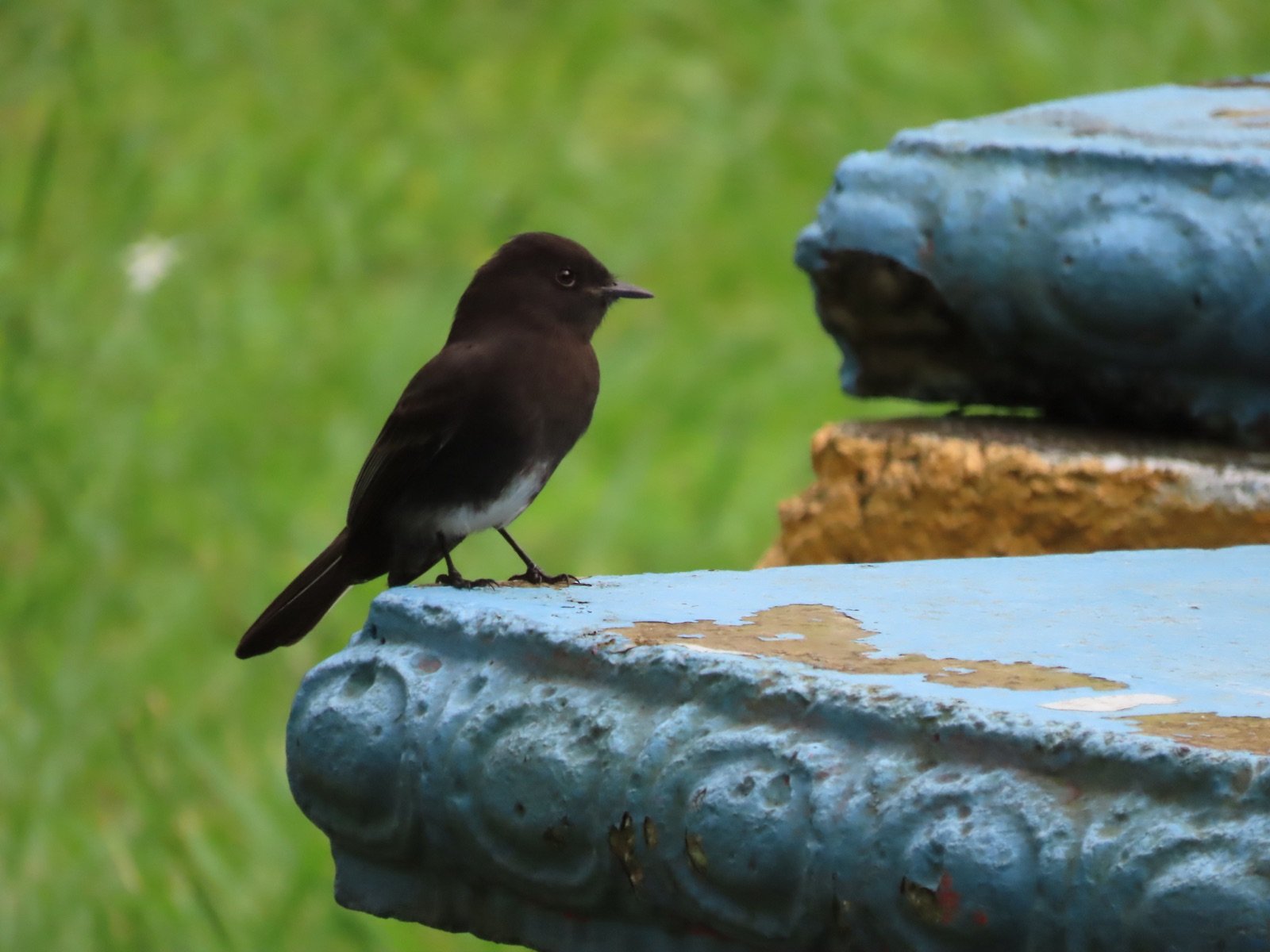
Adults are a medium, blackish flycatcher about 15.5 cm long.
Head, neck and chest: dull black.
Belly: a white center.
Wings: two gray wing-bars.
The Costa Rican subspecies, amnicola, is the darkest form of the species, with less white on the belly and very little white edging on the wings and tail.
Young birds look different. They are dingy brownish-black, the belly and wing-bars are buffy or cinnamon, and the back feathers have pale brown edges.
The face is so dark that good light is needed to pick out the eye, as one birder who watched it along Costa Rican streams notes. It sits fairly upright and keeps wagging its tail.
What it sounds like
Behaviour and diet
It catches dragonflies and other insects in the air, flying up from a stream rock. It flutters out after flying insects, then returns to the same perch or a nearby one, often close to the ground. It almost never walks or hops and moves almost entirely in flight.
It also picks insects off mud or concrete coffee-drying floors, dropping from a fence post or wire. It wags its tail up and down and is found alone or in pairs.
It nests from March to May. The nest is a thick-walled cup of mud and plant bits, stuck under a bridge or on a rock overhang.
Where it lives
In Costa Rica it is a resident on both the Caribbean and Pacific slopes, most common between about 600 and 1,850 m above sea level. After nesting, birds move down to lower elevations.
It lives along mountain streams with big scattered rocks. It also uses coffee mills that use a lot of water, and town streets beside streams. It is rarely found far from water.
It is listed in the Arenal, Central Volcanic Range, Amistad Caribbean, Amistad Pacific, Huetar Norte, Guanacaste, Osa, Tortuguero and Central Pacific conservation areas. Across its whole range it lives close to water from sea level up to about 3,000 m, using coastal cliffs, streams, lake edges and park fountains.
When to see it
A birding writer calls it common and easy to notice at any time of year along middle-elevation streams in humid forested areas of Costa Rica.
Similar birds
The look-alike is the Eastern Phoebe, which has a whitish breast and gray head, while Black Phoebe has a black head and breast. The AOCR list gives the Eastern Phoebe as accidental (A) in Costa Rica, a rare vagrant, while Black Phoebe is a resident (R).
Names and lore in Costa Rica
In Costa Rica the bird is called Mosquero de Agua, which means water flycatcher. Other Spanish-speaking countries use different names, such as Mosquero Negro in Mexico and Panama and Viudita de Río in Argentina. An English nickname is Bridge Pewee, which fits its habit of nesting and perching on bridges.
Status and conservation
The AOCR list gives it resident (R) status, and the IUCN lists the species as Least Concern.
Photography tips
Protruding stones in the stream are key perches. San José birds also used wires, bridges, walls, railings, roof gutters and even PVC pipes.
Urban birds there picked perches with plenty of tree and grass cover and low light, and hunting worked best where the understory was open and well lit. Look for shaded perches over water, and wait for good light to show the dark face.
How we know this 17 sources, each read on the date shown
- Aves de Costa Rica read 2026-11-04
https://www.avesdecostarica.com/Sayornis-nigricans.html - Flickr (INBio-based species text) read 2026-11-04
https://www.flickr.com/photos/jobando/25768413775 - Zeledonia (via ResearchGate) read 2026-11-04
https://www.researchgate.net/publication/285079326_Caracterizacion_del_habitat_y_comportamiento_del_mosquero_de_agua_Sayornis_nigricans_en_la_microcuenca_del_rio_Torres_en_San_Jose_Costa_Rica - Birds of the World (Cornell) read 2026-11-04
https://birdsoftheworld.org/bow/species/blkpho/cur/systematics - Ecos del Bosque read 2026-11-04
https://ecosdelbosque.com/fauna/sayornis-nigricans - Wikipedia (Spanish) read 2026-11-04
https://es.wikipedia.org/wiki/Sayornis_nigricans - GBIF read 2026-11-04
https://www.gbif.org/taxon/6Y53D - Birdingcraft read 2026-11-04
https://birdingcraft.com/wordpress/2011/01/27/the-costa-rican-riverbird-flush/ - Cornell Lab, All About Birds read 2026-11-04
https://www.allaboutbirds.org/guide/Black_Phoebe/species-compare/ - Lista Oficial de las Aves de Costa Rica (AOCR) read 2026-11-04
https://listaoficialavesdecostarica.wordpress.com/lista-oficial/lista-oficial-online/ - Laura's Birding Blog read 2026-11-04
https://blog.lauraerickson.com/2012/11/black-phoebe.html - Field Guides tour list read 2026-11-04
https://fieldguides.com/triplists/cr220.html - Wikipedia read 2026-11-04
https://en.wikipedia.org/wiki/Black_phoebe - Audubon Field Guide read 2026-11-04
https://www.audubon.org/field-guide/bird/black-phoebe - Branta Media read 2026-11-04
https://brantamedia.com/2025/10/05/black-phoebe-watcher-by-the-water/ - Birding Craft read 2026-11-04
http://birdingcraft.com/wordpress/tag/black-phoebe/ - Project Noah read 2026-11-04
https://projectnoah.org/spottings/mosquero-de-agua-black-phoebe