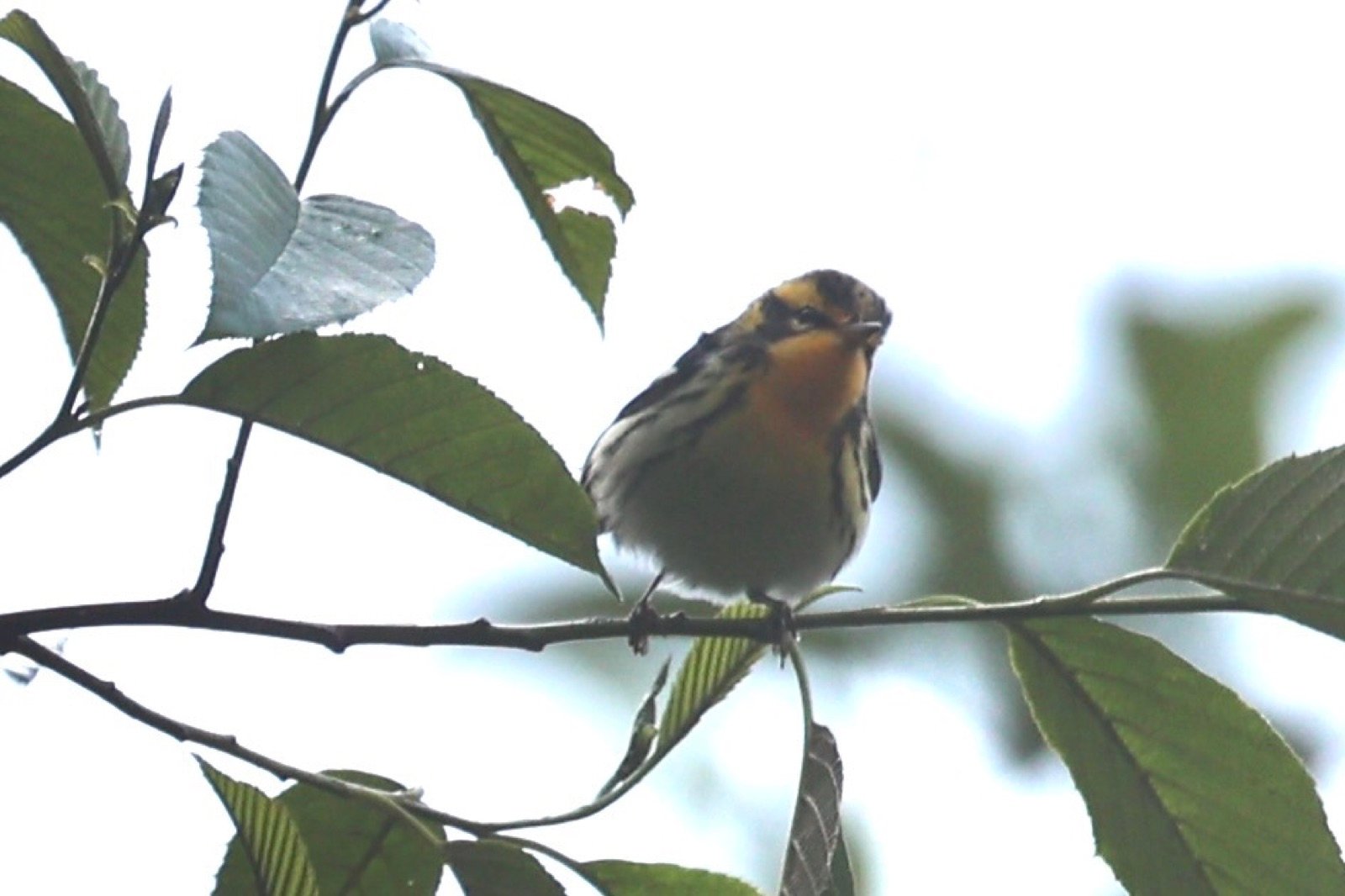
Family Parulidae
Blackburnian Warbler
Setophaga fusca
In Spanish: Reinita Gorginaranja
- Migrant
A flame-throated winter migrant of foothill forest and canopy
The Blackburnian Warbler does not breed in Costa Rica. It is a migrant that spends the northern winter here, and fall passage is common to abundant from late August to late October.
Some birds then stay on for the winter. Its orange throat gave it English folk names such as Torch Bird and Fire-brand, and the breeding male is the only warbler in its genus with orange in its plumage.
On a trip we build, the best place to look is a mixed flock in foothill or cloud forest, or a canopy bridge that puts you level with the treetops.
How to find it
Check mixed flocks in foothill and cloud forest, and watch for quiet birds picking at leaves. Migrants can turn up anywhere in early fall, even in streamside trees behind a house. Canopy walkways and hanging bridges give a chance to look into the treetops, so scan for warblers when a mixed flock passes. Males singing high in trees are hard to spot. The best chance is during migration or on the wintering grounds, where it feeds at lower, easier heights.
How to recognise it
The breeding male has a striking black and orange pattern. He is the only warbler in his genus with orange in his plumage.
Birders in Costa Rica note that the orange throat can look brighter in spring, as the bird nears breeding condition.
Females and immatures show a triangular ear patch. Non-breeding birds are easy to mix up with other warblers, so check these points:
- Female Blackpoll Warbler: she has yellow legs, while the female Blackburnian has dark legs.
- Female or young Cerulean Warbler: it has a blue tint on the back and lacks the triangular ear patch.
- Other look-alikes for non-breeding birds: Bay-breasted, Cape May and Yellow-throated Warblers.
What it sounds like
Behaviour and diet
It feeds on the outer foliage of trees and shrubs. It picks small insects and spiders from leaves, from a perch or by hovering or chasing them in flight.
Usually solitary and possibly territorial in winter, it often joins mixed flocks of tanagers, honeycreepers, warblers and other small birds.
In early fall migration in Costa Rica, Blackburnians were quiet and hard to notice. They hopped through foliage, picking items off leaves, and fed heavily to fuel the move on to their Andean wintering grounds. It is also fairly tame.
Where it lives
Wintering birds are common between about 900 and 1500 m. Fewer go down to 450 m or up to 2500 m. They are more numerous on the Caribbean side.
It prefers forest edges and the forest canopy, partly cleared areas and tall secondary growth. On migration it also uses low scrub, hedgerows and gardens.
In the highlands of Costa Rica and Panama, Blackburnians are fairly common among migrants in shade coffee plantations.
When to see it
Fall passage is common to abundant from late August to late October, and some birds then stay for the winter. Spring migration back north happens through April, mostly along the Caribbean coast.
Similar birds
The female is told from a female Blackpoll Warbler by her dark legs, since the Blackpoll has yellow legs. A female or young Cerulean Warbler has a blue tint on the back and lacks the triangular ear patch that Blackburnian females and immatures show. Both can turn up in Costa Rican mixed flocks.
Names and lore in Costa Rica
Reinita gorginaranja is the name used in Costa Rica, and also in Nicaragua, Panama and Colombia. Other Spanish names elsewhere include reinita de fuego (Puerto Rico) and reinita pechinaranja (Ecuador). English folk names include Torch Bird, Fire-brand and Hemlock Warbler, and several of them refer to the glowing orange throat.
Status and conservation
The AOCR list marks it as a migrant (M), and BirdLife International rates the species Least Concern.
Photography tips
Blackburnians are seldom seen at eye level, except on migration. Look for them among many other warblers at sites where migrants gather. A canopy bridge, where a mixed flock passes at your height, gives the best chance for a clear view.
How we know this 23 sources, each read on the date shown
- Ecos del Bosque (citing Aves de Costa Rica) read 2026-11-04
https://ecosdelbosque.com/fauna/setophaga-fusca - Flickr (Costa Rica natural history text) read 2026-11-04
https://www.flickr.com/photos/jobando/23469843428 - 10,000 Birds read 2026-11-04
https://www.10000birds.com/how-to-help-cerulean-warblers-other-migrant-species-and-resident-birds-in-costa-rica.htm - The Tico Times read 2026-11-04
https://ticotimes.net/2026/04/02/costa-rica-birdwatchers-makes-puriscal-a-must-visit - Birds for Beer read 2026-11-04
https://birdsforbeer.com/2015/09/10/first-warblers-of-this-migration-canada-warbler-blackburnian-warbler/ - Smithsonian National Zoo read 2026-11-04
https://nationalzoo.si.edu/migratory-birds/news/fiery-gem - Cloudbridge Nature Reserve species list read 2026-11-04
https://www.cloudbridge.org/wp-content/uploads/2020/04/Bird-Species-List-Costa-Rica-13-April-2020.pdf - Boreal Songbird Initiative read 2026-11-04
https://www.borealbirds.org/bird/blackburnian-warbler - Costa Rica Focus read 2026-11-04
https://www.costaricafocus.com/spring-bird-migration-in-costa-rica-what-to-expect/ - EcoRegistros read 2026-11-04
https://www.ecoregistros.org/sheet/Setophaga-fusca - Field Guides Birding Tours trip list read 2026-11-04
https://fieldguides.com/triplists/cr220.html - Field Guides Birding Tours trip list read 2026-11-04
https://fieldguides.com/triplists/cr124PRINT.html - Birding Craft read 2026-11-04
http://birdingcraft.com/wordpress/2020/09/ - Birding Craft read 2026-11-04
https://birdingcraft.com/wordpress/2020/09/14/blackburnian-warblers-in-costa-rica-will-they-always-be-here/ - Birds Colombia (from Wikipedia text) read 2026-11-04
https://birdscolombia.com/2020/04/15/reinita-gorginaranja-blackburnian-warbler-setophaga-fusca/ - Bioexploradores Farallones del Citará read 2026-11-04
https://farallonesdelcitara.bioexploradores.com/biodiversidad/aves/passeriformes/parulidae/setophaga-fusca/ - Wikipedia (es) read 2026-11-04
https://es.wikipedia.org/wiki/Setophaga_fusca - STRI Research Portal read 2026-11-04
https://panamabiota.org/stri/taxa/index.php?tid=3646 - GLSEO Barcelona read 2026-11-04
https://glseobarcelona.com/reinita-gorjinaranja/ - Birding Craft read 2026-11-04
https://birdingcraft.com/wordpress/tag/olive-sided-flycatcher/ - EcoRegistros read 2026-11-04
https://www.ecoregistros.org/ficha/Setophaga-fusca&idusuario=567 - Cornell All About Birds read 2026-11-04
https://www.allaboutbirds.org/guide/Blackburnian_Warbler/species-compare/ - Cornell All About Birds read 2026-11-04
https://www.allaboutbirds.org/guide/Blackburnian_Warbler/id