Family Parulidae
Blackpoll Warbler
Setophaga striata
In Spanish: Reinita Rayada
- Migrant
A rare migrant warbler, best looked for at fruiting fig trees.
The Blackpoll Warbler, Reinita Rayada in Costa Rica, is a rare migrant here. A Costa Rican birding writer has seen it only a few times in the country, and a guide's advice is to go and see one when someone finds it.
It breeds in northern boreal forests. In fall, many fly nonstop over the Atlantic to winter in northern South America, so Costa Rica is not a main wintering area.
That is why a sighting here feels like a gift. Small, plain-looking migrants can turn up in ordinary places, and patient looking at fruiting trees and mixed flocks is the way to find one.
How to find it
Expect very low odds, and go when someone has found a bird. Check fruiting fig trees, where it occasionally shows up. Scan mixed flocks of small birds during migration. Look in leafy treetops, but also in ordinary green spaces such as city parks. In fall plumage, check the legs for orange-yellow and look for white wing bars. Its song is very high, so a guide's ears can help.
How to recognise it
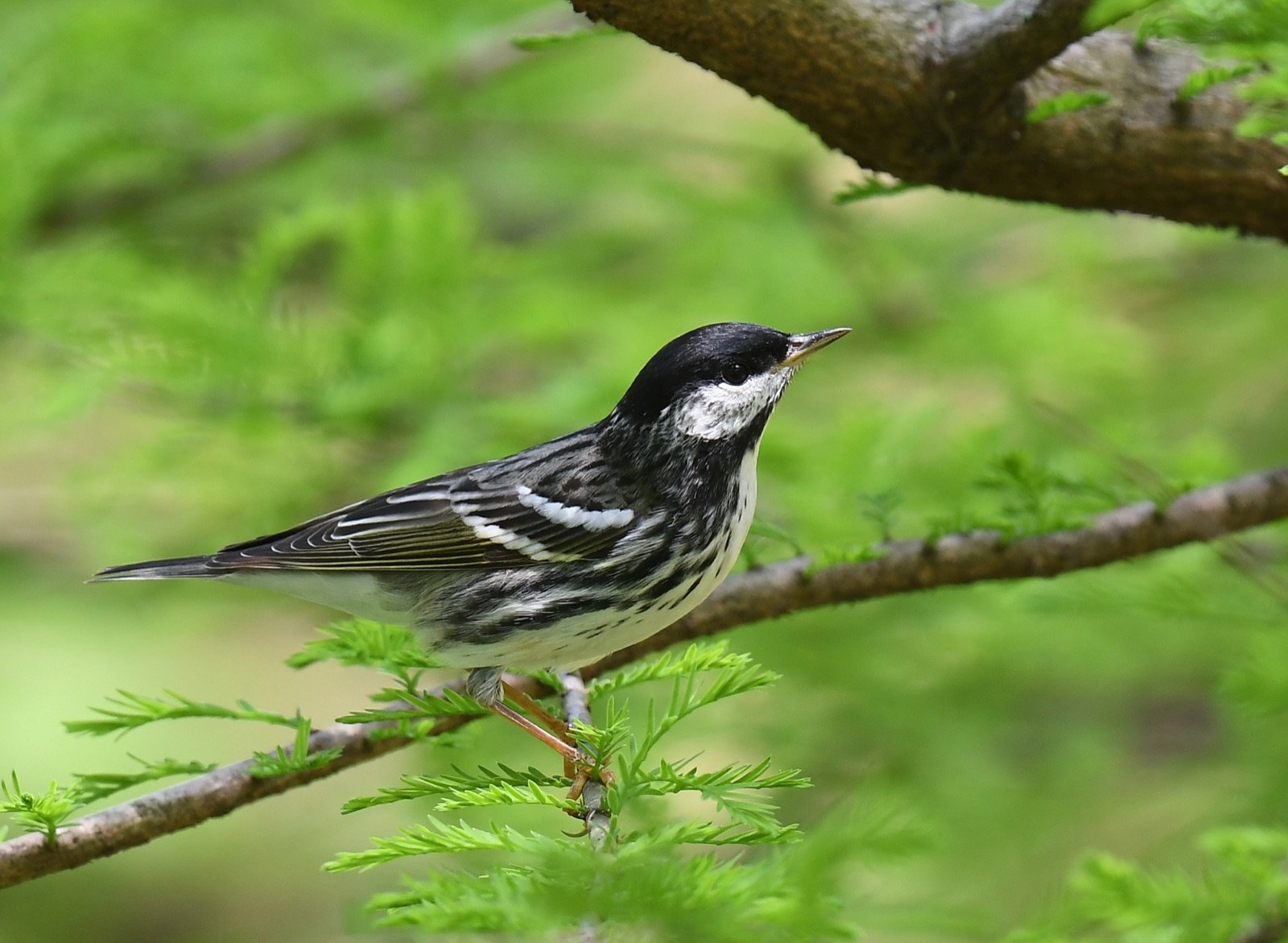
Breeding males are mostly black and white, with a bold black cap, white cheeks and white wing bars.
In spring the male looks much like a Black-and-white Warbler. The Blackpoll differs by having a prominent white cheek and a distinct black cap.
In fall plumage it looks very much like a Bay-breasted Warbler. Orange-yellow legs and white wing bars help separate it from similar olive warblers. A Costa Rican birder found one in a city park among pruned trees by its orange legs.
It is tiny. Before its long flight it nearly doubles its weight, to about 12 grams.
What it sounds like
Behaviour and diet
On migration the Blackpoll keeps to leafy treetops, where it is hard to see. Birders often know it is there only from its frequent song, but in Costa Rica it sings less, so fruiting trees are the better bet.
During migration and in winter it takes berries as part of its diet. In Costa Rica an adult breeding-plumage male was seen feeding in a fig tree just above eye level.
Migrating Blackpolls join mixed-species flocks, so checking flocks of small birds may turn one up.
Where it lives
On its breeding grounds it prefers evergreen trees in northern boreal forests. On migration it tends to forage in deciduous trees and shrubs instead.
In Costa Rica, spring migration watching centres on the Caribbean slope, between the coast and the Talamanca mountains, and the Blackpoll is among the migrants to watch for there. A trip report also lists it among the birds seen around Cahuita on the Caribbean side.
One was found in an urban park in the Residencial Cedral area, which shows migrants can turn up in ordinary green spaces.
When to see it
Northbound migration through Costa Rica runs from late February to mid-April for most species. The Blackpoll is rare and is usually seen only until late March or early April. Migrant warblers in general arrive between August and December, though that is a general statement and not specific to this species.
Similar birds
In fall plumage it looks very much like the Bay-breasted Warbler, and the two are sometimes lumped together as "baypoll" warblers. A Costa Rican naturalist who went looking for Bay-breasted Warblers found a Blackpoll instead, and its orange-ish legs gave it away. In spring, check the white cheek and distinct black cap against a Black-and-white Warbler.
Names and lore in Costa Rica
Reinita Rayada is the name used in Costa Rica. Other Spanish-speaking countries use different names, such as reinita estriada in Ecuador, Panama and Peru, and chipe gorrinegro in Mexico.
Status and conservation
The AOCR list marks the Blackpoll Warbler as a migrant (M), and it is rare in Costa Rica.
Photography tips
The Blackpoll that one birding writer saw in Costa Rica was at a fruiting fig, and birders went to see it once someone had found it. A fruiting fig with berries within reach, as that male was just above eye level, is the best setup to look for.
How we know this 16 sources, each read on the date shown
- Tico Times read 2026-11-04
https://ticotimes.net/2015/04/07/4-things-not-to-miss-during-bird-migration-season - Birding Craft read 2026-11-04
https://birdingcraft.com/wordpress/2021/04/29/twitching-blackpoll-warbler-and-cedar-waxwings-in-costa-rica/ - Birding Craft read 2026-11-04
http://birdingcraft.com/wordpress/category/caribbean-slope/ - iNaturalist read 2026-11-04
https://www.inaturalist.org/taxa/145240-Setophaga-striata - Wikipedia read 2026-11-04
https://en.wikipedia.org/wiki/Blackpoll_warbler - Carolina Bird Club read 2026-11-04
https://www.carolinabirdclub.org/BOCC/Passerines/19%20Warblers/Blackpoll%20Warbler.pdf - Cornell Lab, All About Birds read 2026-11-04
https://www.allaboutbirds.org/guide/Blackpoll_Warbler/overview - Jose Pablo Castillo, El Arte de Volar read 2026-11-04
https://josepablocastillo.wordpress.com/tag/migracion/ - Boreal Songbird Initiative read 2026-11-04
https://www.borealbirds.org/bird/blackpoll-warbler - Cornell Lab, All About Birds read 2026-11-04
https://www.allaboutbirds.org/guide/Blackpoll_Warbler/sounds - Mass Audubon read 2026-11-04
https://www.massaudubon.org/our-work/birds-wildlife/bird-conservation-research/breeding-bird-atlases/find-a-bird-bba1?id=153 - Adirondack Explorer read 2026-11-04
https://www.adirondackexplorer.org/environment/wildlife/blackpoll-warbler-natures-hearing-test/ - Mass.gov read 2026-11-04
https://www.mass.gov/info-details/blackpoll-warbler - Animal Diversity Web read 2026-11-04
https://animaldiversity.org/accounts/Dendroica_striata/ - Wikipedia (es) read 2026-11-04
https://es.wikipedia.org/wiki/Setophaga_striata - Jose Pablo Castillo blog read 2026-11-04
https://josepablocastillo.wordpress.com/