Family Laridae
Bonaparte’s Gull
Chroicocephalus philadelphia
In Spanish: Gaviota de Bonaparte
- A
A small, tern-like gull that reaches Costa Rica only as a rare vagrant.
Bonaparte's Gull (Gaviota de Bonaparte) is one of the smallest gulls in North America. Only the little gull and Saunders's gull are smaller. It breeds in boreal forest wetlands of Alaska and Canada, so a Costa Rican record is a long way from home.
On the official Costa Rican list it carries status A, which means accidental: a vagrant, not a regular visitor. Costa Rica lies within its wider range and the species winters in Central America, but here it is a bird to hope for, not to plan around.
For a beginning birder it is a good lesson in how rare birds work. Knowing what a small gull looks like, and where gulls gather, gives you a chance of spotting something out of place.
How to find it
Think of this as a bird to scan for, not to count on. Costa Rica gets few gulls overall, and a birder doing real gull-watching will be lucky to see more than Laughing Gulls. Check each flock carefully for a smaller, daintier bird. Look for a tern-like flight, a thin black bill and pale, see-through wingtips. Listen for a rasp that differs from the mewing of larger gulls, and watch for small birds hovering to pick food from the water.
How to recognise it
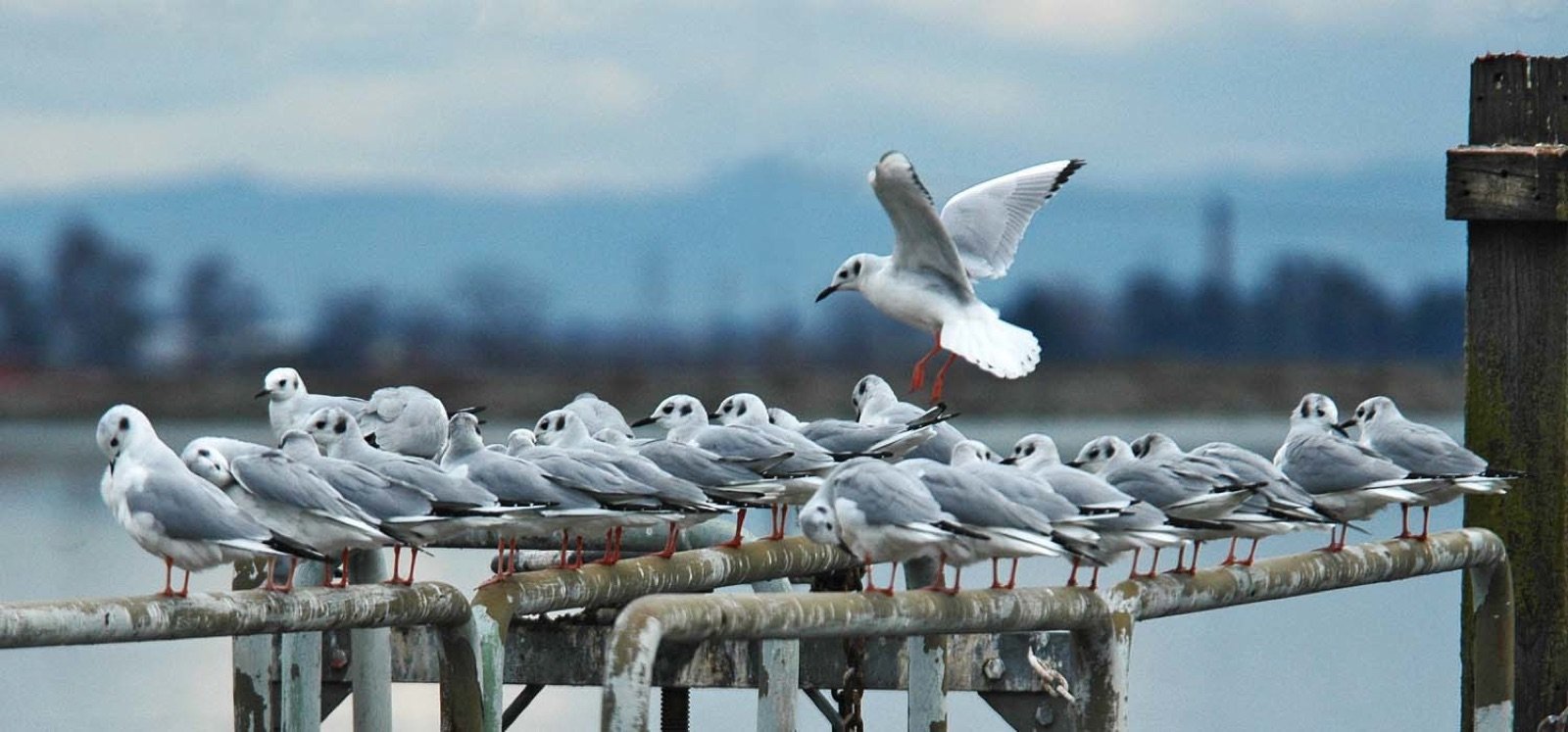
Adults are pale grey above and white below, with black-and-white wingtips and a thin black bill. Year-round the bill is thin and black, the legs are reddish and the tail is white.
Breeding adults have a black hood. In non-breeding plumage, the one you would be most likely to meet if one ever appeared here, the head is white with a small dark spot behind the eye.
A perched bird looks like a long-winged little gull. Its legs are pale and short, so mostly only the lower leg shows. In flight the wing tips look pale and see-through, with a thin black rear edge like a tern's.
What it sounds like
Recording: Jennifer Rycenga, CC BY 4.0, source, read 4 Nov 2026.
Behaviour and diet
It flies lightly with quick wingbeats, much like a tern. When it swims it often stretches its neck out and moves quickly, which gives it a look like a phalarope. It often hovers over one spot to pick food from the water.
In migration and winter it forms large flocks and feeds in dense, tern-like groups. It rarely feeds at garbage dumps. It was first named as a tern because it is so small and dainty.
Where it lives
Outside the breeding season it uses coastal bays, estuaries, inland lakes and rivers. It breeds in boreal forest wetlands of Alaska and Canada.
Costa Rica is within its range and the species is listed as native on the country checklist, and it winters in Central America. Some birds migrate as far south as Panama, where one was reported wintering near Panama City from November into late January in 2014, with a large flock of Laughing Gulls. That is close to Costa Rica.
When to see it
Costa Rica can get rare and vagrant birds in any month, and November and December seem to be the best time for lost birds. That note is general and not specific to this gull.
Similar birds
A Black-headed Gull, which has a red bill, could be mistaken for a Bonaparte's, and Costa Rican birders warn about it, although it has not been recorded in the country. Bonaparte's is smaller, with a slimmer, darker bill, pinker legs, a pale grey rear neck and a clearly whiter underwing in flight. In Costa Rica the gull you will meet far more often is the Laughing Gull.
Names and lore in Costa Rica
The Spanish name on the official Costa Rican list is Gaviota de Bonaparte.
Status and conservation
The AOCR list classes it as accidental (status A), while the IUCN lists it as Least Concern because its range is very large and its population is increasing.
How we know this 21 sources, each read on the date shown
- Wikipedia (via iNaturalist) read 2026-11-04
https://mexico.inaturalist.org/taxa/144502-Chroicocephalus-philadelphia - Mexican Birds read 2026-11-04
https://www.mexican-birds.org/bonapartes-gull/ - Gaviotas de Málaga species sheet read 2026-11-04
https://static.costadelsolmalaga.org/malaga/subidas/archivos/0/4/351340/gaviota-de-bonaparte.-especie-rara.-chroicocephalus-philadelphia.pdf - Birds of the World (Cornell Lab) read 2026-11-04
https://birdsoftheworld.org/bow/species/bongul/cur/introduction?lang=es&media=photos - iNaturalist (Wikipedia text) read 2026-11-04
https://inaturalist.org/taxa/144502-Chroicocephalus-philadelphia - Animalia (from Wikipedia) read 2026-11-04
https://animalia.bio/bonapartes-gull - Asturnatura read 2026-11-04
https://www.asturnatura.com/especie/chroicocephalus-philadelphia - Wikipedia, List of birds of Costa Rica read 2026-11-04
https://en.wikipedia.org/wiki/List_of_birds_of_Costa_Rica - Avibase, Guanacaste checklist read 2026-11-04
https://avibase.bsc-eoc.org/checklist.jsp?region=CRgu&list=howardmoore - ArgentiNat (from Wikipedia) read 2026-11-04
https://www.argentinat.org/taxa/68125-Larus-philadelphia - Lista Oficial de las Aves de Costa Rica (AOCR) read 2026-11-04
https://listaoficialavesdecostarica.wordpress.com/lista-oficial/lista-oficial-online/ - 10,000 Birds read 2026-11-04
https://www.10000birds.com/gullmania-in-costa-rica.htm - Birding Craft read 2026-11-04
https://birdingcraft.com/wordpress/2022/04/13/puntarenas-costa-rica-a-hotspot-that-merits-a-bird-observatory/ - Marine Ornithology (Bonilla et al. 2014) read 2026-11-04
https://www.marineornithology.org/PDF/42_1/42_1_3-4.pdf - Birding Craft read 2026-11-04
https://birdingcraft.com/wordpress/category/costa-rica-birding-app/ - Cornell Lab, All About Birds read 2026-11-04
https://www.allaboutbirds.org/guide/Bonapartes_Gull/sounds - Birdfact read 2026-11-04
https://www.birdfact.com/birds/bonapartes-gull - Birding Craft read 2026-11-04
https://birdingcraft.com/wordpress/2021/01/03/costa-rica-birds-in-waiting-guanacaste-7-species-to-look-for-not-on-the-list/ - Cornell Lab, All About Birds read 2026-11-04
https://www.allaboutbirds.org/guide/Bonapartes_Gull/id - Houston Audubon read 2026-11-04
https://houstonaudubon.org/programs/birding/gallery/bonapartes-gull.html - Jan Axel's Blog (Panama) read 2026-11-04
http://janbirdingblog.blogspot.com/2014/01/vagrant-gulls-still-in-panama-viejo.html