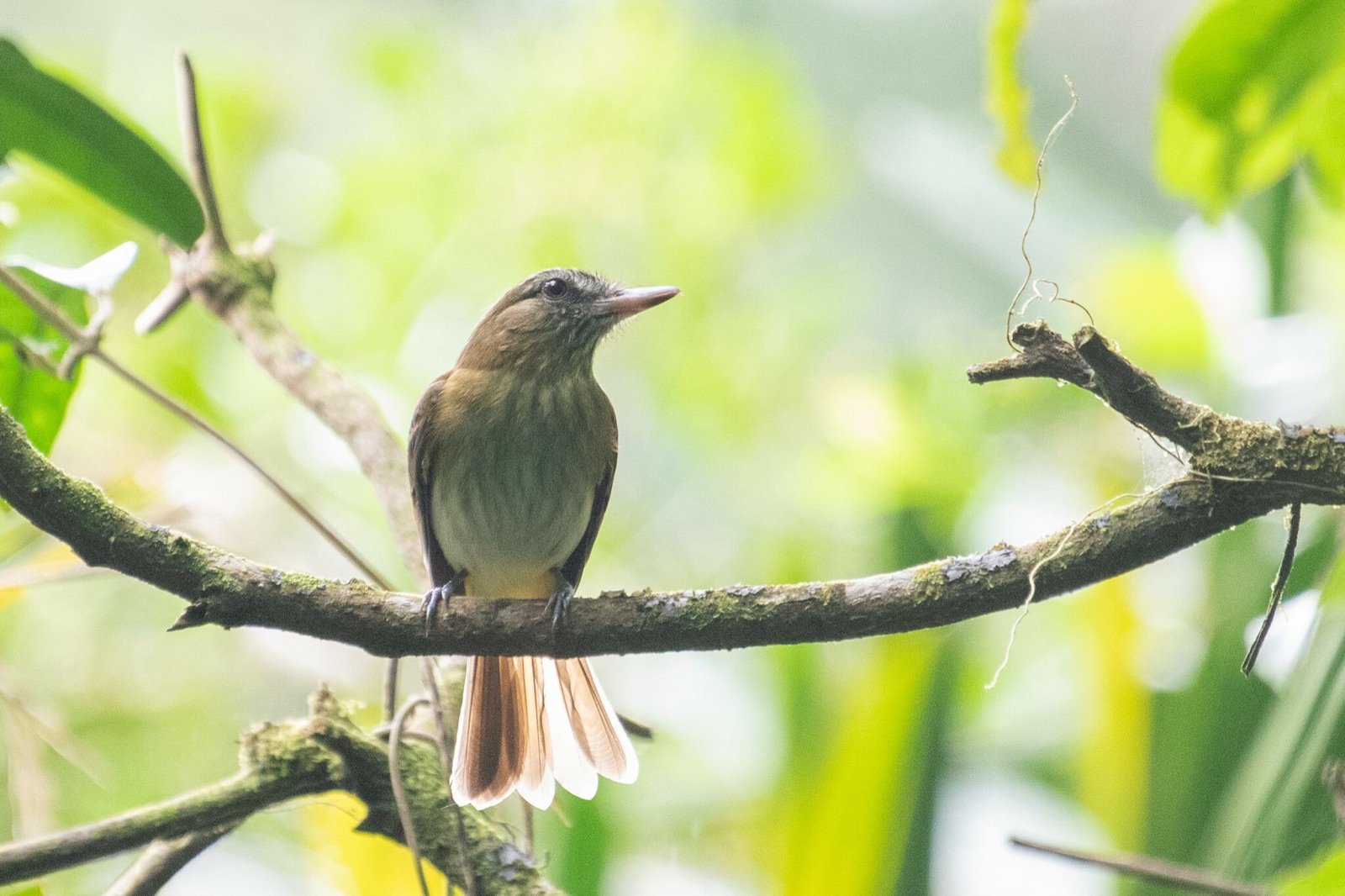
Family Tyrannidae
Bright-rumped Attila
Attila spadiceus
In Spanish: Atila Lomiamarilla
- Resident
A loud, red-eyed flycatcher that sings from hidden canopy perches.
The Bright-rumped Attila is a large-headed flycatcher about 18 cm long, and it is resident across Costa Rica. It is common wherever forest remains, even in fragments.
It is easier to hear than to see. At dawn it repeats loud phrases from a perch hidden deep in the canopy, so the trick is to follow the sound.
How to find it
It is hard to see because it usually calls from a hidden perch. It stays still while singing, so track the call to a perch rather than watching for movement. Early morning is the best time to listen, since it is often among the first birds heard just after dawn.
How to recognise it
This is a large-headed flycatcher about 18 cm long, roughly the size of a Great Kiskadee, with a long hooked bill that often tilts slightly upward. The eye is red to orange, which stands out against the big head. Across its range, features that are always present are two pale wing bars, a yellow rump and a streaked breast. The plumage is extremely variable, so do not rely on overall colour alone. Juveniles have a brown eye and a cinnamon crown. Look for the bill shape, the wing bars and the streaked underparts together.
What it sounds like
Behaviour and diet
The attila is solitary, even in the breeding season, and does not join mixed flocks. It perches upright and often flicks its tail downward. It is described as active, aggressive and noisy. It eats insects, spiders, frogs and lizards taken from vegetation or the ground. It is loud, but it does not usually call in flight, so it can stay unnoticed.
Where it lives
It is resident across Costa Rica, from the lowlands up to at least 1,850 m. It uses the canopy and edges of very wet and dry forest, shaded clearings, old secondary forest and gallery forest. It also turns up in banana and cacao plantations. Records come from both the Pacific and Caribbean sides, including the Caribbean lowlands and Puntarenas.
When to see it
Breeding in Costa Rica runs from March to July. The nest is a bulky cup placed low, 0.8 to 3 m up.
Similar birds
The Great Kiskadee is a similar size but very common and highly visible in Costa Rican gardens. The attila is equally loud but stays hidden. The streaked underparts and obvious wing bars help separate it from other attilas.
Names and lore in Costa Rica
In Costa Rica the usual Spanish name is Atila Lomiamarilla. Other countries use names such as Atila Rabadilla Brillante, Atila Gritona, Atila Polimorfo and Mosquero Atila. The genus name honors Attila, king of the Huns, and points to the aggressive nature of these birds.
Status and conservation
The official Costa Rican list marks it as R, a resident species, and it is rated Least Concern with a stable population.
Photography tips
Track the call to its perch, because the bird stays still while singing. Scan the canopy and forest edges once you have located the sound.
How we know this 12 sources, each read on the date shown
- Lista Oficial de las Aves de Costa Rica read 2026-11-04
https://listaoficialavesdecostarica.wordpress.com/lista-oficial/lista-oficial-online/ - Aves de Costa Rica read 2026-11-04
https://www.avesdecostarica.com/Attila-spadiceus.html - AVoCet (Michigan State University) read 2026-11-04
https://avocet.zoology.msu.edu/species/4777 - EcoRegistros read 2026-11-04
https://www.ecoregistros.org/ficha/Attila-spadiceus - Birds for Beer read 2026-11-04
https://birdsforbeer.com/2022/07/04/bright-rumped-attila/ - BirdNote via Living on Earth read 2026-11-04
https://www.loe.org/shows/segments.html?programID=16-P13-00005&segmentID=7 - Wikipedia (Spanish) read 2026-11-04
https://es.wikipedia.org/wiki/Attila_spadiceus - Animalia.bio read 2026-11-04
https://animalia.bio/bright-rumped-attila - Tsuru Bird Photography read 2026-11-04
http://www.tsuru-bird.net/a_species/attila_bright-rumped/ - Macaulay Library read 2026-11-04
https://macaulaylibrary.org/asset/140149401 - Animalia.bio read 2026-11-04
https://animalia.bio/bright-rumped-attila?letter=b - BirdNote read 2026-11-04
https://www.birdnote.org/podcasts/birdnote-daily/costa-rica-winter-sunrise