Family Corvidae
Brown Jay
Cyanocorax morio
In Spanish: Urraca Parda (Piapia, Piapa)
- Resident
A big, noisy brown jay of gardens and pastures, known here as Piapia.
You will probably hear the Brown Jay before you see it. Its loud, low call carries far, and Costa Ricans named it Piapia after the sound.
It is a common resident here, found from sea level up to about 2500 m on the volcanoes, and it does well in open, cleared country. That makes it one of the easier jays for a beginning birder to meet.
Birders meet it around Arenal, Monteverde, the Turrialba area and the gardens of hotels in the Central Valley. A flock tends to arrive in a noisy group, so it is a good first lesson in finding birds by ear.
How to find it
The call carries far, so listen for it first. Then look for flocks in open gardens, pastures and forest edges, often perched high in trees. Brown Jays often show up at bird feeders, and in lodge gardens they perch in trees in noisy groups. Once, a guide-led group watched a flock hunting quietly along a pasture edge, which was unusual, since the jays are usually seen in big, boisterous groups. If you hear a clamour of protest, check nearby trees: a flock will mob a predator such as an owl or hawk until it leaves.
How to recognise it
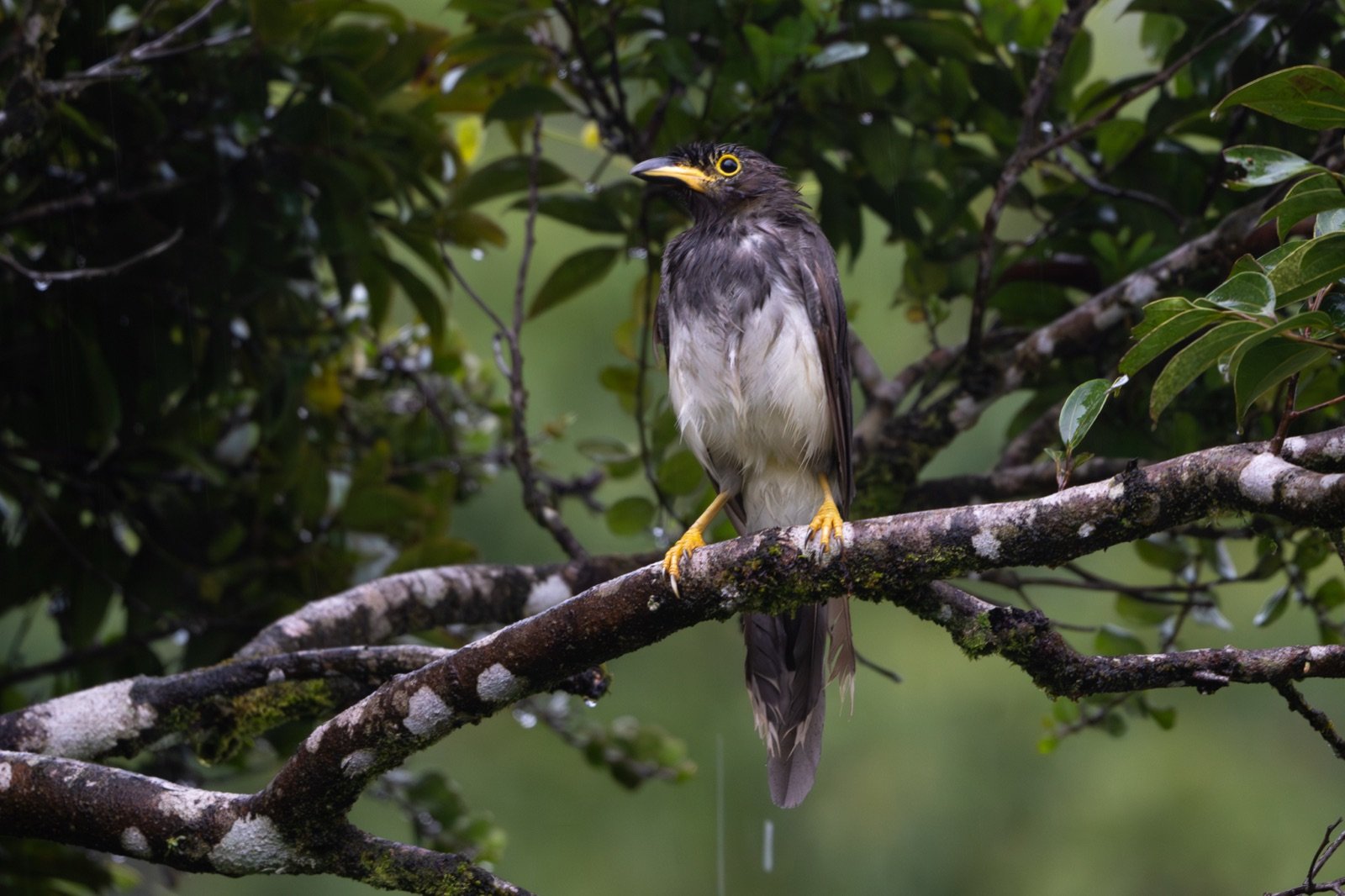
Costa Rican adults are large dark brown jays, about 39 cm long. The breast is pale brown and fades to creamy white on the belly. Most tail feathers have broad white tips, and the tail is long and stepped. Adults have black bills, legs and feet.
There is no crest, but look for the stiff, upright feathers on the forehead that point forward over the base of the bill. Southern birds, including those in Costa Rica, have a white belly and bright white tips on the outer tail feathers, while northern birds in Mexico are nearly all dark brown.
Young birds have a yellow bill and a yellow ring around the eye. This helps explain the odd pale-billed jays you may see in a flock.
What it sounds like
Recording: Arthur de Jesús Chavarría Pérez, CC BY 4.0, source, read 4 Nov 2026.
Behaviour and diet
Brown Jays forage in noisy flocks of about six to ten birds, often alongside Montezuma Oropendolas. Studies in Costa Rica show they breed cooperatively in family groups, and neighbouring groups hold stable territories and meet along the borders.
On the ground they move in long, springy hops. In courtship in the Tilarán range, a female called quickly and intensely from a branch, spread her wings, raised her tail and hopped in front of the male while calling. More than one female may sing at once near the nest, which makes nests easy for predators to find.
Where it lives
The Brown Jay is a common resident of deforested areas, from sea level up to about 2500 m on the volcanoes. It does well in open, cleared country. Its Costa Rican range covers the northern mountain ranges, the central mountains and the Caribbean lowlands.
It is spreading as forest is cleared, and is more common now in the Guanacaste lowlands, the southern coast and the Pacific interior valleys. Look in cleared groves, banana and coffee plantations, forest edges, open ground with scattered trees and secondary growth.
Names and lore in Costa Rica
In Costa Rica the jay is widely called Piapia, also written Pia Pia, and the AOCR name is Urraca Parda. Another local name, Pea, comes from the sound of its call.
Status and conservation
The AOCR lists the Brown Jay as a resident (R), the IUCN rates it Least Concern, and in Costa Rica it is described as a common resident.
Photography tips
Fruit feeders are a good bet. Photographers have recorded flocks of up to four at fruit feeders around Turrialba, and single birds at feeders near Ujarrás in Cartago. Birds perched high in trees are often against the sky, so feeders and garden decks give better light and closer views.
How we know this 21 sources, each read on the date shown
- Aves de Costa Rica read 2026-11-04
https://avesdecostarica.com/Psilorhinus-morio.html - Wikipedia read 2026-11-04
https://en.wikipedia.org/wiki/Brown_jay - Ecos del Bosque read 2026-11-04
https://ecosdelbosque.com/fauna/psilorhinus-morio - Biosonidos UNED read 2026-11-04
https://biosonidos.uned.ac.cr/?q=node/1195 - ResearchGate (territoriality study abstract) read 2026-11-04
https://www.researchgate.net/publication/232688337_Territoriality_and_neighbor_assessment_in_Brown_Jays_Cyanocorax_morio_in_Costa_Rica - Avibase read 2026-11-04
https://avibase.bsc-eoc.org/species.jsp?avibaseid=AD6BFD7E07B429EF - EcoRegistros read 2026-11-04
https://www.ecoregistros.org/sheet/Cyanocorax-morio - Cloudbridge Nature Reserve read 2026-11-04
https://www.cloudbridge.org/wp-content/uploads/2020/04/Bird-Species-List-Costa-Rica-13-April-2020.pdf - Animalia.bio read 2026-11-04
https://animalia.bio/brown-jay - Field Guides Birding Tours trip list read 2026-11-04
https://fieldguides.com/triplists/crh22b.html - Field Guides Birding Tours trip list read 2026-11-04
https://fieldguides.com/triplists/crh21b.html - Wingspan Bird Tours blog read 2026-11-04
http://www.wingspanbirdtours.com/blog/costa-rica-tour-day-2-0944ceec-eadc-4eb6-a29f-7165a3d06446 - Birds & Breakfast Costa Rica read 2026-11-04
https://birdsandbreakfast.com/en/brown-jay/ - Contenido Tico read 2026-11-04
https://contenidotico.com/biodiversidad/aves/urraca-parda/ - Birds & Wildlife tour itinerary read 2026-11-04
https://birdswildlife.com/costa-rica-with-david-lindo-aug-26th-7th-sept-2023/ - Field Guides Birding Tours trip list read 2026-11-04
https://fieldguides.com/triplists/crh23a.html - Field Guides Birding Tours trip list read 2026-11-04
https://fieldguides.com/triplists/cr118.html - John Gordon, Listening to Birds read 2026-11-04
https://thecanadianwarbler.blogspot.com/2025/03/costa-rica.html - iNaturalist (Wikipedia-based names) read 2026-11-04
https://www.inaturalist.org/taxa/1584194-Cyanocorax-morio - Flickr, text from Aves de Costa Rica read 2026-11-04
https://www.flickr.com/photos/jobando/34165197016 - HBW Internet Bird Collection read 2026-11-04
https://www.hbw.com/ibc/species/brown-jay-cyanocorax-morio