 Brown Noddy
Family Laridae
Brown Noddy
Anous stolidus
In Spanish: Tiñosa Común (Charrán Negro)
- Resident
A dark brown seabird that nests on Cocos Island, far out in the Pacific.
The Brown Noddy, Tiñosa Común in Spanish, is a seabird, and in Costa Rica it belongs above all to Cocos Island. The AOCR list treats it as a resident that nests there, with important colonies on the island's cliffs and on the small islets around it.
Cocos Island National Park lies in the eastern Pacific, about 523 km southwest of Cabo Blanco, and its islands and rocks hold large seabird nesting colonies. The Brown Noddy is one of those nesters.
For a beginning birder, this is a bird to plan a boat journey around, not one to hope for from a beach. Seabird records in Costa Rica are mostly limited to the coasts and Cocos Island National Park, so on a trip we build, the noddy is best sought on a boat trip to Cocos Island.
How to find it
Plan around a boat trip to Cocos Island, because seabird records in Costa Rica are mostly limited to the coasts and that national park. Boat trips to offshore islands are the best bet outside the breeding season too, since the bird stays over open ocean then. Scan the small islets around the main island as well as the cliffs, as the colonies are likely to be there. Watch for low flight over the water and for mixed feeding flocks working over schools of fish. Check any dark noddy carefully, because two species occur on the island.
How to recognise it
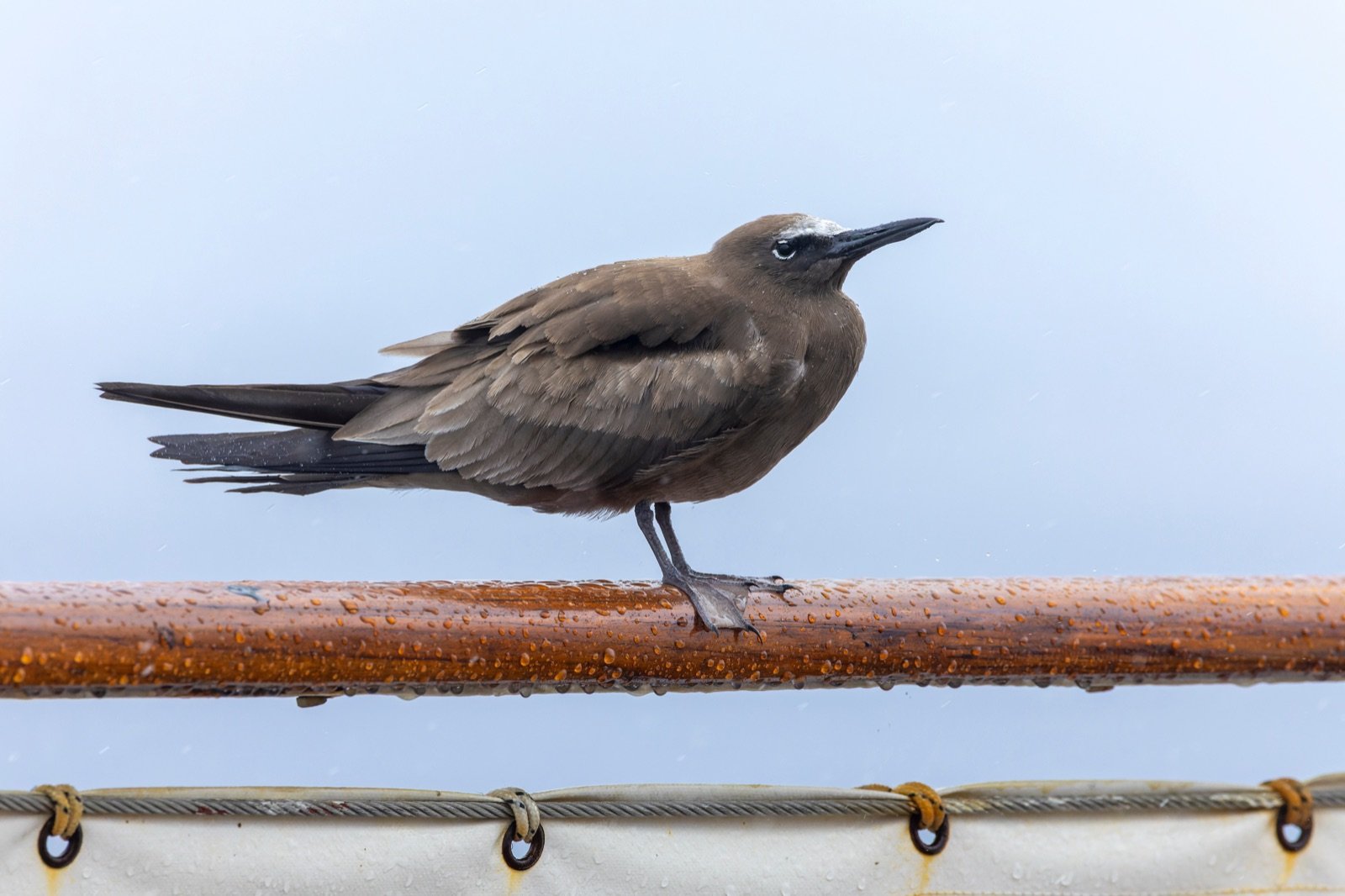
Dark brown plumage with a silvery forehead and crown marks the Brown Noddy on Cocos Island.
The head and neck look paler and greyish, which sets off the darker body.
In flight, look for the long wedge-shaped tail. The bird flies low over the sea on strong wingbeats.
Size helps when a second noddy is around. The Brown Noddy is the larger of the two species on the island, and its plumage is dark brown, not black.
Across its range, the subspecies ridgwayi, the one that occurs in Costa Rican waters, is said to be darker overall than the Indian and Pacific Ocean race pileatus.
What it sounds like
Behaviour and diet
The Brown Noddy plucks prey from the surface in low flight. It also patters its feet on the water while hovering, and it catches flying fish in the air. It often feeds in mixed flocks over schools of predatory fish that push small fish to the surface.
Near its island nesting sites it often forages along breaking waves or in lagoons. Pairs bow their heads to each other in courtship, which is the origin of the name noddy.
Roosting groups of tens to hundreds of birds gather, especially outside the breeding season.
Where it lives
In Costa Rica the Brown Noddy is a bird of Cocos Island National Park, an uninhabited island park about 550 km off the Pacific coast. It nests on the island's cliffs and on the small islets around it.
Researchers say nesting sites are likely on those islets, while Black Noddy nests are more likely on the main island itself.
Outside the breeding season the species lives over open ocean. It seldom comes near mainland coasts except when storms push it there.
When to see it
On Cocos Island, the Brown Noddy nests from March to May.
Similar birds
On Cocos Island two noddies occur, the Brown Noddy and the Black Noddy. The Black Noddy is smaller and more uniformly dark with a white cap. The Brown Noddy is the larger bird, dark brown rather than black, with a paler greyish head and neck.
Names and lore in Costa Rica
Costa Ricans know it as Tiñosa Común. One Spanish source also lists the names Tiñosa Boba and Charrán Café for it.
Status and conservation
The AOCR list treats the Brown Noddy as a resident (R) species that nests on Cocos Island, where it is listed among the non-endemic birds.
Photography tips
Boat trips to offshore islands give the best chance for photos. The birds fly low over the sea on strong wingbeats, and the long wedge-shaped tail is a useful feature to look for in flight.
How we know this 16 sources, each read on the date shown
- Universidad de Costa Rica read 2026-11-04
https://www.ucr.ac.cr/multimedios/galerias/especies-de-aves-que-habitan-o-visitan-la-isla-del-coco.html - Costa Rica Infolink read 2026-11-04
https://costaricainfolink.com/es/parque-nacional-isla-del-coco-costa-rica/ - Birdwatching in Costa Rica read 2026-11-04
https://birdwatchingincostarica.com/aves-oceanicas-en-costa-rica-un-pais-de-mar-un-tesoro-por-descubrir/ - FotoNaturaleza forum read 2026-11-04
https://www.fotonaturaleza.net/foro/?m=t&tid=31648 - iNaturalist (Wikipedia summary) read 2026-11-04
https://www.inaturalist.org/guide_taxa/459950 - Birds of the World read 2026-11-04
https://birdsoftheworld.org/bow/species/brnnod/cur/systematics - Oiseaux-Birds read 2026-11-04
https://www.oiseaux-birds.com/card-brown-noddy.html - Audubon Field Guide read 2026-11-04
https://www.audubon.org/field-guide/bird/brown-noddy - Montoya 2007, Brenesia (via ResearchGate) read 2026-11-04
https://www.researchgate.net/publication/259399232_Notas_historicas_sobre_la_ornitologia_de_la_Isla_del_Coco_Costa_Rica - Montoya 2007, Brenesia (Lista Oficial de las Aves de Costa Rica) read 2026-11-04
https://listaoficialavesdecostarica.wordpress.com/wp-content/uploads/2012/06/montoya-m-2007-historia-ornitologia-isla-del-coco-brenesia-6837-57.pdf - Animalia.bio read 2026-11-04
https://animalia.bio/brown-noddy - Oiseaux-Birds read 2026-11-04
https://www.oiseaux-birds.com/article-island-birds-endemic-cocos-island.html - Bird Finding read 2026-11-04
https://birdfinding.info/brown-noddy/ - Universidad de Costa Rica read 2026-11-04
https://www.ucr.ac.cr/noticias/2025/12/08/mas-del-90-de-las-especies-de-aves-en-la-isla-del-coco-llegan-desde-muy-lejos.html - Cornell Lab, All About Birds read 2026-11-04
https://www.allaboutbirds.org/guide/Brown_Noddy/lifehistory - Earthlife read 2026-11-04
https://earthlife.net/noddies/