Family Anatidae
Canvasback
Aythya valisineria
In Spanish: Porrón Picudo
- A
An accidental diving duck, first recorded at Cachí lake in 2012
The Canvasback, Porrón Picudo on the official Costa Rican list, is not a bird to plan a trip around. The list gives it status A, accidental: a vagrant with very few records in the country, neither a resident nor an endemic.
That rarity is what makes it worth knowing. Costa Rica lies well south of the California and Texas coasts and the northern to central Mexico lowlands where it usually winters, so any Canvasback here is a bird far from its normal route.
For a beginning birder the useful lesson is how to recognise one if a lake ever holds a stray, and how to separate it from the two other accidental Aythya ducks on our list.
How to find it
A vagrant is best searched for on lakes among other diving ducks. Open water is the place to look, since the species seldom comes ashore. Scan each raft slowly and look for the wedge-shaped head profile, which helps you pick it out of a mixed flock. Check any chestnut-headed duck with a black bill and a whitish back. Costa Rica sees only a few vagrants, so a good candidate deserves careful photos and a guide's opinion.
How to recognise it
The Canvasback is the largest diving duck in North America, 48 to 56 cm long. It is about the size of a mallard but heavier and more compact. These details describe the species across its range, so use them as a checklist for any suspect duck.
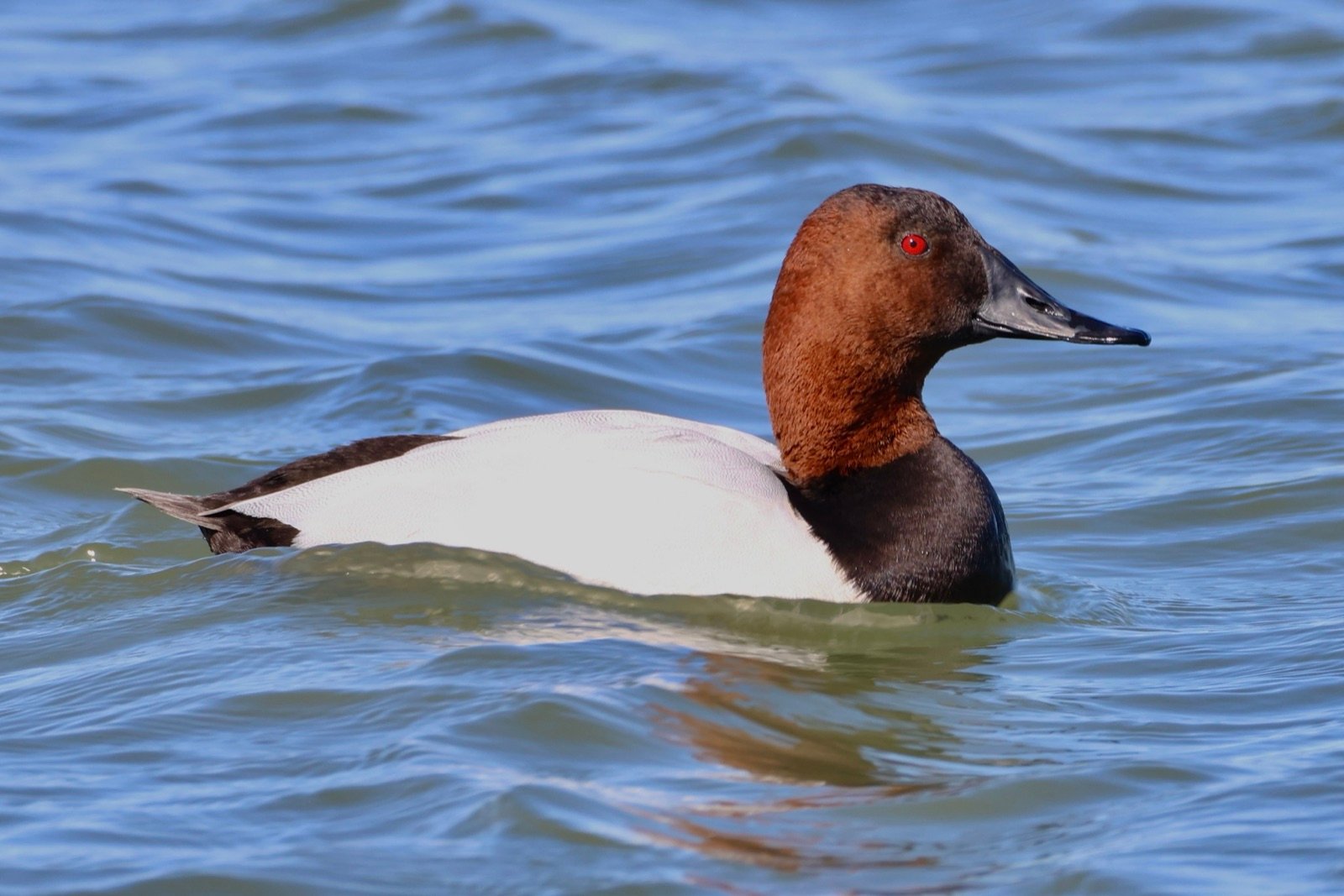
Its best field mark is the long, sloping head and bill profile, with the forehead running straight into a black bill. That wedge shape helps you pick it out of a mixed flock.
The male has a chestnut head, a black bill, a black chest and a whitish back.
The female is brownish-gray with a pale tan head.
Behaviour and diet
Canvasbacks live on open water in rafts and seldom come ashore. They dive for much of their food from the lake bottom.
They need a running start across the water to take off. Once airborne they are strong, fast fliers, reaching about 56 miles per hour.
Where it lives
Across its range the Canvasback is a bird of open water. It usually winters on the California and Texas coasts and in northern to central Mexico, and it reaches only central Mexico in small numbers in winter. There have been a few sightings in northern Central America and the Caribbean.
Costa Rica lies well south of that normal winter range, which fits its accidental status here. The official list treats it as a vagrant, not a resident.
Similar birds
Costa Rica's other accidental Aythya ducks are the Redhead and the Common Pochard. The Canvasback is larger than the Redhead and has a long sloping forehead running straight into a black bill. The Redhead has a rounder head, so compare head shape first.
Names and lore in Costa Rica
Porrón Picudo is the Spanish name used in Costa Rica, and Nicaragua uses it too. Other countries differ, such as Pato Coacoxtle in Mexico. Spanish sources also give porrón coacoxtle, pato lomo blanco, pato piquisesgado and porrón de lomo cruzado, but these come from general Spanish sources, not Costa Rican nicknames.
Status and conservation
The Asociación Ornitológica de Costa Rica lists the Canvasback as status A (accidental), and the 2025 to 2026 list, updated June 2026, keeps it that way.
Photography tips
Canvasbacks live on open water in rafts and seldom come ashore, so scan lakes among other diving ducks. The wedge-shaped head profile helps you pick one out of a mixed flock. Photograph the head and bill in profile first.
How we know this 15 sources, each read on the date shown
- Asociación Ornitológica de Costa Rica (AOCR) read 2026-11-04
https://www.avesdecostarica.org/anatidae.html - Lista Oficial de las Aves de Costa Rica (AOCR) read 2026-11-04
https://listaoficialavesdecostarica.wordpress.com/lista-oficial/lista-oficial-online/ - Wikipedia read 2026-11-04
https://en.wikipedia.org/wiki/List_of_birds_of_Costa_Rica - Wikipedia read 2026-11-04
https://en.wikipedia.org/wiki/Canvasback - iNaturalist Mexico (Spanish Wikipedia text) read 2026-11-04
https://mexico.inaturalist.org/taxa/7057-Aythya-valisineria - Biofotos (INBio) read 2026-11-04
http://biofotos.org/biofotos/Detalle.aspx?Cat=1&Esp=18 - Smithsonian National Zoo read 2026-11-04
https://nationalzoo.si.edu/animals/canvasback - Cornell Lab, All About Birds read 2026-11-04
https://www.allaboutbirds.org/guide/Canvasback/lifehistory - Audubon Field Guide read 2026-11-04
https://www.audubon.org/field-guide/bird/redhead - Audubon Field Guide read 2026-11-04
https://www.audubon.org/field-guide/bird/canvasback - Cornell Lab, All About Birds read 2026-11-04
https://www.allaboutbirds.org/guide/Canvasback/sounds - Tripadvisor Costa Rica Forum read 2026-11-05
https://www.tripadvisor.com/ShowTopic-g291982-i813-k5939471-Good_news_for_Birdwatchers-Costa_Rica.html - Avibase read 2026-11-05
https://avibase.bsc-eoc.org/species.jsp?avibaseid=1929E1E16E073570 - Wikipedia (es), Anexo: Aves de Costa Rica read 2026-11-05
https://es.wikipedia.org/wiki/Anexo:Aves_de_Costa_Rica - American Bird Conservancy read 2026-11-05
https://abcbirds.org/birds/canvasback/