Family Tyrannidae
Cattle Tyrant
Machetornis rixosa
In Spanish: Tirano Jinete
- A
A slim, yellow-bellied pasture flycatcher, first recorded in Costa Rica in 2023.
The Cattle Tyrant, Tirano Jinete in Spanish, is a ground-living flycatcher that follows grazing livestock. In Costa Rica it is a very rare visitor, and its first documented record came in late 2023 at La Gamba, near Golfito in the south-west.
A second bird was later seen by local birders on the road to Caño Negro, in the far north, which suggests more may be wandering with cattle elsewhere in the country. Costa Rica sits at the edge of the species' known northern range, and the northern forms have spread a little northward in recent years, into Panama and, rarely, Costa Rica.
For a beginning birder this is a bird to know about rather than to plan a trip around. Knowing its look and its habits helps you recognise a surprise in an open pasture.
How to find it
Look in open pastures with livestock. Scan fence posts, rooftops and other exposed perches, where pairs or small groups often keep watch. Watch the cattle themselves, since the bird may perch on their backs. Listen for sharp chips and twittering carried across open ground. In Costa Rica any sighting would be exceptional, so note the throat colour, the crown and the habitat carefully.
How to recognise it
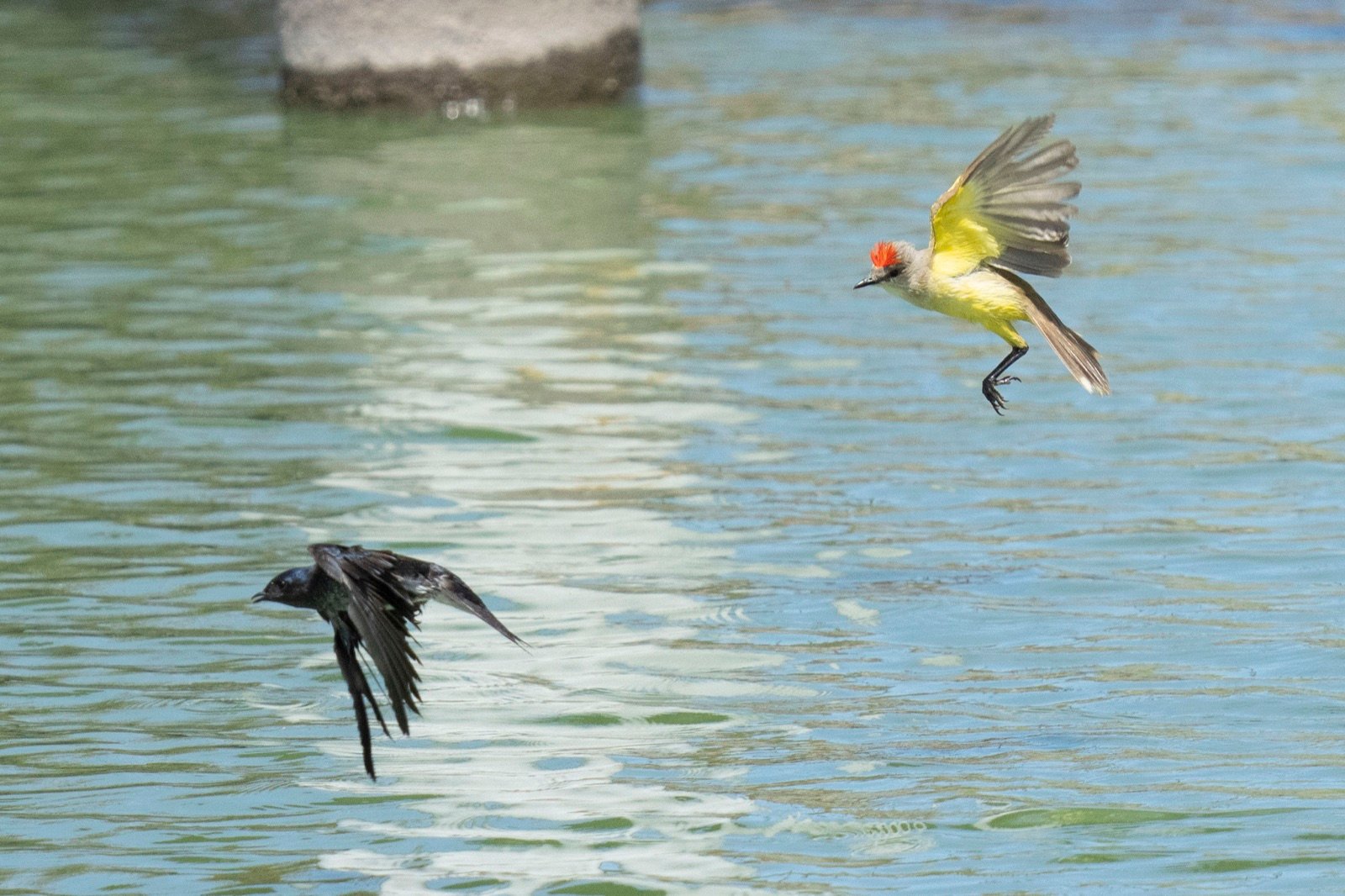
The Cattle Tyrant is a fairly slim, mostly ground-living flycatcher about 20 cm long. Across the species it is olive-brown above and yellow below.
Look for these marks:
- a grey head, with a gray-tinged crown and nape
- a thin dark eyestripe
- a paler whitish throat
- bright yellow breast and belly
- a narrow white tip on the tail
- a black bill and black legs
The northern subspecies, the form expected near Costa Rica, has a yellow throat and a brownish crown, a pattern that sets it apart from the southern form. So check the throat colour closely, since the whitish throat described for the species in general may not fit the northern birds.
There is also a usually hidden orange or red crown patch, shown only when the bird is excited.
What it sounds like
Recording: Joaquín Krasuk, CC BY 4.0, source, read 4 Nov 2026.
Behaviour and diet
This is a bird of the ground. It forages mostly in pairs or small groups, running quickly in an upright posture.
It eats mostly medium to large insects, caught in short flights from a perch. Its best-known habit involves livestock: it often snaps up insects that grazing animals flush out of the grass, and it often perches on cattle to feed on their parasites.
Where it lives
Across its range the Cattle Tyrant lives in open country: grassland, savanna, pasture, roadsides, wetland edges and even towns. It avoids dense forest but may use forest edges and cleared areas.
It copes well with farmland and other changed landscapes. In Costa Rica it has been recorded at two ends of the country: La Gamba in the south-west, close to the Panama border, and the San Emiliano wetland area in the far north, almost at the Nicaraguan border.
When to see it
The first Costa Rican bird was documented in 2023 and was still being seen at La Gamba in December of that year.
Similar birds
It looks a lot like the Tyrannus kingbirds, but the resemblance may come from convergent evolution, not close kinship. To tell them apart, check its ground-feeding habit and its plain, olive-brown back.
Names and lore in Costa Rica
Costa Rica and Panama both use the Spanish name Tirano Jinete. Elsewhere in South America it goes by names like Picabuey, Caballerizo, Margarita, Matadura and Sirirí Bueyero.
Status and conservation
The AOCR official list (updated June 2026) includes it as Tirano Jinete in category A, and worldwide it is rated Least Concern, with a wide range and stable numbers.
Photography tips
Open pastures give clear views, so scan fence posts and rooftops where pairs or small groups keep watch. Cattle are worth watching closely, since the bird may perch on them.
How we know this 14 sources, each read on the date shown
- Texas Bird Records Committee read 2026-11-04
https://www.texasbirdrecordscommittee.org/review-information/list-of-statements/cattle-tyrant - Wikipedia read 2026-11-04
https://en.wikipedia.org/wiki/Cattle_tyrant - EcoRegistros read 2026-11-04
https://www.ecoregistros.org/sheet/Machetornis-rixosa - Roperoaventuras read 2026-11-04
https://roperoaventuras.com/2016/01/07/siriri-bueyero-o-picabuey-machetornis-rixosa/ - AOCR Lista Oficial read 2026-11-04
https://listaoficialavesdecostarica.wordpress.com/lista-oficial/lista-oficial-online/ - Featherscan (Wikipedia-based summary) read 2026-11-04
https://www.featherscan.com/birds/cattle-tyrant - Aves Saladillo read 2026-11-04
https://avessaladillo.blogspot.com/2015/04/picabuey-machetornis-rixosa.html - Birding Craft read 2026-11-04
https://birdingcraft.com/wordpress/2024/01/04/2024-starting-another-year-of-birding-in-costa-rica/ - Birding Craft read 2026-11-04
https://birdingcraft.com/wordpress/2023/12/19/highlights-from-birding-costa-rica-2023/ - Smithsonian Magazine read 2026-11-04
https://www.smithsonianmag.com/smart-news/south-american-bird-makes-rare-appearance-in-texas-thousands-of-miles-from-home-180983373/ - Avibase read 2026-11-04
https://avibase.bsc-eoc.org/species.jsp?avibaseid=87874F973B876854 - Costa Rica Living and Birding read 2026-11-05
https://birdingcraft.com/wordpress/page/7/ - Wikipedia (Spanish) read 2026-11-05
https://es.wikipedia.org/wiki/Machetornis_rixosa - iNaturalist guide read 2026-11-05
https://spain.inaturalist.org/places/cached_guide/universidad-ces