Family Parulidae
Cerulean Warbler
Setophaga cerulea
In Spanish: Reinita Cerulea
- Migrant
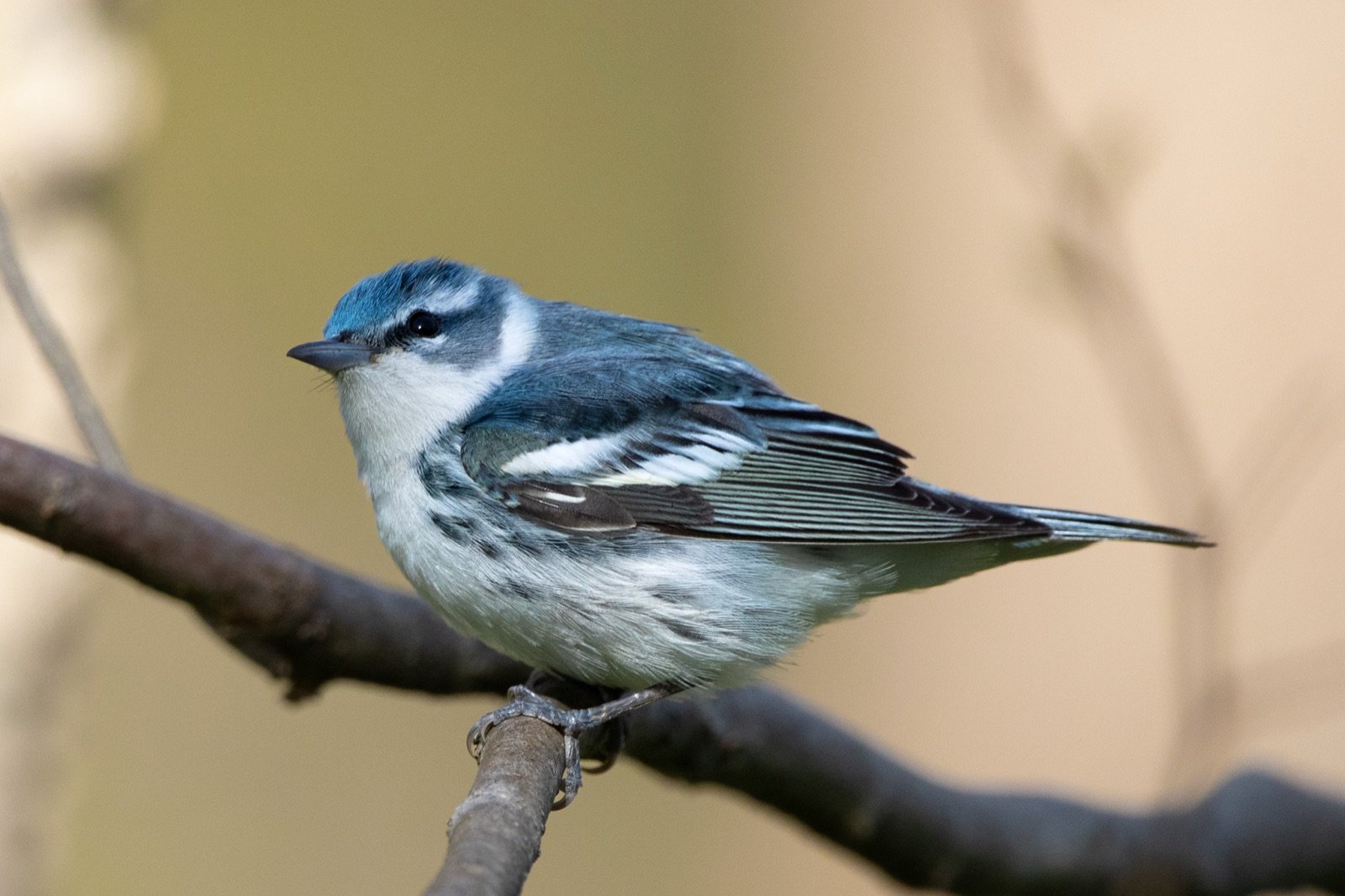
A tiny sky-blue canopy warbler that stops in the Caribbean foothills each fall.
The Cerulean Warbler does not stay in Costa Rica. It stops here on its way south, and most use foothill and middle elevation forests on the Caribbean slope. That short pause is the whole window to see it.
Before recent local research it was considered rare and scarce in the country. Las Brisas Reserve, in the foothills above the banana lands near Siquirres, is now a known stopover hotspot, and some days a dozen or more have been seen there.
Sightings are never guaranteed, but birding the right places between late August and late September should turn up several. On a trip we build, the Caribbean foothills are where we would put the time.
How to find it
Plan around the migration window and head for the Caribbean foothills, between late August and late September. Look up and scan mixed species flocks moving through the high canopy. Checking Cecropia trees in migration season may help, since one Costa Rica birder spotted a Cerulean searching thick Cecropia foliage. In the Central Valley, two females were once seen foraging low in tall trees mixed with thick low vegetation. Experience with identification helps a great deal, so a guide who knows the flocks is worth having.
How to recognise it
This is a very small warbler, about 11 cm long, with a thin pointed bill. These marks describe the species in general.
Adult males are sky blue above and white below. They have a dark necklace across the breast and streaks on the back and flanks.
Females and young are blue-green above, with a pale eyebrow and yellow below.
All of them have two white wing bars. In Costa Rica the warblers are picked out from mixed species flocks moving through the high canopy, so experience with identification helps.
What it sounds like
Recording: Jonathan Layman, CC BY 4.0, source, read 4 Nov 2026.
Behaviour and diet
The Cerulean Warbler feeds on insects and forages and nests high in the canopy of mature forest, higher than many other warblers. In Costa Rica it moves with mixed species flocks through the high canopy. At Las Brisas it shares habitat with other migrants such as Blackburnian Warbler and American Redstart. Bird banders there call it a hard target, because it spends most of its time foraging in the upper levels of the forest.
Where it lives
Most Cerulean Warblers in Costa Rica use foothill and middle elevation forests on the Caribbean slope. Las Brisas Reserve stands out as especially important, and it sits on the slopes of the Turrialba volcano. Ceruleans can also turn up in the Central Valley, but seeing them there is hit or miss.
Costa Rica is only a passage stop. Wintering birds use Andean forests from Colombia and Venezuela south to eastern Ecuador and southeastern Peru.
When to see it
Las Brisas gets its Cerulean Warblers from late August to mid-September. Prime arrival in the Corredor Azul and Cerúlea Nature Reserve area is the last week of August and the first week of September.
Similar birds
Cornell lists the female or young Blackburnian Warbler and the non-breeding female or young Blackpoll Warbler as look-alikes. Both are migrants that can also pass through Costa Rica. Check the wing bars, the pale eyebrow and the blue-green tone of the back before you call it.
Names and lore in Costa Rica
The name on the Costa Rican bird list is Reinita Cerúlea. Other Spanish names for the species are Chipe Celeste and Chipe Cerúleo.
Status and conservation
The AOCR list marks it as a migrant (M), and worldwide it is Near Threatened, with populations falling because of severe loss of breeding and wintering habitat.
Photography tips
Even in good migration spots, most birders need a few days of searching to find a single Cerulean Warbler, so it is a patience bird for photographers. Check Cecropia trees in migration season, and give yourself several days rather than one.
How we know this 19 sources, each read on the date shown
- 10,000 Birds read 2026-11-04
https://www.10000birds.com/how-to-help-cerulean-warblers-other-migrant-species-and-resident-birds-in-costa-rica.htm - Proyecto Cerúlea read 2026-11-04
https://www.cerulea.org/proyecto-cerulea/post/cerulean-warbler-migration---2025-zetNWfd5yNpSdJQ - 10,000 Birds read 2026-11-04
https://www.10000birds.com/fall-migration-in-costa-rica-six-things-i-have-learned.htm - Birding Craft read 2026-11-04
https://birdingcraft.com/wordpress/tag/planning-a-birding-trip-to-costa-rica/ - Animalia (from Wikipedia) read 2026-11-04
https://animalia.bio/cerulean-warbler - Rainforest Alliance read 2026-11-04
https://www.rainforest-alliance.org/species/cerulean-warbler/ - Proyecto Cerúlea read 2026-11-04
https://www.cerulea.org/proyecto-cerulea/post/every-bird-counts-highlights-from-the-2026-cerulean-warbler-count-in-gFKnSSFscrTeSwx - American Bird Conservancy read 2026-11-04
https://abcbirds.org/birds/cerulean-warbler/ - All About Birds (Cornell Lab) read 2026-11-04
https://www.allaboutbirds.org/guide/Cerulean_Warbler/species-compare/ - Portal Verde (Mongabay Latam report) read 2026-11-04
https://portalverde.com.bo/dia-mundial-de-las-aves-migratorias-cada-observacion-cuenta-y-la-ciencia-ciudadana-es-un-pilar-de-la-conservacion/ - Asociación Ambiental Cerúlea read 2026-11-04
https://www.cerulea.org/research - Mongabay Latam read 2026-11-04
https://es.mongabay.com/2026/05/dia-mundial-de-las-aves-migratorias-cada-observacion-cuenta-y-la-ciencia-ciudadana-es-un-pilar-de-la-conservacion/ - NaturaLista Colombia read 2026-11-04
https://colombia.inaturalist.org/taxa/145232-Setophaga-cerulea - Asociación Cerúlea read 2026-11-04
https://www.cerulea.org/fundraising - 10,000 Birds read 2026-11-04
https://www.10000birds.com/quality-lowland-caribbean-birding-in-costa-rica-at-centro-manu.htm - Costa Rica Living and Birding read 2026-11-04
http://birdingcraft.com/wordpress/ - Lanceros Digitales (Mongabay) read 2026-11-04
https://lanceros.confeniae.net/dia-mundial-de-las-aves-migratorias-cada-observacion-cuenta-y-la-ciencia-ciudadana-es-un-pilar-de-la-conservacion/ - Fuerza Informativa (Mongabay) read 2026-11-04
https://fuerzainformativa.pe/dia-mundial-de-las-aves-migratorias-la-ciencia-ciudadana-como-pilar-de-la-conservacion/ - Revista Literaria El Candelabro read 2026-11-04
https://revistaliterariaelcandelabro.blog/2024/02/alas-azules-en-vuelo-la-vida-secreta-de-la-reinita-cerulea/