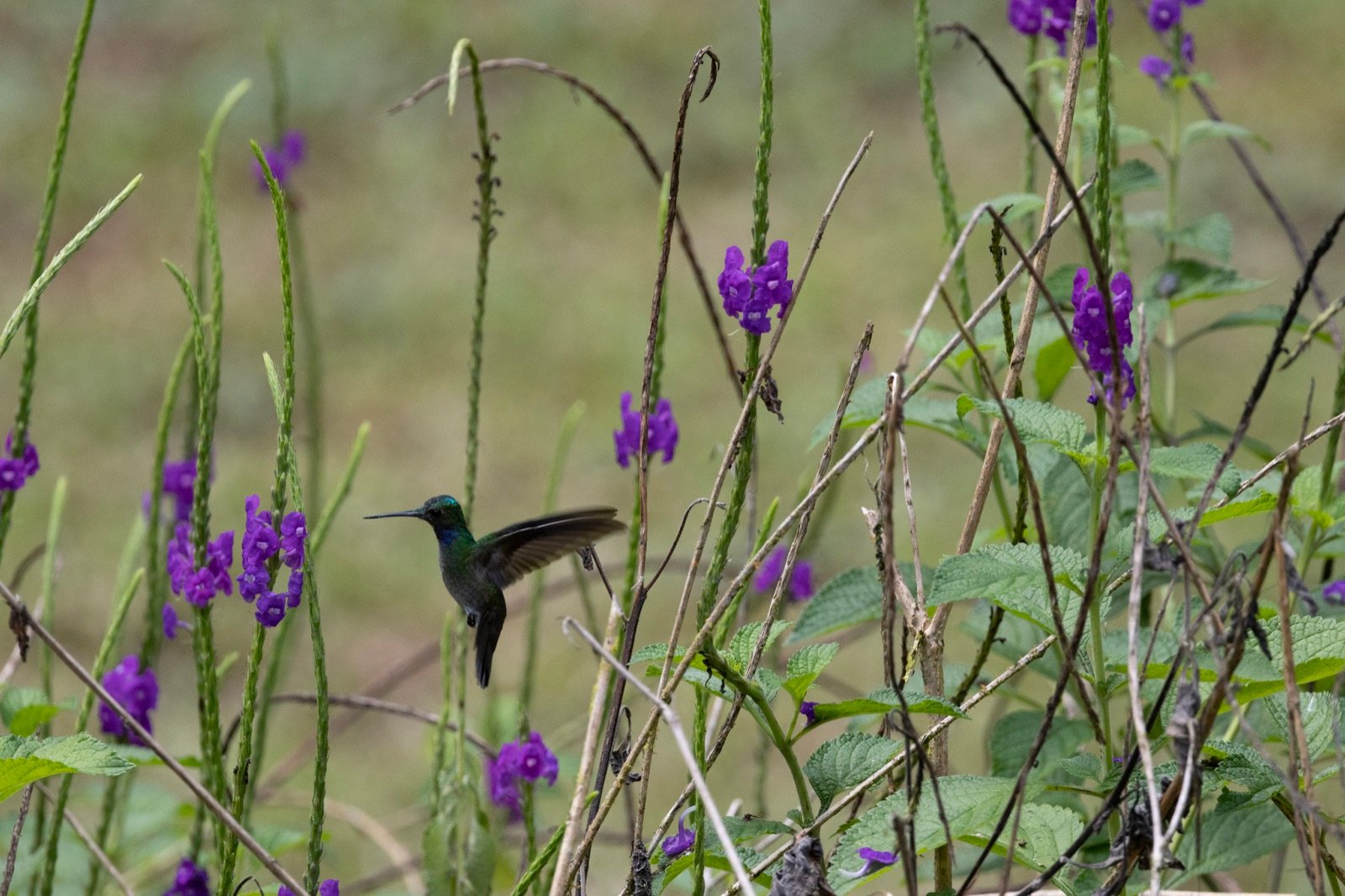
Family Trochilidae
Charming Hummingbird
Polyerata decora
In Spanish: Colibrí Corona de Berilo (Gurrión)
- Resident
- Regional endemic
A dark Pacific-side hummingbird found only in Costa Rica and western Panama.
The Charming Hummingbird (Colibrí Corona de Berilo, also called Gurrión) is a regional endemic, found only in Costa Rica and western Panama. In Costa Rica it is mostly limited to Puntarenas province, on the southern Pacific side.
It is a bird of edges, coffee farms and gardens rather than deep forest, so you do not need a long hike to meet it. On a trip we build around the central and southern Pacific, a slow morning beside flowering shrubs and heliconias is the way to look.
Its numbers vary a lot and it can turn up and vanish without warning, so a little patience at a good flowering patch pays off.
How to find it
Look low, at forest borders, in shrubs and in gardens, and keep your eyes at shrub height rather than in the canopy. Flowering shrubs and heliconias near clearings are good places to wait. The zone between gardens and primary forest is also worth a slow scan. Heliconia gardens are places where visitors can watch it feed. A group of singing males in one spot can be a clue to a lek. Because it comes and goes, return to a good patch more than once.
How to recognise it
This is a medium-small, dark hummingbird about 9 cm long, with a fairly long bill and no striking pattern. It rewards a careful look rather than a quick glance.
The male has a shiny blue-green crown and a violet-blue lower throat and chest. His belly is buffy gray.
The female has a duller crown and a pale gray throat and chest covered in many green and blue spots. Her bill is black, with a pink base on the lower half.
When the plumage is subdued, check the bill length and the colour of the throat and chest.
What it sounds like
Behaviour and diet
The Charming Hummingbird visits scattered flowers, picks insects off foliage and defends flower territories. One birder watched a male guarding his heliconia patch in rainforest.
It is mostly solitary, but males gather to sing in small groups called leks, which can hold up to 12 birds. In the display, males make steep climbs followed by fast dives, with calls.
Nests are deep cups of plant down, fibers and spider webs, set 2 to 4 m up on a horizontal branch. Breeding is given as December to January and May to July or August.
Where it lives
In Costa Rica it is a resident of the lowlands, slopes and valleys of the southern Pacific side. It ranges north to about Carara Biological Reserve, from sea level up locally to near 1,200 m, for example the Coto Brus valley near San Vito.
It likes open groves, coffee farms, second growth and gardens with scattered trees. In wooded areas it stays at edges, along streams and rivers, and in clearings, and it tends to avoid the interior of dense forest. One adult male was recorded near Drake Bay at 25 m elevation.
When to see it
Peak display season for males is given as December through March. Breeding is given as December to January and May to July or August.
Similar birds
The close lookalike is the Blue-chested Hummingbird of the Caribbean slope, once treated as the same species. The Charming has a longer bill and wings, duller colour overall and more green on the head. Its song also differs, since the Blue-chested's is slower, less tinny and often simpler.
Names and lore in Costa Rica
In Costa Rica the Spanish name is Colibrí Corona de Berilo, and Gurrión is also used. Other Spanish names listed are Amazilia encantadora and Amazilia corona de berilo, and in Panama it is called Amazilia hermosa. English field guides also call it Beryl-crowned Hummingbird, the name the Stiles and Skutch guide used, and the newer Birds of Costa Rica guide lists both names.
Status and conservation
It is a resident endemic (R-END) on the AOCR list, rated Least Concern, though its numbers vary a lot and it is only irregularly common.
Photography tips
Look for it low, at forest borders, in shrubs and in gardens. The zone between gardens and primary forest is a good place to set up, and a heliconia patch is a likely perch for a defending male.
How we know this 14 sources, each read on the date shown
- Aves de Costa Rica read 2026-11-04
https://avesdecostarica.com/Amazilia-decora.html - Cornell Birds of the World read 2026-11-04
https://birdsoftheworld.org/bow/species/chahum1/cur/introduction - Wikipedia (Spanish) read 2026-11-04
https://es.wikipedia.org/wiki/Polyerata_decora - American Birding Association read 2026-11-04
https://www.aba.org/how-to-know-the-birds-no-84-talking-bird-names-with-my-former-self/ - Macaulay Library read 2026-11-04
https://macaulaylibrary.org/asset/204317721 - Anthony Lujan read 2026-11-04
https://www.anthony-lujan.com/hummingbirds/charming-hummingbird - Avestikas read 2026-11-04
https://avestikas.com/category/avesehistorias/ - Wikipedia read 2026-11-04
https://en.wikipedia.org/wiki/Charming_hummingbird - Birds of Costa Rica (Princeton field guide, text copy) read 2026-11-04
https://dokumen.pub/birds-of-costa-rica-9780691243351.html - Destination: Wildlife read 2026-11-04
https://www.destinationwildlife.com/blog/best-guide-to-see-our-9-favorite-hummingbirds-in-costa-rica - Costa Rica Focus read 2026-11-04
https://www.costaricafocus.com/best-spots-for-spotting-hummingbirds-in-costa-rica/ - Macaulay Library read 2026-11-04
https://macaulaylibrary.org/asset/96553801 - Copa de Arbol read 2026-11-04
https://www.copadearbol.com/costa-rica-hummingbirds/ - Earthlife read 2026-11-04
https://earthlife.net/charming-hummingbirds/