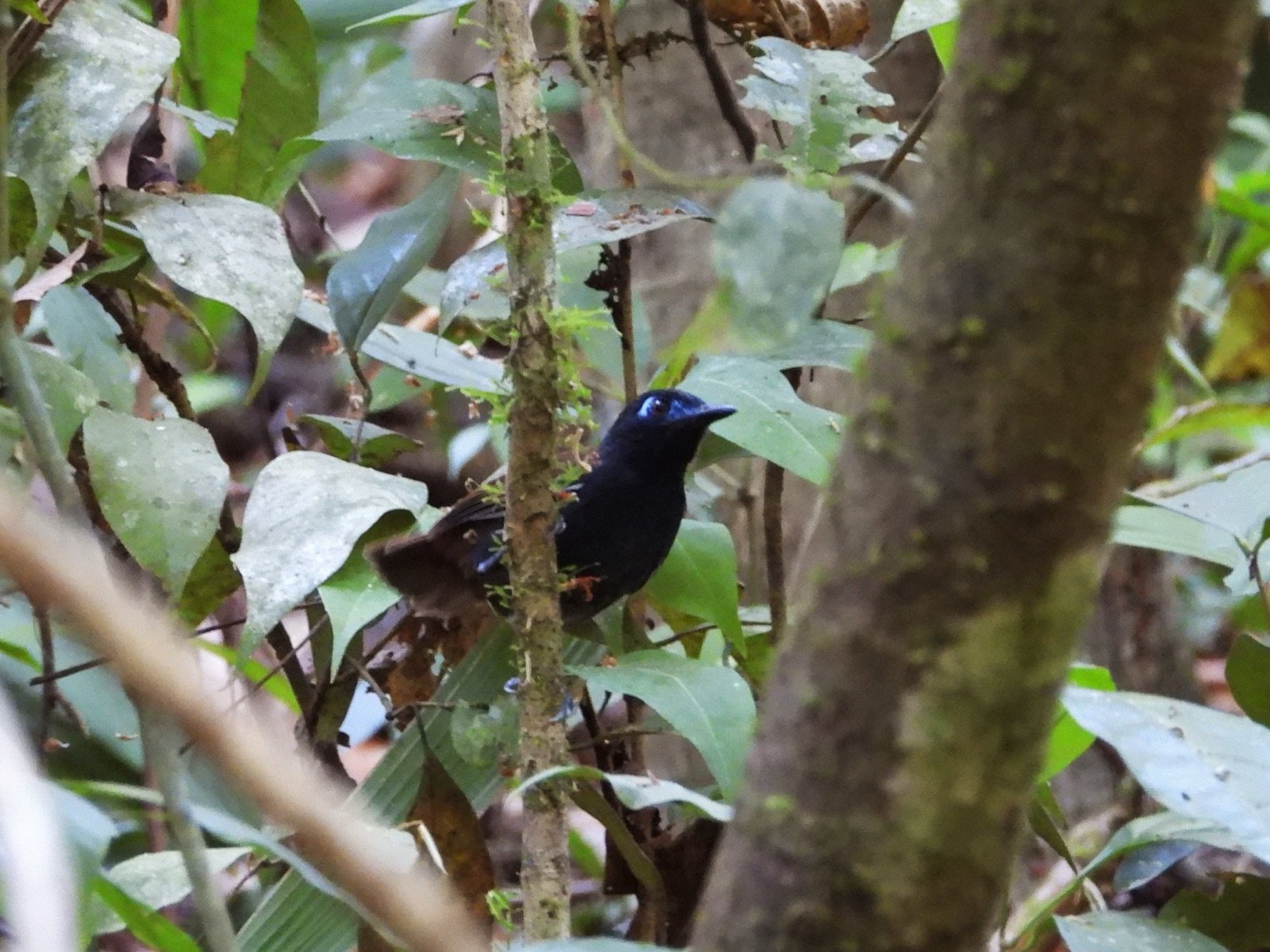
Family Thamnophilidae
Chestnut-backed Antbird
Poliocrania exsul
In Spanish: Hormiguero Dorsicastaño
- Resident
A small, whistling understory antbird of both slopes, easy to see at Carara.
The Chestnut-backed Antbird (Hormiguero Dorsicastaño) is a small, chunky bird of the wet forest understory, about 14 to 15 cm long, with a short tail. In Costa Rica it lives on both the Caribbean and Pacific slopes, up to about 1,200 m.
It is easier to hear than to see in dense forest, yet at Carara National Park a tour found it a common understory bird, fairly unwary and easy to see. Birds walked across the path and perched on it, which makes Carara a friendly place for a beginning birder to meet a first antbird.
On a trip we build, Carara is one of the better places in Costa Rica for antbirds, and this species is a regular part of that story.
How to find it
Start by listening, because it is easier to hear than to see in dense forest. Birders can draw it into view by imitating its whistled song, and it may then show a puffed-up body, drooped wings and a pumping tail. Scan low along forest edges, streams and old treefall gaps. At Carara, a guide on the main loop trail saw it well near an army ant swarm and calls it commonly seen there. Finding a swarm is called the most reliable way to see antbirds.
How to recognise it
Think small, chunky and short-tailed. The bird is about 14 to 15 cm long and weighs roughly 29 g.
Look for a bold eye ring and spots on the wing. Costa Rican experts used exactly these marks, together with the habit of living in pairs, to identify the bird on a decorated artifact from an archaeological project.
The two Costa Rican forms differ in colour below. The Caribbean form has darker chestnut underparts. On the Pacific slope the female of the form occidentalis has more rufous underparts.
When excited, it may show a puffed-up body, drooped wings and a pumping tail. Use the eye ring, the wing spots and the compact shape together rather than leaning on one mark.
What it sounds like
Behaviour and diet
This antbird feeds low in the vegetation, sometimes with other species in mixed flocks. It is usually alone, in pairs or in family groups, and pairs stay together through the year. In northeastern Costa Rica a territory is roughly 1 to 3 hectares.
In a territory dispute, birds pound the tail, sleek the back of the head and sing hard, and both sexes do this.
It is not an obligate army ant follower. It joins a swarm only when one passes through its territory, so a swarm is a good chance to see it.
Where it lives
It lives in the understory of wet forest, especially at edges, along streams and in old treefall gaps. In Costa Rica it occurs up to about 1,200 m elevation.
The nominate form lives on the Caribbean slope. The subspecies occidentalis lives on the Pacific slope of western Costa Rica. Its song has also been recorded in the Gandoca-Manzanillo and Sixaola area of the Caribbean southeast.
When to see it
Breeding has been recorded between April and November in Costa Rica and Panama.
Similar birds
Dusky Antbird is another antbird seen with it at Carara. Dusky Antbird favors second growth at the park edge, while Chestnut-backed stays in the forest understory.
Names and lore in Costa Rica
Costa Ricans use the AOCR name Hormiguero Dorsicastaño. Other Spanish names are hormiguero de lomo castaño and hormiguerito dorsicastaño.
A Costa Rican museum identified this bird on a decorated artifact, and noted that the artifact's sound is very like the bird's song.
Status and conservation
The AOCR list marks it as R, a resident, and the IUCN rates it Least Concern, meaning no significant threats to survival.
Photography tips
An army ant swarm is the best chance for a clear view, since the bird joins swarms that pass through its territory. A Costa Rica trip account lists it among the birds that visit swarms. Imitating its whistled song can bring it into the open, and at Carara birds have perched on the path.
How we know this 17 sources, each read on the date shown
- Wikipedia read 2026-11-04
https://en.wikipedia.org/wiki/Chestnut-backed_antbird - Birda read 2026-11-04
https://app.birda.org/species-guide/16162/Chestnut-backed_Antbird - Cornell Birds of the World read 2026-11-04
https://birdsoftheworld.org/bow/species/chbant1/cur/behavior - EcoRegistros read 2026-11-04
https://www.ecoregistros.org/ficha/Poliocrania-exsul - Museo Nacional de Costa Rica read 2026-11-04
https://www.museocostarica.go.cr/nuestro-trabajo/investigaciones/historia-natural/gandoca-manzanillo-y-sixaola/ - Animalia.bio (from Wikipedia) read 2026-11-04
https://animalia.bio/chestnut-backed-antbird?taxonomy=3319 - Wikipedia read 2026-11-04
https://en.wikipedia.org/wiki/Chestnut-backed_Antbird - Field Guides Birding Tours read 2026-11-04
https://fieldguides.com/triplists/cos16.html - Birding Craft read 2026-11-04
https://birdingcraft.com/wordpress/2013/05/03/carara-can-be-great-for-antbirds/ - White Noise Costa Rica read 2026-11-04
https://whitenoisecostarica.com/wildlife-birding-wildlife-birding-manuel-antonio/ - Wikipedia (es) read 2026-11-04
https://es.wikipedia.org/wiki/Poliocrania_exsul - Museo Nacional de Costa Rica read 2026-11-04
https://www.museocostarica.go.cr/divulgacion/articulos-educativos/fauna-y-arqueologia/ - JungleDragon read 2026-11-04
https://www.jungledragon.com/specie/19871/chestnut-backed_antbird.html - ScienceDirect (Biological Conservation) read 2026-11-04
https://www.sciencedirect.com/science/article/abs/pii/S0006320715000361 - Animalia.bio read 2026-11-04
https://animalia.bio/chestnut-backed-antbird - Birds of the World read 2026-11-04
https://birdsoftheworld.org/bow/species/chbant1/cur/introduction - Birds Outside My Window read 2026-11-04
https://www.birdsoutsidemywindow.org/2026/02/11/they-follow-the-army-ants/