Family Passerellidae
Chipping Sparrow
Spizella passerina
In Spanish: Chimbito Común
- A
A rare vagrant sparrow here, easy to mistake for Clay-colored.
The Chipping Sparrow (Chimbito Común, Spizella passerina) is not a bird to plan a day around. The official Costa Rican bird list ranks it as A, meaning accidental: a rare vagrant, not a resident and not a regional endemic.
Sightings are scarce, and it is unknown whether it breeds or follows any migration pattern in the country. A Costa Rican birding blog says very few reach us, or very few get found, and that many fields and pastures have never been birded.
That is what makes a record exciting. A bird in the Talamanca mountains in December 2021 was called the country's first twitchable one, a good reminder that careful looking at small sparrows can pay off.
How to find it
Finding one here is a matter of luck and patience. Birders hunting vagrant sparrows in Costa Rica are advised to check open fields and pastures, many of which have never been birded. Go through every flock of small sparrows slowly. Listen for the thin chip or the sharp tseet when a bird flushes. Check the lores and rump on any odd pale sparrow.
How to recognise it
Any bird that reaches Costa Rica is most likely in nonbreeding plumage, which looks duller than the breeding look. These marks describe the species in general, not Costa Rican birds.
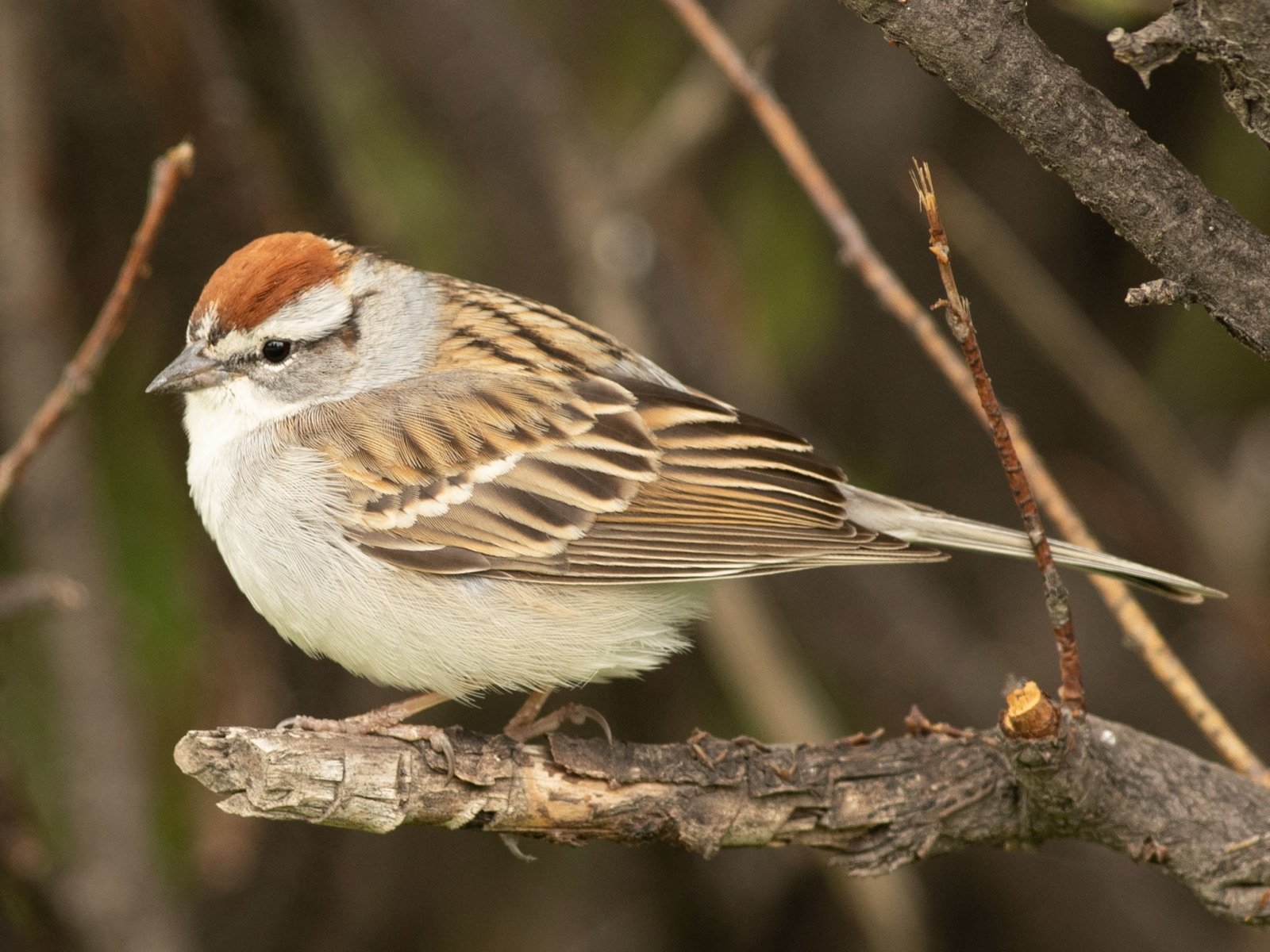
The crown is brown with black streaks and a gray center stripe. The eye lines and wing bars fade. The bill turns pinkish.
Two checks matter most on a dull bird. A dark line runs through the lores, the space between eye and bill. The rump is gray, not brown. There is no prominent malar stripe.
What it sounds like
Behaviour and diet
Range-wide, this sparrow eats seeds all year, and insects make up a large part of the diet in the breeding season.
Outside the breeding season it forages in flocks of about 25 to 50 birds, sometimes mixed with other sparrows. The flock waits in trees, then drops one by one into the grass to feed. When flushed it flies up to a tree or other high perch to look around.
Where it lives
Records are single events, not reliable sites. Two birds were recorded in the Central Valley at Valle del Sol, San José, on 2 October 2007. One was seen at Calle Víquez, a hotspot close to San José, but it was either a one day wonder or not refound. In December 2021 one was reported at an organic farm in the Talamanca mountains.
When to see it
Costa Rican birders say rare and vagrant birds can turn up in any month, and November and December seem best for lost birds, including sparrows. That is said about vagrants in general, not this sparrow alone. Past records fall in September and October (Valle del Sol on 2 October 2007, Calle Víquez in an October 2023 post) and December 2021 in Talamanca, linked to a cold front.
Similar birds
Clay-colored Sparrow is also an accidental visitor to Costa Rica, and one has been reported near Jacó. The Chipping Sparrow has dark lores, a gray rump and no prominent malar stripe. The Clay-colored has pale lores, a clear malar stripe, a broader pale eyebrow, a stronger gray nape and a brownish rump. Dull Chipping Sparrows can also resemble Brewer's Sparrow, and the gray rump is again the check.
Names and lore in Costa Rica
The Costa Rican Spanish name is Chimbito Común. Names used elsewhere include Chingolo Cejiblanco, Gorrión Cejas Blancas and Gorrión Coronirrufo, and these are not specific to Costa Rica.
Status and conservation
The official Costa Rican bird list ranks the Chipping Sparrow as A, accidental, and the National Museum lists it among species of accidental or uncertain status; IUCN range data treat Costa Rica as a vagrant country.
Photography tips
Open fields and pastures are the places to check for vagrant sparrows, and many are unbirded. Outside the breeding season the species is often easy to notice and flushed birds fly to a high perch, which can offer a view.
How we know this 14 sources, each read on the date shown
- Lista Oficial de las Aves de Costa Rica (AOCR) read 2026-11-04
https://listaoficialavesdecostarica.wordpress.com/lista-oficial/lista-oficial-online/ - Museo Nacional de Costa Rica read 2026-11-04
https://www.museocostarica.go.cr/nuestro-trabajo/investigaciones/historia-natural/gam/aves/ - Kiddle (Spanish Wikipedia text) read 2026-11-04
https://ninos.kiddle.co/Chimbito_com%C3%BAn - Cornell Birds of the World read 2026-11-04
https://birdsoftheworld.org/bow/species/chispa/cur/foodhabits - Audubon Field Guide read 2026-11-04
https://www.audubon.org/field-guide/bird/chipping-sparrow - National Geographic read 2026-11-04
https://www.nationalgeographic.com/animals/birds/facts/chipping-sparrow - Audubon Field Guide read 2026-11-04
https://www.audubon.org/field-guide/bird/clay-colored-sparrow - Avibase read 2026-11-04
https://avibase.bsc-eoc.org/species.jsp?avibaseid=37E9CCDA7A4B06ED - Birding Craft read 2026-11-04
http://birdingcraft.com/wordpress/2024/11/27/its-rare-bird-time-in-costa-rica/ - Birding Craft read 2026-11-04
https://birdingcraft.com/wordpress/2023/10/03/october-the-most-exciting-month-for-birding-in-costa-rica/ - Birding Craft read 2026-11-04
https://birdingcraft.com/wordpress/2021/ - Recent records of new and rare bird species in Costa Rica (ResearchGate) read 2026-11-05
https://www.researchgate.net/publication/236176245_Recent_records_of_new_and_rare_bird_species_in_Costa_Rica - Featherbase (IUCN 2025 data) read 2026-11-05
https://www.featherbase.info/en/species/spizella/passerina - GBIF read 2026-11-05
https://www.gbif.org/species/2492109