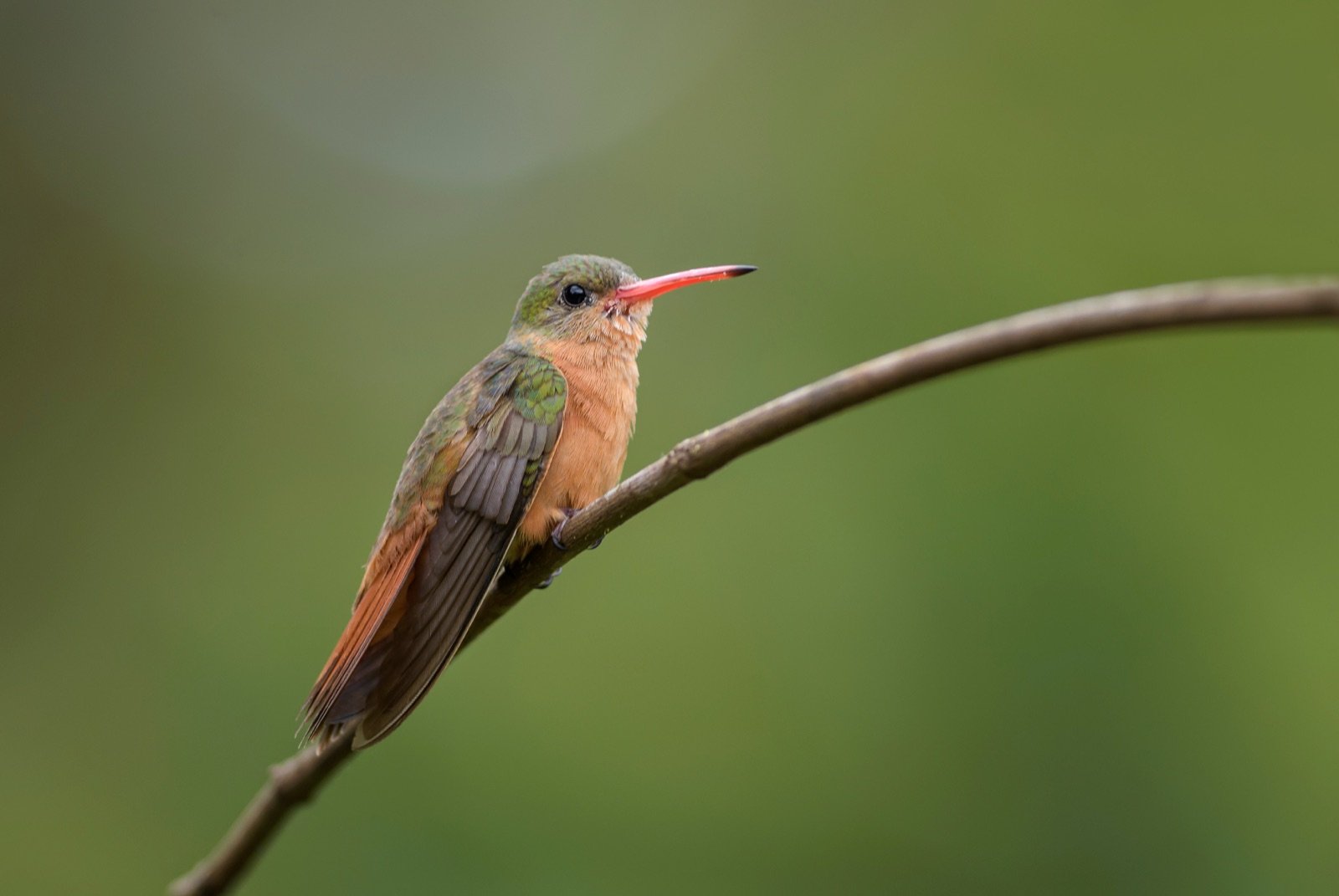
 Cinnamon Hummingbird
Family Trochilidae
Cinnamon Hummingbird
Amazilia rutila
In Spanish: Colibrí Canelo (Gurrión)
- Resident
Cinnamon belly, rufous tail, red bill: a hummingbird of the northern Pacific.
The Cinnamon Hummingbird (Colibrí Canelo, Amazilia rutila) is the only Costa Rican hummingbird with a uniformly cinnamon belly and a rufous tail. That makes it easy to name once you get a good look at it in the light.
It is a common resident of the lowlands and foothills on the northern Pacific slope, and its range reaches south to near Orotina and the Tárcoles river. Costa Rica is the southern end of a range that runs along the Pacific slope from Mexico into the northwest of the country.
On a trip we build, it is a bird to look for in Guanacaste and around Carara, wherever flowering bushes and trees are in bloom.
How to find it
Check flowering bushes and trees in the dry lands of Guanacaste, where it shares them with Canivet's Emerald and Plain-capped Starthroat. Guanacaste sites are described as more reliable than Carara. Near Carara, the dry forest of the Guácimo Road area is suggested, again alongside Plain-capped Starthroat. Flowering porterweed near Carara is also good, and Steely-vented, Ruby-throated and Rufous-tailed Hummingbirds visit it too. A tree in red flower is worth watching, because a feeding bird may dart out to chase off a rival.
How to recognise it
Start with size and colour. It is a medium sized hummingbird, about 9.5 cm long.
Adults are bronzy green above, with a uniformly cinnamon belly and a rufous tail. The throat is paler than the rest of the underparts. Females tend to be paler below than males.
The bill tells you the sex. The male has a red bill with a black tip. The female's upper bill is mostly black, with red only at the base and along the ridge.
Pure Cinnamon has all-rufous underparts, while Rufous-tailed has a green breast and gray belly.
What it sounds like
Behaviour and diet
It drinks nectar from many flowering trees, shrubs and epiphytes, and it also eats insects. It defends feeding territories around flowering plants. Across its range it chases other hummingbirds, bees and butterflies away from its flowers.
It usually feeds from the understory to mid-story but also visits taller flowering trees. One birder watched it flit between flowers, perch under the leaves, then dart out after another hummingbird. Outside the breeding season it is solitary, and males court by flying in a U-shaped arc in front of the female.
Where it lives
In Costa Rica it lives in the canopy and edges of deciduous forest, old second growth, brushy savanna and gallery forest. It is a bird of the lowlands and foothills on the northern Pacific slope.
It climbs to about 500 m or more on nearby mountain slopes. West of the Central Valley it reaches 1000 m, where it is regular to Grecia and occasional to San José. It is accidental on the Caribbean slope, with records from the Reventazón Valley. Across its whole range it lives from sea level to about 1,600 m.
When to see it
It does not migrate and is a year-round resident in northern Costa Rica. It breeds from December to May or June, building a small cup nest covered in lichen and held with spider web, 1 to 5 m up.
Similar birds
Rufous-tailed Hummingbird is the usual mix-up. A visitor first took a Cinnamon for one, since it is the most commonly seen hummingbird in Guanacaste, until the black-tipped red bill and reddish underparts gave it away. Seen only from behind, Cinnamon can also be mistaken for Rufous-tailed or Buff-bellied, which show a green throat and chest from the side or front.
Names and lore in Costa Rica
Costa Rican natural history sites list the common names colibrí, gurrión and amazilia canela for this bird. The AOCR name is Colibrí Canelo.
Status and conservation
The AOCR list marks it as a resident (R), and IUCN rates it Least Concern.
Photography tips
Watch a flowering tree or bush and wait. A feeding bird often returns to the same blooms, and one birder saw it come into a red-flowering tree where it could be photographed. Late afternoon has produced a nesting bird on a February tour.
How we know this 16 sources, each read on the date shown
- Aves de Costa Rica read 2026-11-04
https://avesdecostarica.com/Amazilia-rutila.html - Birda read 2026-11-04
https://app.birda.org/species-guide/3580/Cinnamon_Hummingbird - Wikipedia (via iNaturalist) read 2026-11-04
https://inaturalist.ca/taxa/5758-Amazilia-rutila - Cornell Birds of the World read 2026-11-04
https://birdsoftheworld.org/bow/species/cinhum1/cur/introduction - Costa Rica Focus read 2026-11-04
https://www.costaricafocus.com/best-spots-for-spotting-hummingbirds-in-costa-rica/ - Costa Rica Focus read 2026-11-04
https://www.costaricafocus.com/birding-guanacaste-costa-rica-a-complete-guide/ - Birding Field Guides read 2026-11-04
http://birdingfieldguides.com/wp/how-many-hummingbirds-can-you-see-in-costa-rica/ - Birdingcraft read 2026-11-04
http://birdingcraft.com/wordpress/2013/08/01/how-many-hummingbird-species-can-you-see-in-costa-rica-in-just-one-day-a-plan-of-attack/ - BirdForum read 2026-11-04
https://www.birdforum.net/threads/guanacaste-province-costa-rica-hummingbirds.31183/ - Bird Watching HQ read 2026-11-04
https://birdwatchinghq.com/hummingbirds-of-costa-rica/ - Meadowhawk blog read 2026-11-04
https://meadowhawk.wordpress.com/2017/05/28/costa-rica-birding-around-the-resort/ - Eagle-Eye Tours read 2026-11-04
https://www.eagle-eye.com/blog/costa-rica-sampler-trip-report-feb-16-27-2026/ - Wikipedia read 2026-11-04
https://en.wikipedia.org/wiki/Cinnamon_hummingbird - Earthlife read 2026-11-04
https://earthlife.net/cinnamon-hummingbirds/ - Macaulay Library read 2026-11-04
https://macaulaylibrary.org/asset/615931128 - Reflections of the Natural World read 2026-11-04
https://reflectionsofthenaturalworld.com/2024/08/10/cinnamon-hummingbird/