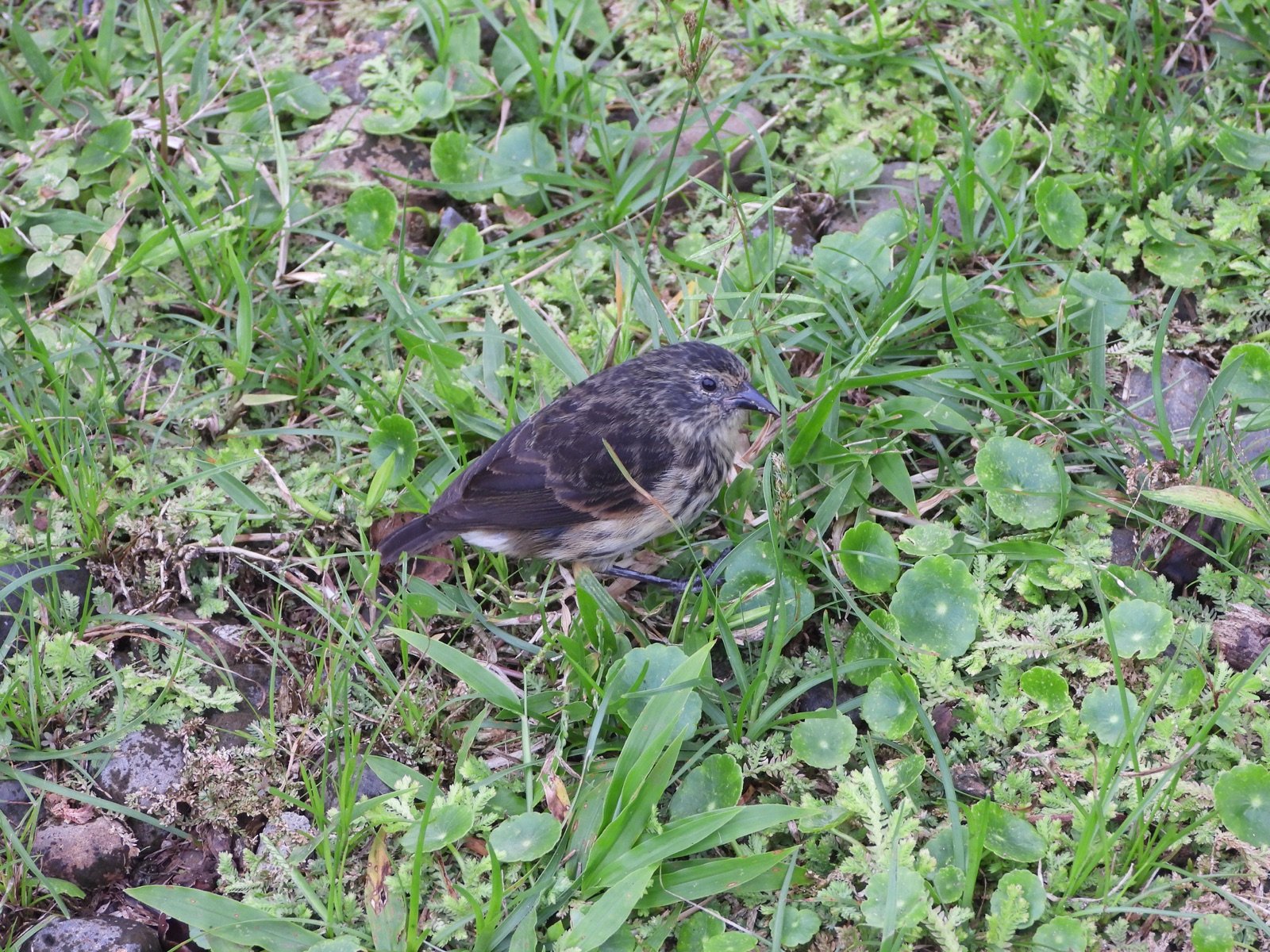
Family Thraupidae
Cocos Finch
Pinaroloxias inornata
In Spanish: Pinzón de la Isla del Coco
- Resident
- Regional endemic
Found only on Cocos Island, 580 km out in the Pacific.
The Cocos Finch lives on one island and nowhere else in the world. Cocos Island is a Costa Rican Pacific island roughly 580 km from the mainland, and all of it is protected as Isla del Coco National Park, created in 1978.
It is the only one of Darwin's finches that is not native to the Galápagos, and it belongs to the tanager family, Thraupidae. It is also one of three bird species endemic to Cocos Island, with the Cocos Cuckoo and the Cocos Flycatcher.
On the island it is the most abundant land bird, so it is easy to find once you are there. Visitors meet it at the Wafer Bay ranger station, where a few finches work the porch.
How to find it
Start at the Wafer Bay ranger station on Cocos Island, where visitors meet the finch. A few gather on the porch rafters and rails during coffee breaks. They hop closer to food, so they let people get very near. Away from the station, look in the lowlands first, where it is more abundant, though it turns up at all elevations. Because it is the most abundant land bird on the island, it is easy to find once you are ashore.
How to recognise it
Adult male: entirely black.
Female: dark brown above, buff below, with dark streaking.
Bill: slightly curved and pointed, long and thin compared with other Darwin's finches.
Size: adults measure about 12 cm.
Young birds look like the adult female but have a yellow bill. Now and then a black male with a yellow bill is seen, so a yellow bill does not always mean a female-like youngster.
As a beginner you can lean on one reassuring fact: it is the only finch on its island, so there is little to confuse it with.
Behaviour and diet
Cocos Finches move about restlessly in pairs or small groups. Each bird tends to stick to its own favourite feeding method: one may hunt insects while another takes fruit or nectar, and researchers think they learn this by watching each other.
The nest is a loose ball of grass stems, twigs and dry leaves, with a side entrance. It sits at the tip of a branch, usually 2 to 9 m up. Breeding runs from January to May, although some nesting happens all year.
Where it lives
The finch uses every habitat on Cocos Island, including coastal hibiscus thickets, closed forest and woodland. It is seen at all elevations but is more abundant in the lowlands, and it also uses disturbed vegetation.
In Costa Rica it is found only on Cocos Island, in the Pacific. Its whole range is only about 25 square km, and the entire island lies within Isla del Coco National Park.
When to see it
The finch lives on Cocos Island all year and does not migrate. Breeding happens year-round, with a peak from January to May.
Similar birds
The Cocos Finch has no lookalikes on its island, because it is the only finch there. Its long, thin, curved bill sets it apart from other Darwin's finches. It resembles the Galápagos finches, but it feeds as a generalist while those species are specialists, so behaviour tells them apart.
Names and lore in Costa Rica
In Costa Rica the bird goes by Pinzón de la Isla del Coco. Other Spanish names are Pinzón de Darwin de la Cocos and Pinzón de Cocos.
Status and conservation
The AOCR lists it as a resident endemic (R-END), and it is rated Vulnerable because of its very small range, though it is common, with an estimated 6,000 to 15,000 mature birds.
Photography tips
The finches at the Wafer Bay ranger station hop closer to food and let people get very near, so the porch rafters and rails are the place to try. Watch for restless pairs or small groups moving through the trees elsewhere.
How we know this 12 sources, each read on the date shown
- Wikipedia read 2026-11-04
https://en.wikipedia.org/wiki/Cocos_finch - Wikipedia (Spanish) read 2026-11-04
https://es.wikipedia.org/wiki/Pinaroloxias_inornata - Aves de Costa Rica read 2026-11-04
https://avesdecostarica.com/Pinaroloxias-inornata.html - Birda read 2026-11-04
https://app.birda.org/species-guide/36448/Cocos_Finch - Museo Nacional de Costa Rica read 2026-11-04
https://www.museocostarica.go.cr/nuestro-trabajo/investigaciones/historia-natural/isla-del-coco/aves/ - Animalia read 2026-11-04
https://animalia.bio/cocos-finch - Sea Save read 2026-11-04
https://seasave.org/cocos-island-finches-darwins-forgotten-bird/ - Oiseaux-Birds read 2026-11-04
https://www.oiseaux-birds.com/card-cocos-finch.html - iNaturalist (Wikipedia text) read 2026-11-04
https://www.inaturalist.ca/taxa/10367-Pinaroloxias-inornata - ResearchGate (feeding specialization study) read 2026-11-04
https://www.researchgate.net/publication/7185663_Behavioral_feeding_specialization_in_Pinaroloxias_inornata_the_Darwin%27s_Finch_of_Cocos_Island_Costa_Rica - Endemic Costa Rica student site read 2026-11-04
https://8thhallmarktrip.wixsite.com/endemiccostarica/-cocos-island-finch - Visit Cocos Island read 2026-11-04
http://www.visitcocosisland.com/cocos-finch/