Family Anatidae
Common Pochard
Aythya ferina
In Spanish: Porrón Europeo
- A
An Old World diving duck, recorded in Costa Rica only once, near Turrialba.
The Common Pochard is not a bird you plan a trip around. The official Costa Rican list gives it status code A, the accidental or vagrant category, so it is neither a resident nor a regular visitor.
Its story here is short and rather lovely. The first documented Costa Rican bird was a first-year duck found at Lago Angostura, a reservoir near Turrialba, in April 2023, and guides from a Turrialba-area lodge spotted it on 21 April.
For a beginning birder it is a good lesson in careful looking: the bird was first taken for something else, and it took local guides to notice what it really was.
How to find it
Finding one is a matter of luck and patience, since it is a one-off vagrant. Angostura Lake is the place that has produced it. It is the largest water body near Turrialba, made by a dam on the Reventazón River, and a good site for migratory birds and wintering waterfowl. Scan any mixed groups of diving ducks carefully. Compare each bird with the head colour and bill pattern described above. The drive from the Central Valley to Turrialba took about an hour and 45 minutes for one group, over scenic roads through pasture on volcanic slopes above Cartago.
How to recognise it
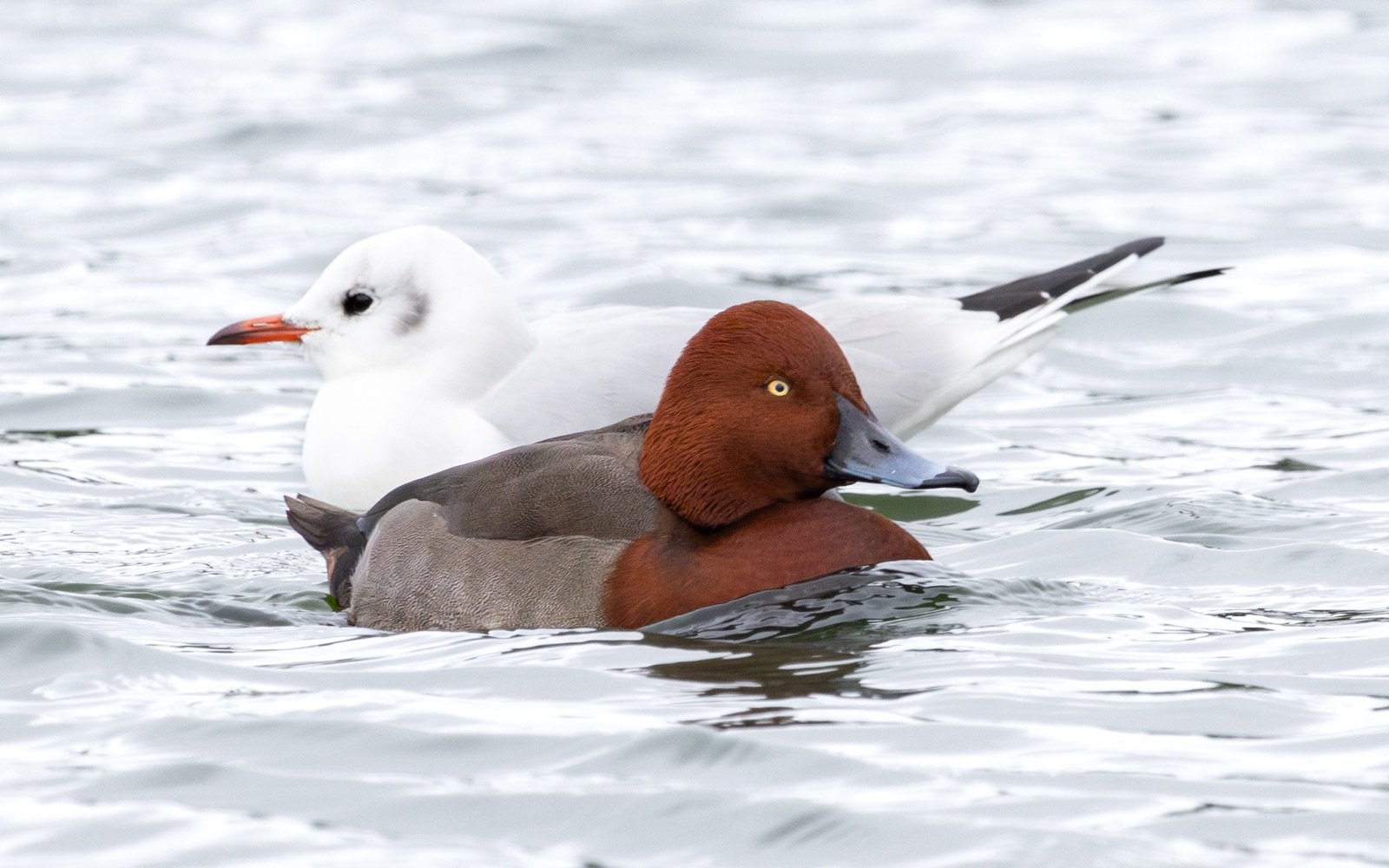
The breeding male has a rusty red head and neck, a black chest and rear, and a pale grey body. His bill is dark with a pale grey band, and his eye is red.
The female is brown on the head, neck and chest, with a greyer brown rear. She has a faint pale line behind the eye, a narrower grey bill band and brown eyes.
In both sexes the head is triangular with a sloping profile. In flight there is no white wing bar, only a broad, diffuse grey stripe on the flight feathers. These are range-wide field marks, and the Costa Rican bird was a first-year bird.
What it sounds like
Behaviour and diet
The Common Pochard is a diving duck. It eats aquatic plants, seeds and small invertebrates, and it can dive up to about 3 meters. It feeds mostly by diving, using its feet to propel it, and takes food from the bottom.
It is sociable and often forms large winter flocks, often mixed with other diving ducks. Those are habits of the species across its range. A lone unusual duck among other diving ducks is exactly the kind of bird that rewards a slow scan through the flock.
Where it lives
Outside the breeding season, across its range, the species uses lakes, other open freshwater, slow rivers, brackish marshes, lagoons and sheltered bays.
In Costa Rica the only documented bird was at Lago Angostura, a reservoir near Turrialba. Open, still water in that part of the country is therefore where the species has actually appeared.
When to see it
The only documented Costa Rican Common Pochard was found on 21 April 2023, in the northern spring.
Similar birds
The North American Redhead looks very similar but is larger. The male Pochard has a red eye where the Redhead's is yellow, and the two have different bill patterns. The female Pochard has whiter flanks. The male Canvasback is larger and paler, with a flatter forehead and a much longer, all dark bill. The 2023 Costa Rican bird was first thought to be a Redhead, a Canvasback or a hybrid of the two, until local guides noticed that the head colour and bill pattern fit a Common Pochard.
Names and lore in Costa Rica
The Spanish name on the Costa Rican official list is Porrón Europeo, and Spanish sources also call the species porrón común. The official list calls the Redhead Porrón Americano (Pato Cabeza Roja) and the Canvasback Porrón Picudo.
Status and conservation
The official Costa Rican list gives it status A, accidental or vagrant, and globally the species is rated Vulnerable.
Photography tips
Chasers of the 2023 pochard found that jet skis and kayaks on the open water kept scaring the ducks. Searching the water between the water hyacinths and from the lake overlook was suggested.
How we know this 14 sources, each read on the date shown
- Lista Oficial de las Aves de Costa Rica (AOCR) read 2026-11-04
https://listaoficialavesdecostarica.wordpress.com/lista-oficial/lista-oficial-online/ - EcoRegistros read 2026-11-04
https://www.ecoregistros.org/ficha/Aythya-ferina&idusuario=1372&idlugar=8304&idpais=33&idprovincia=450 - Les Oiseaux read 2026-11-04
https://www.les-oiseaux.com/en/common-pochard.htm - Sierwatervogels bird guide read 2026-11-04
https://www.sierwatervogels.nl/en/birdguide/common-pochard - BirdLife International read 2026-11-04
https://www.birdlife.org/news/2024/10/18/common-pochard/ - Birding Craft (Costa Rica Living and Birding) read 2026-11-04
https://birdingcraft.com/wordpress/2023/04/24/chasing-common-pochards-in-costa-rica/ - Birding Craft (Costa Rica Living and Birding) read 2026-11-04
https://birdingcraft.com/wordpress/page/7/ - Wikipedia (Spanish) read 2026-11-04
https://es.wikipedia.org/wiki/Aythya_ferina - Rancho Naturalista (trips page) read 2026-11-04
https://ranchonaturalista.com/birdwatching/trips/ - Birdingcraft read 2026-11-05
http://birdingcraft.com/wordpress/2023/04/ - Birdingcraft read 2026-11-05
https://birdingcraft.com/wordpress/2023/12/ - Wikipedia, List of birds of Costa Rica read 2026-11-05
https://en.wikipedia.org/wiki/List_of_birds_of_Costa_Rica - Pacuare Outdoor Center read 2026-11-05
https://pacuareoutdoorcenter.com/2023/12/22/lake-angostura/ - Asturnatura read 2026-11-05
https://www.asturnatura.com/especie/aythya-ferina