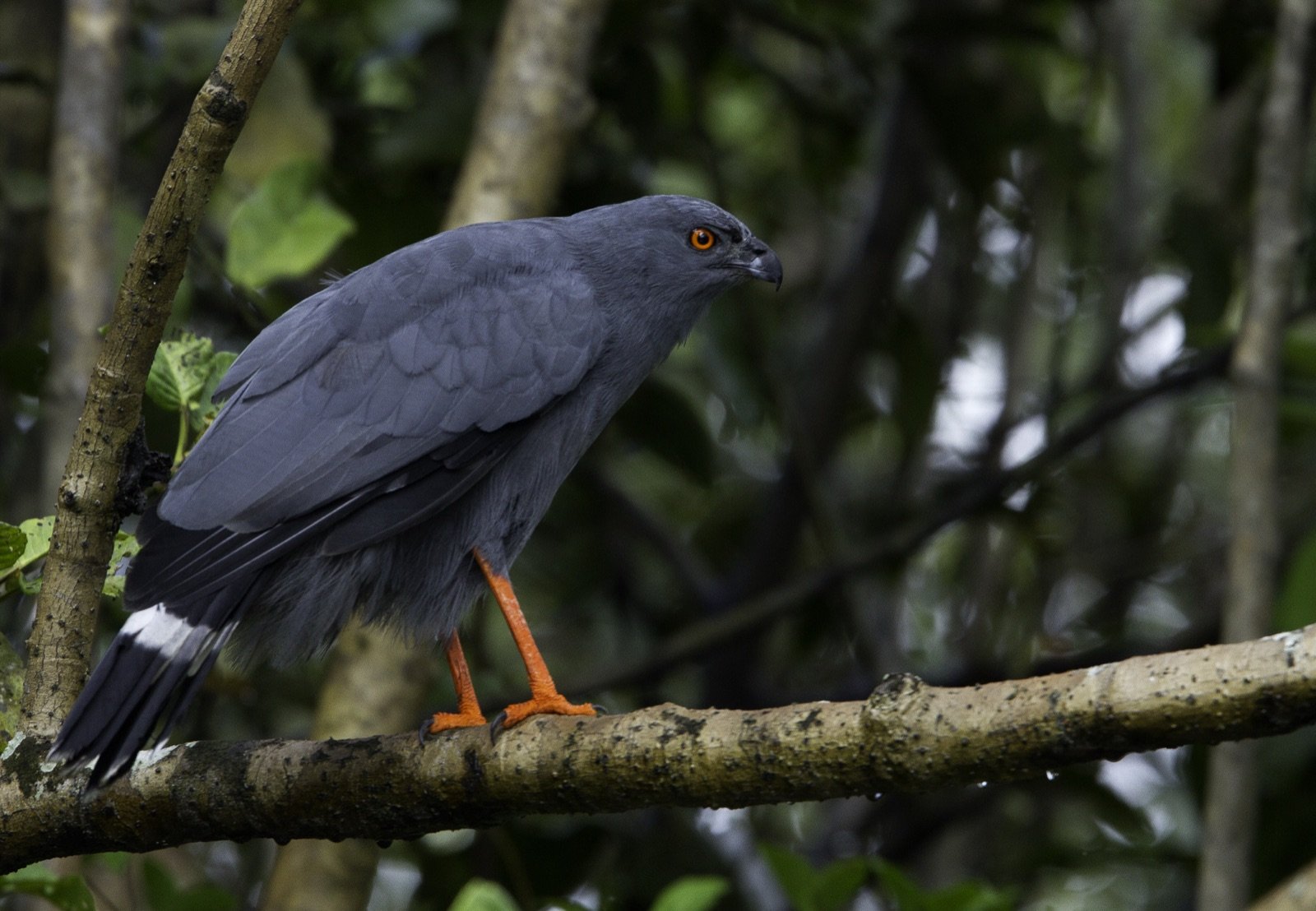
 Crane Hawk
Family Accipitridae
Crane Hawk
Geranospiza caerulescens
In Spanish: Gavilán Ranero (Caracolero)
- Resident
A long-legged, red-eyed hawk that reaches into tree holes and bromeliads.
The Crane Hawk is one of the odd ones among Costa Rica's raptors. Its tarsal joints bend both forwards and backwards, so it can push its long orange legs into tree holes, crevices and bromeliads to pull out hidden prey.
In Costa Rica it is a local, uncommon resident of the lowlands on both the Caribbean and Pacific slopes, so it rewards patience. On a trip we build around Carara and the Central Pacific, it is one of the raptors worth watching for along the quieter roads.
How to find it
Look first along water. One Costa Rica recordist most often finds it in tree branches that overhang a stream or pond, and sometimes on the ground checking a puddle for food. Along the entrance road of a lodge near Carara, a birding guide suggests watching for it flopping through the canopy or near the ground, and it sometimes soars. A perched bird is recognisable by its shape, posture and orange legs. Because it soars rarely and is usually seen flying low overhead or perched at the forest edge, scan branches rather than the sky, and use the white wing band to confirm one in flight.
How to recognise it
Costa Rican adults are slate black with two white bands across the tail. The eye is red, the bill is dark and the legs are orange.
It is a slim hawk with a small head and very long legs, about 48 cm long. Loose, fluffy feathers can make it look stockier than it is.
In flight, a curved white band across the outer wing feathers shows clearly from below. It is the key mark.
Young birds are mostly slate black with a white forehead, eyebrow and throat. The belly, thighs and undertail are barred whitish to buff.
Birds in the south of Costa Rica tend to be paler overall and sometimes show light barring on the underparts toward the rear.
What it sounds like
Recording: Jennifer Rycenga, CC BY 4.0, source, read 4 Nov 2026.
Behaviour and diet
The Crane Hawk searches epiphytes methodically. It flaps or walks along branches somewhat like a chachalaca, then flies from tree to tree, probably hunting small amphibians. Its flight is slow and heavy, and when it stops it walks with its legs upright and its body almost horizontal.
In Costa Rica its prey includes lizards, frogs, mice and nesting birds taken from tree cavities and epiphytes. Across its whole range it sometimes pulls small birds such as parrots out of nests. In display it flaps and soars in tight circles, then climbs steeply and drops sharply.
Where it lives
In Costa Rica it lives near water in forests and wooded swamps in the lowlands. It is a local, uncommon resident on both the Caribbean and Pacific slopes, and in some places it reaches about 500 m elevation.
Across its wider range it favours scrub or dry deciduous woodland with small streams or pools, and the ranch lands of northwestern Costa Rica are cited as an example where it is most common.
When to see it
In Costa Rica it breeds mainly in the dry season and early in the rainy season.
Similar birds
From a distance it can be mistaken for the Common Black Hawk, since both are black with white tail bars. Costa Rican Crane Hawks show a few white bars under the tail, and white bars under the wings appear only in flight. Up close, look for the dark bill, red eyes and long orange legs of the Crane Hawk.
Names and lore in Costa Rica
Costa Rican sources list the bird as Gavilán Ranero, and a Costa Rican wildlife-rescue guide calls it Gavilán Zancón. Other Spanish names elsewhere include Gavilán Patas Largas and Azor Zancón. A review of Spanish raptor names records Gavilán Ranero as the name used in Costa Rica, Guatemala and Mexico, and recommends Gavilán Patas Largas because it describes the long legs.
Status and conservation
The AOCR lists it as a resident, and the IUCN classes it as Least Concern, although the population trend is listed as decreasing.
Photography tips
Watch branches that overhang streams and ponds, where it is most often found. A photographer at Tárcoles had one come very close along a country road while it hunted from tree to tree. It usually flies low overhead or perches in a tree at the forest edge, so look for chances at eye level or just above.
How we know this 18 sources, each read on the date shown
- Aves de Costa Rica (Stiles guide data) read 2026-11-04
http://www.avesdecostarica.com/Geranospiza-caerulescens.html - The Tico Times read 2026-11-04
https://ticotimes.net/2024/03/22/costa-rica-birding-meet-the-crane-hawk - Planet of Birds read 2026-11-04
https://planetofbirds.com/accipitriformes-accipitridae-crane-hawk-geranospiza-caerulescens/ - Flickr (Rosa Gamboias) read 2026-11-04
https://www.flickr.com/photos/rgamboias/34709168525/ - Oiseaux.net read 2026-11-04
https://www.oiseaux.net/photos/paul.van.giersbergen/crane.hawk.1.html - Birda read 2026-11-04
https://app.birda.org/species-guide/8639/Crane_Hawk - Fauna Decomisada, Costa Rica (SINAC guide) read 2026-11-04
https://www.faunadecomisada.go.cr/guia-de-especies/aves/accipitridae/geranospiza-caerulescens - Wikipedia read 2026-11-04
https://en.wikipedia.org/wiki/Crane_hawk - Birding Craft read 2026-11-04
https://birdingcraft.com/wordpress/category/costa-rica-bird-finding-guide/ - Birding Craft read 2026-11-04
https://birdingcraft.com/wordpress/2010/09/07/where-are-the-raptors-when-birding-costa-rica/ - Aves de Costa Rica read 2026-11-04
https://www.avesdecostarica.com/Geranospiza-caerulescens.html - UWI St. Augustine Life Sciences read 2026-11-04
https://sta.uwi.edu/fst/lifesciences/sites/default/files/lifesciences/documents/ogatt/Geranospiza_caerulescens%20-%20Crane%20Hawk.pdf - Hawk Mountain, Spanish common names of raptors read 2026-11-04
https://www.hawkmountain.org/download/?id=4958&dl=1 - Flickr (Historia Natural text) read 2026-11-04
https://www.flickr.com/photos/jobando/30376046544 - Regeneración (Universidad de Costa Rica journal) read 2026-11-04
https://regeneratio.uci.ac.cr/index.php/regeneratio/article/view/34 - Animalia.bio read 2026-11-04
https://animalia.bio/crane-hawk?limit=all - Birds of the World read 2026-11-04
https://birdsoftheworld.org/bow/species/crahaw/cur/introduction - Bird Advisors read 2026-11-04
https://www.birdadvisors.com/crane-hawk/