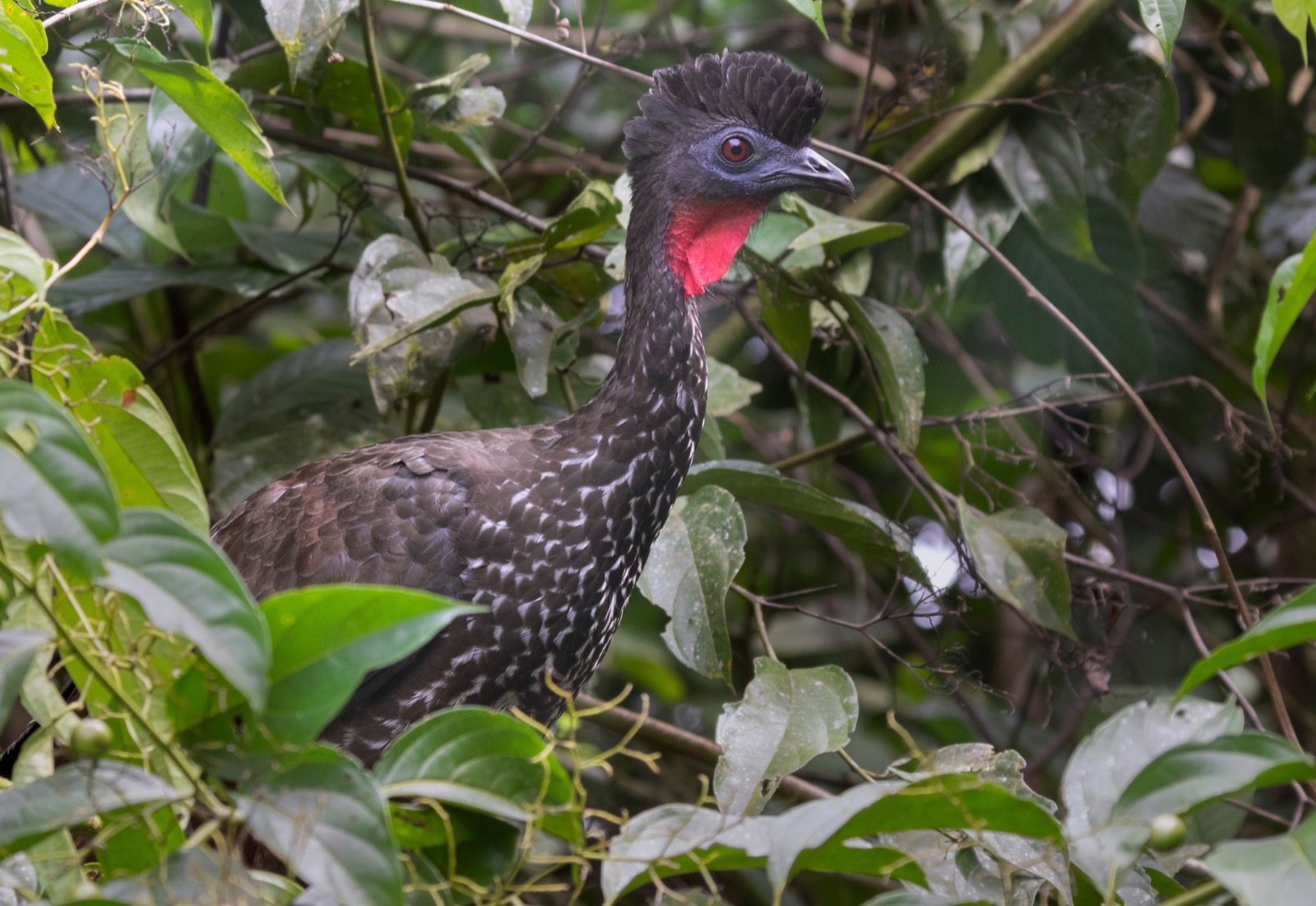
 Crested Guan
Family Cracidae
Crested Guan
Penelope purpurascens
In Spanish: Pava Crestada (Pava Granadera)
- Resident
A big, noisy, turkey-like canopy bird with a red throat flap.
The Crested Guan (Pava Crestada, Penelope purpurascens) is a very large, turkey-like bird with a shaggy crest and a bare red throat flap. It lives on both slopes of Costa Rica, from sea level up to about 1,800 m, and is common near any stretch of forest.
It is easy to find because of its size and its loud honking, and in protected areas without hunting it can be quite approachable, even tame.
Birders meet it at Arenal, where guans turn up on nearly every trail on morning walks, and in the lowlands near Sarapiquí.
How to find it
Start with your ears, because the loud honking makes the guan easy to locate. Then look up into the middle and upper canopy rather than on the ground, since it is rarely seen on the ground and avoids open spaces. It forages mostly early in the morning or at dusk, in pairs or groups of up to 8. Fruiting trees are a good place to wait, such as those near the administration buildings at La Selva. Where there is no hunting, the birds can be quite approachable. When you find one, look for a second bird nearby.
How to recognise it
Think of a turkey that has taken up life in the treetops. Look for these marks:
Very large size, about 86 cm in body length.
Mostly brown plumage.
A shaggy crest.
White streaking on the breast.
A bare red throat flap.
Red eyes, a blackish bill and dull coral-colored legs.
Males and females look alike, so you do not need to sort the sexes. Young birds differ: they have no red throat flap, or only a small one, with brown eyes and reduced white streaking.
What it sounds like
Recording: dylancamachoguzman10, CC0 1.0, source, read 4 Nov 2026.
Behaviour and diet
Crested Guans usually move in pairs or family groups. They feed on fruit and new leaves in the forest canopy and move very nimbly there, even eating upside down on slender branches. They sometimes drop to the ground for fallen fruit and seeds. Guans in a flock tend to follow the leader's flight path from tree to tree, one by one. Breeding in Costa Rica runs from March to June. The nest is a bulky cup of twigs lined with leaves, built in a tree, and the clutch is 2 to 3 whitish eggs.
Where it lives
The guan lives on both slopes of Costa Rica, from sea level up to about 1,800 m. It once ranged from the lowlands up to 1,200 m on the Caribbean slope in places, and up to 1,850 m on the Pacific slope. It prefers mature forest, old secondary forest and gallery forest. It also lives in dry forest: in Santa Rosa National Park it favored forest patches with dense cover and used streamside vegetation as refuge in the dry season. It is absent from deforested areas.
When to see it
Males call loudly at dawn and dusk at the start of the breeding season, which in Costa Rica is given as February or March to June.
Similar birds
Costa Rica has five cracids: Great Curassow, two chachalacas (Plain and Gray-headed), Black Guan and this species. Black Guan is found mainly above 1,200 m and is endemic to Costa Rica and western Panama. It is quiet, calls hardly at all and stays calmer than the Crested Guan when you walk beneath it. At Arenal the Great Curassow is the other big bird, but the guan flies a lot and spends as much time in trees as on the ground, so it is much easier to see.
Names and lore in Costa Rica
In Costa Rica the bird is called pava crestada, pava granadera, or simply "pava" in everyday Tico Spanish. The word pava also means turkey, though guans are not closely related to turkeys.
Status and conservation
It is a resident (R) on the AOCR list, and the IUCN rates it Near Threatened with a decreasing population.
Photography tips
Guans are often watched in pairs or small family groups, so look for a second bird when you find one. In a flock they tend to follow the leader's flight path from tree to tree, one by one. One photographer waited for the lead bird to move, then set up to catch the followers.
How we know this 22 sources, each read on the date shown
- Costa Rica Birding Trips read 2026-11-04
https://www.costaricabirdingtrips.com/cracidae/crested-guan-penelope-purpurascens - Aves de Costa Rica read 2026-11-04
https://avesdecostarica.com/Penelope-purpurascens.html - EcuRed read 2026-11-04
https://www.ecured.cu/Penelope_purpurascens - Área de Conservación Guanacaste read 2026-11-04
https://www.acguanacaste.ac.cr/paginas-de-especies/insectos-2/744-cracidae/6622-i-penelope-purpurascens-i-cracidae - Rothschildia, Área de Conservación Guanacaste read 2026-11-04
https://www.acguanacaste.ac.cr/rothschildia/v1n2/textos/05.html - Foto Diarist (Finca Cántaros) read 2026-11-04
https://fotodiarist.com/2018/06/04/the-noisy-flower-eating-acrobatic-crested-guan/ - El Norte Hoy read 2026-11-04
https://elnortehoycr.com/2021/04/22/conozca-la-pava-granadera-o-crestada-propia-de-nuestros-bosques-de-la-zona-norte/ - Reflections of the Natural World read 2026-11-04
https://reflectionsofthenaturalworld.com/2024/06/24/crested-guan/ - Flickr, Calle Socorro (natural history text) read 2026-11-04
https://www.flickr.com/photos/jobando/28637715430 - Animalia read 2026-11-04
https://animalia.bio/crested-guan - Aves de Costa Rica (avesdecostarica.org) read 2026-11-04
https://www.avesdecostarica.org/cracidae.html - Fauna Decomisada, Costa Rica read 2026-11-04
https://faunadecomisada.go.cr/guia-de-especies/aves/cracidae/penelope-purpurascens - Getting to know birds read 2026-11-04
https://gettingtoknowbirds.blogspot.com/p/crested-guan.html - Flickr (Tim Hopwood) read 2026-11-04
https://www.flickr.com/photos/timjhopwood/32852750583 - Retired in Costa Rica read 2026-11-04
https://www.charliedoggett.net/2024/05/19/guans-on-the-trails/ - EcoRegistros read 2026-11-04
https://www.ecoregistros.org/ficha/Penelope-purpurascens - Tico Times read 2026-11-04
https://ticotimes.net/2023/06/19/costa-rica-wildlife-meet-the-crested-guan - Wikipedia read 2026-11-04
https://en.wikipedia.org/wiki/Crested_guan - Birding Craft read 2026-11-04
https://birdingcraft.com/wordpress/2010/02/12/seeing-curassows-guans-and-chachalacas-when-birding-costa-rica/ - Kiddle (from Wikipedia) read 2026-11-04
https://kids.kiddle.co/Crested_guan - Oiseaux-Birds read 2026-11-04
https://www.oiseaux-birds.com/card-crested-guan.html - Encyclopedia.com (Grzimek's) read 2026-11-04
https://www.encyclopedia.com/environment/encyclopedias-almanacs-transcripts-and-maps/curassows-guans-and-chachalacas-cracidae