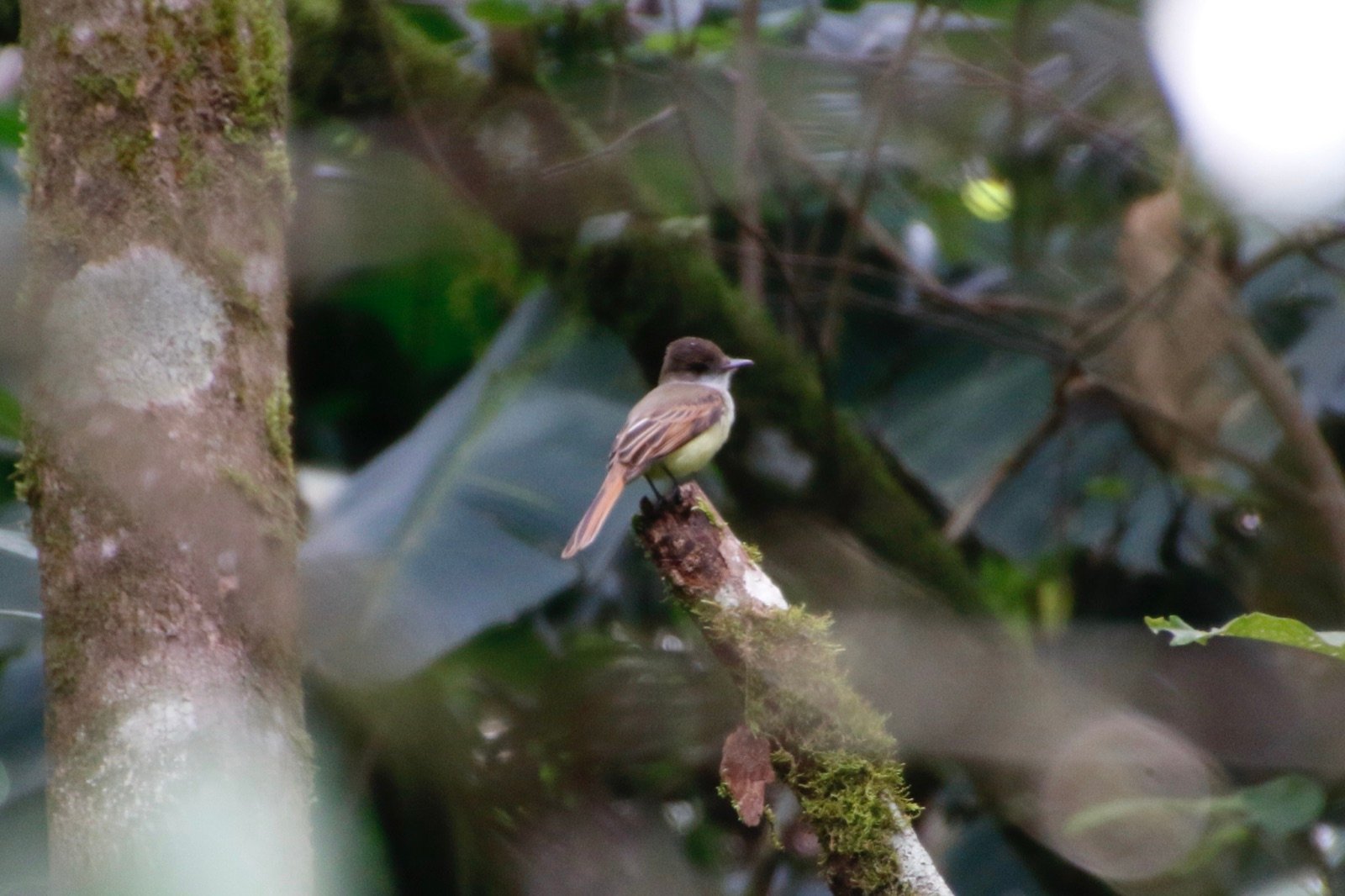
Family Tyrannidae
Dusky-capped Flycatcher
Myiarchus tuberculifer
In Spanish: Copetón Crestioscuro (Tontillo)
- Resident
A small, common flycatcher with a dark cap, yellow belly and a plaintive whistle.
The Dusky-capped Flycatcher is a common resident throughout Costa Rica, on both the Caribbean and Pacific slopes. It is a small Myiarchus flycatcher with a dark cap and a fairly bright yellow belly.
It often slips out of sight inside tree foliage, so a trip with a guide who knows its whistled call is a good way to meet it. It turns up in forest edges, plantations and shaded coffee farms.
How to find it
Start by learning its plaintive whistled call, which pairs use to stay in contact through much of the day, even in midday heat. Seeing it can take patience because it slips out of view inside tree foliage. Check forest edges, openings, plantations and gardens. In the nesting season, look for birds collecting bits of debris from the ground for the nest.
How to recognise it
This is a small Myiarchus flycatcher with a dark brownish to blackish cap, an olive back, a grey throat and chest, and a fairly bright yellow belly. Adults show little rufous in the wings and tail. Range-wide, it is about 18 cm long, weighs roughly 19 to 20 grams, and has a slight crest on its darker head. Young birds are browner above and much paler below than adults, with broad rufous edges on the wing coverts, flight feathers and tail feathers.
What it sounds like
Behaviour and diet
It catches insects in the air and from foliage, and drops to the ground for grasshoppers and spiders. It also eats berries and seeds. Birds are usually alone after nesting, but they pair up in December, during the dry season. It nests in a cavity in a tree or fence post, sometimes in an old woodpecker hole, 1 to 30 m up. Range-wide, it joins mixed-species flocks more often than other Myiarchus flycatchers.
Where it lives
In Costa Rica it lives in the canopy and edges of forest, old and young secondary forest, tree plantations, shaded coffee farms, tall scrub, gallery forest and mangroves. It ranges from the lowlands up to about 1200 m, and in smaller numbers up to 1850 m. It is found throughout the country, on both the Caribbean and Pacific slopes, in fairly open settings as well as wooded ones.
When to see it
It breeds from April to June in Costa Rica, and pairs form in December, in the dry season.
Similar birds
It is much smaller than the other Myiarchus species in Costa Rica, so it is hard to confuse with them. It looks much like the Ash-throated Flycatcher but sounds different, with a whiny whistle against a trilled call, and Ash-throated is only an accidental visitor here.
Names and lore in Costa Rica
In Costa Rica it is called Copetón Crestioscuro, with the nickname Tontillo. One Costa Rican natural history source also lists the name Bobillo.
Status and conservation
The official Costa Rican list gives it the status of resident (R), and it is rated Least Concern by the IUCN and considered common in Costa Rica.
Photography tips
Watch for it on the ground picking up nest material. One Costa Rican page has a photo of it gathering eggshell pieces, which fits this habit.
How we know this 17 sources, each read on the date shown
- Aves de Costa Rica read 2026-11-04
https://www.avesdecostarica.com/Myiarchus-tuberculifer.html - Birda read 2026-11-04
https://app.birda.org/species-guide/17881/Dusky-capped_Flycatcher - LibrePedia (Spanish Wikipedia text) read 2026-11-04
https://librepedia.miraheze.org/wiki/Myiarchus_tuberculifer - Flickr (text from INBio Especies de Costa Rica) read 2026-11-04
https://www.flickr.com/photos/jobando/25507773262 - Spanish Wikipedia read 2026-11-04
https://es.wikipedia.org/wiki/Myiarchus_tuberculifer - Cloudbridge Nature Reserve species list read 2026-11-04
https://www.cloudbridge.org/wp-content/uploads/2020/04/Bird-Species-List-Costa-Rica-13-April-2020.pdf - Contenido Tico read 2026-11-04
https://contenidotico.com/biodiversidad/aves/copeton-crestioscuro/ - Wikipedia read 2026-11-04
https://en.wikipedia.org/wiki/Dusky-capped_flycatcher - Lista Oficial de las Aves de Costa Rica (AOCR) read 2026-11-04
https://listaoficialavesdecostarica.wordpress.com/lista-oficial/lista-oficial-online/ - Cornell Lab, All About Birds read 2026-11-04
https://www.allaboutbirds.org/guide/Dusky-capped_Flycatcher/sounds - Cornell Lab, All About Birds read 2026-11-04
https://www.allaboutbirds.org/guide/Dusky-capped_Flycatcher/overview - shadeTree Imaging read 2026-11-04
https://shadetreeimaging.com/gallery/dusky-capped-flycatcher - Cloudbridge Nature Reserve read 2026-11-04
https://www.cloudbridge.org/wp-content/uploads/2020/04/Especies-de-Aves-Costa-Rica-13-April-2020.pdf - Wikipedia read 2026-11-04
https://en.wikipedia.org/wiki/Dusky-capped_Flycatcher - Field Guides Birding Tours read 2026-11-04
https://fieldguides.com/triplists/cos16.html - Audubon Field Guide read 2026-11-04
https://www.audubon.org/field-guide/bird/dusky-capped-flycatcher - Birds of the World (Cornell) read 2026-11-04
https://birdsoftheworld.org/bow/species/ducfly/cur/introduction?media=audio