Family Podicipedidae
Eared Grebe
Podiceps nigricollis
In Spanish: Zambullidor Mediano
- A-SC
Accidental in Costa Rica: one 1987 record, never documented.
The Eared Grebe (Zambullidor Mediano, Podiceps nigricollis) is a bird to read about rather than to plan a trip around. The official Costa Rican list marks it A-SC, an accidental visitor, so it is not a resident or a regional endemic, and a beginning birder should not expect to see it.
Costa Rica has only one record, from 1987 in Chirripó National Park. It was accidental and no documentation was kept, and the June 2026 update of the list still codes it A-SC, which means the committee is still seeking evidence.
The grebes birders actually find here are the Least and the Pied-billed. Knowing the Eared Grebe helps you read a field guide with confidence, and it shows why any small grebe on a lake deserves a careful look.
How to find it
Realistically, plan to see other grebes instead. The Least and Pied-billed Grebes are the two on the national list that birders actually find. Scan open water with plenty of vegetation, because that is the habitat Eared Grebes favour elsewhere. If a small grebe looks dusky with a thin, upturned, all-dark bill, take careful notes and photographs. With no documented record in the country, good documentation would matter a great deal.
How to recognise it
The Eared Grebe is a small grebe, about 28 to 34 cm long.
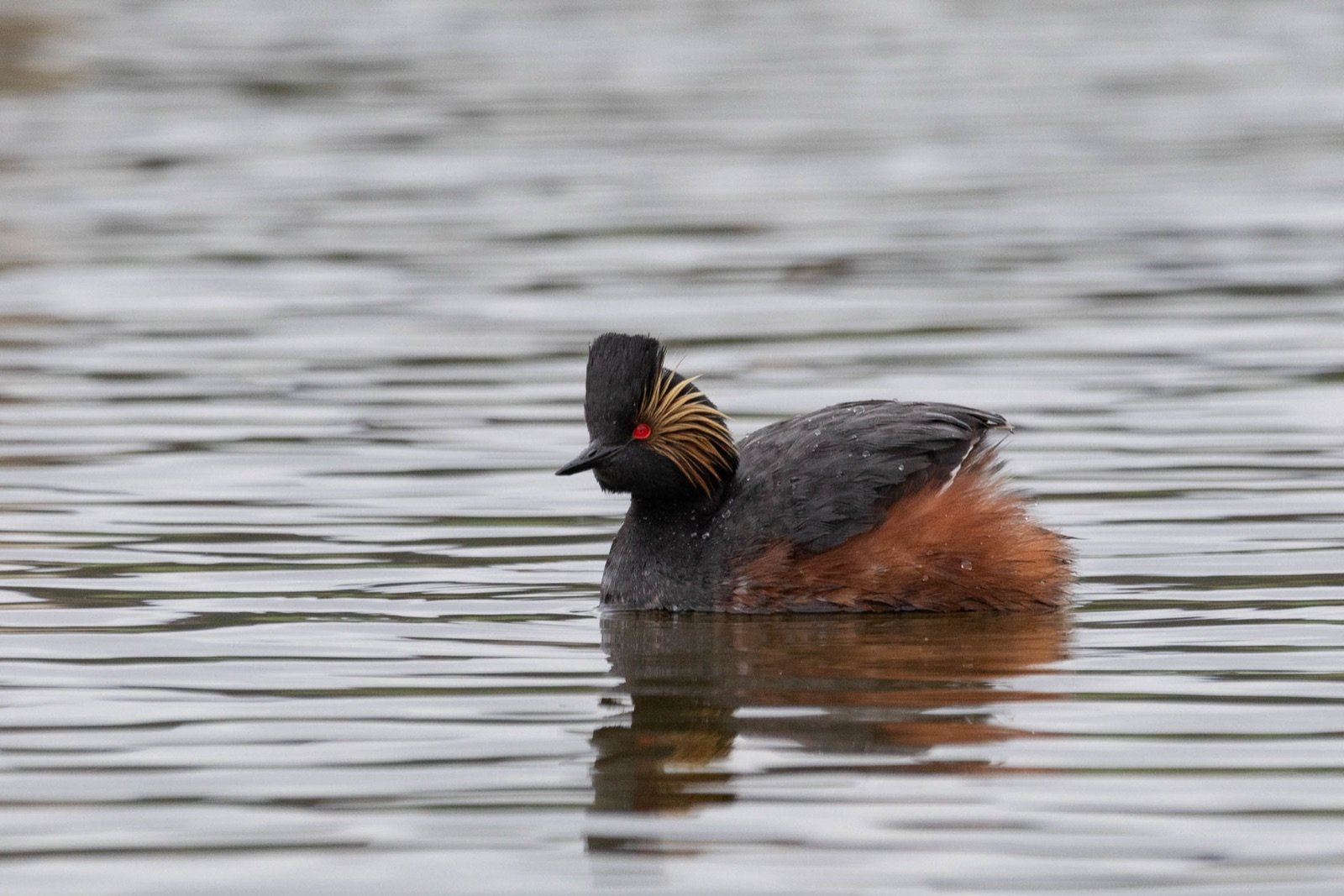
In breeding plumage it has a black head, neck and back, golden-buff ear tufts and chestnut flanks.
In winter it looks very different:
A blackish crown and head sides, with a dark, poorly defined cap.
A dusky hindneck, and a pale grey-brown, mottled foreneck and flanks.
White underparts, with a black bill and black feet.
Two shape clues help. It has a peaked crown and a thin bill that tips slightly upward. The bill is all dark, and the neck looks dusky or grey rather than white.
What it sounds like
Behaviour and diet
Grebes catch small crustaceans, aquatic insects and small vertebrates underwater. They also dive to escape danger, so a grebe that vanishes from the surface may be feeding or simply avoiding you.
Eared Grebes lose the ability to fly during their moult, which lasts three months or more, and they depend on calm open water during that time. These notes describe the species in general, not birds in Costa Rica.
Where it lives
Across its range, Eared Grebes favour wetlands with lots of vegetation and open water.
In Costa Rica the only report comes from a glacial lake on Mount Chirripó, in a high mountain park rather than a wetland, which shows how far out of place that bird was. There is no regular range for the species in the country.
North American birds winter mainly along the Pacific coast, regularly reaching El Salvador. One tour-site description says the species winters from the southwestern USA to Guatemala, so Costa Rica lies beyond its normal winter range.
When to see it
The only dated Costa Rican sighting is April 1987, when two birds already in breeding plumage were on a high glacial lake on Chirripó. North American Eared Grebes winter mainly along the Pacific coast, and stray birds may turn up as far south as Costa Rica.
Similar birds
In winter the Eared Grebe is most easily mixed up with the Horned Grebe. The Horned Grebe has a sharp line between its dark crown and white cheek, and at close range it shows a white bill tip, while the Eared Grebe's bill is all dark. Horned Grebes also have flatter crowns, straighter and heavier bills, and whiter necks.
Names and lore in Costa Rica
The official Costa Rican name is Zambullidor Mediano. Other Spanish names listed for the species include Zambullidor orejudo, Zampullín cuellinegro and Zambullidor cuellinegro, and Mexican sources use Zambullidor Orejón. In Europe it is called the Black-necked Grebe.
Status and conservation
The official Costa Rican list marks the Eared Grebe as A-SC, an accidental visitor, and its single record has never been documented.
Photography tips
Any small grebe that looks dusky with a thin, upturned, all-dark bill deserves careful photographs. Try to capture the crown shape, the bill tip and the neck colour, since these separate it from the Horned Grebe. Good images would be valuable, because the country's only record has no documentation.
How we know this 14 sources, each read on the date shown
- Lista Oficial de las Aves de Costa Rica (AOCR) read 2026-11-04
https://listaoficialavesdecostarica.wordpress.com/lista-oficial/lista-oficial-online/ - Aves de Costa Rica (avesdecostarica.org) read 2026-11-04
https://www.avesdecostarica.org/podicipedidae.html - Wildlifepedia (Fandom) read 2026-11-04
https://wildlifepedia.fandom.com/wiki/Black-necked_Grebe - Mexican Birds.org read 2026-11-04
https://www.mexican-birds.org/eared-grebe/ - Bird Watching Costa Rica read 2026-11-04
https://www.birdwatchingcostarica.com/ave/eared-grebe/ - Wikipedia read 2026-11-04
https://en.wikipedia.org/wiki/Black-necked_grebe - Audubon Field Guide read 2026-11-04
https://www.audubon.org/field-guide/bird/eared-grebe - All About Birds, Cornell Lab of Ornithology read 2026-11-04
https://www.allaboutbirds.org/guide/Eared_Grebe/species-compare/ - GBIF (Atlas de la Biodiversidad de Costa Rica) read 2026-11-04
https://www.gbif.org/es/taxon/4KPP4 - Aves de Costa Rica read 2026-11-04
https://avesdecostarica.com/Podiceps-nigricollis.html - Waste Magazine read 2026-11-04
https://wastemagazine.es/podicepsnigricollis.htm - Focus On Nature Tours read 2026-11-05
http://focusonnature.com/BirdListCostaRica.htm - National Wildlife Foundation read 2026-11-05
https://nwlfd.org/species/eared-grebe - Avibase read 2026-11-05
https://avibase.bsc-eoc.org/species.jsp?avibaseid=EEE760EDB3A62488