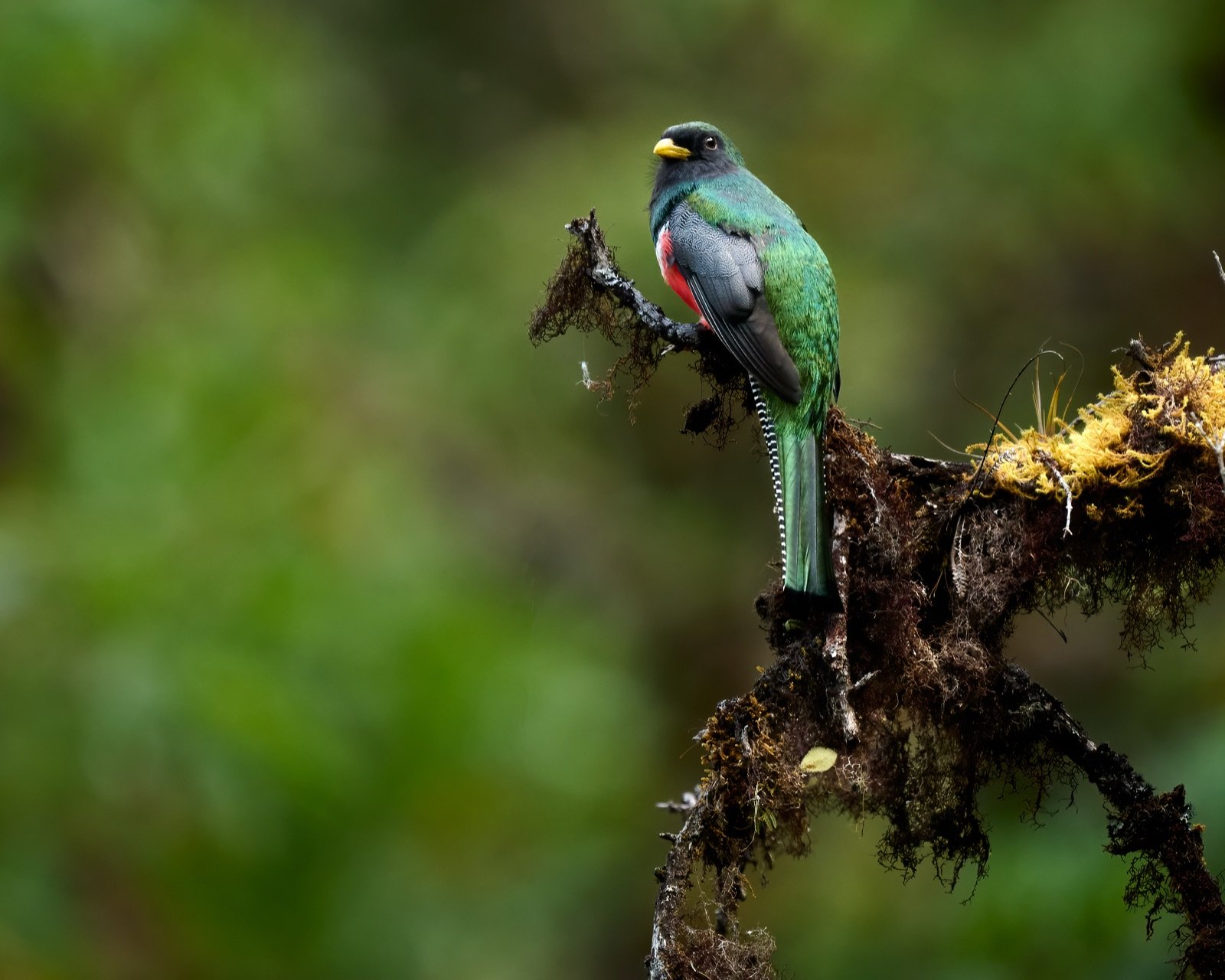
 Elegant Trogon
Family Trogonidae
Elegant Trogon
Trogon elegans
In Spanish: Trogón Elegante (Viuda Roja)
- Resident
Red-bellied trogon of Guanacaste's dry forest, often sitting still and calling
The Elegant Trogon is a slim, long-tailed bird about 28 cm long. The male wears a metallic green head and back, a white chest band and a bright red belly. Costa Ricans call it Viuda Roja, the red widow.
In Costa Rica it belongs to the northwest. It is an uncommon to locally common resident of the northern Pacific lowlands and slopes, from the Nicaraguan border south to around Bagaces and the head of the Gulf of Nicoya. On a trip we build, the dry-forest national parks of Guanacaste are the way to meet it.
It is also a recent split. In 2025 it was separated from the Coppery-tailed Trogon because of song and plumage differences, and the Costa Rican birds belong to the Elegant Trogon.
Where to see it
How to find it
Hot Guanacaste weather sends birds to rest in the shade, so start on the trails as soon as the park opens in the early morning. Listen for the call first, since it can give the bird away before you see it. Then scan the lower branches of trees for the male's colours. Because the bird often sits motionless, scan slowly and look again at branches you have already passed. Gallery forest in Santa Rosa and Guanacaste National Parks gives a fair chance of seeing it.
How to recognise it
The male has a black face and throat, with a metallic green head, upper breast and back.
A white band separates the green chest from the bright red belly.
The bill is yellow.
The female is plainer: a bronze head and breast, a dull white upper belly and a small white stripe behind the eye.
Both sexes show a white undertail with fine black barring.
The bird is about 28 cm long, slim, with a long tail. Costa Rican birds are the subspecies lubricus, which has more black streaking on the lower tail feathers than the Guatemalan form, and its female is darker brown.
What it sounds like
Recording: Zac Peterson, CC BY 4.0, source, read 4 Nov 2026.
Behaviour and diet
The Elegant Trogon usually stays high in the canopy and drops lower to feed and nest. It often sits motionless, watching for flying insects, before dashing out to take one. It usually takes insects and fruit on the wing, and outside the breeding season it often forages in mixed-species flocks. A study in Guanacaste found that males raise the tail in display. They do this toward mates and rivals, and also toward possible predators such as humans, monkeys and birds of prey.
Where it lives
It lives in the canopy of dry forest, gallery forest and evergreen forest, mostly on slopes, in hollows and in ravines. It climbs to about 750 m on the slopes of the Guanacaste cordillera. A Guanacaste Conservation Area worker has seen it from near sea level to about 300 m, where dry forest meets rain forest, and says it also climbs through scrub and gallery forest. Across its wider range it likes dry, open habitat, including thorn forest and deciduous forest, and it also uses shade coffee plantations.
When to see it
In Costa Rica it breeds from April to July and often raises two broods. At Las Catalinas, the late green (rainy) season brings more fruit and calmer conditions, and the birds are more active then and easier to see and hear.
Similar birds
It looks like the Violaceous Trogon, but its call is more staccato, and it has an unbroken bluish eye ring and no barring on the tail. In the northern Pacific lowlands it is the only red-bellied trogon, so a red belly there points to this species. In Guanacaste it shares the dry forest with the Black-headed Trogon, and the two get along.
Names and lore in Costa Rica
Costa Ricans call it Trogón Elegante or Viuda Roja (red widow). Other Spanish names are coa elegante and surucuá elegante. A photo of an Elegant Trogon appears on a Santa Rosa National Park postal card, with images supplied by Guanacaste Conservation Area, whose director called such images iconic elements of the area.
Status and conservation
The AOCR list marks it as a resident (R), and the IUCN lists it as Least Concern as of 2020, with forest loss within its range the main concern.
Photography tips
Trogons often sit for long periods on the same branch, which gives birders long looks and photographers a chance at a good shot. Listen for the call, then scan the lower branches for the male's colours.
Trips that find it
- Birding in Costa Rica's Nicoya Peninsula11 nightsSee the trip
Tell us when you are travelling and our team in Costa Rica builds the trip around the birds you want to see.
Plan my birding tripHow we know this 14 sources, each read on the date shown
- Oiseaux.net read 2026-11-04
https://www.oiseaux.net/en/elegant.trogon.html - Animalia (Wikipedia text) read 2026-11-04
https://animalia.bio/elegant-trogon - INBio-based species note (Flickr, Jorge Obando) read 2026-11-04
https://www.flickr.com/photos/jobando/25617189823 - Birds of the World read 2026-11-04
https://birdsoftheworld.org/bow/species/eletro2/cur/introduction - Costa Rica Star News read 2026-11-04
https://news.co.cr/raising-tail-in-guanacaste-the-trogon-elegans/32465/ - Costa Rica Focus read 2026-11-04
https://www.costaricafocus.com/the-best-places-for-spotting-trogons-in-costa-rica/ - Birding Craft read 2026-11-04
https://birdingcraft.com/wordpress/2010/04/15/costa-rica-birding-trogons/ - Santa Rena Journal read 2026-11-04
https://thejournal.santarenahotel.com/common-costa-rican-birds-in-las-catalinas - Wikipedia read 2026-11-04
https://en.wikipedia.org/wiki/Elegant_trogon - Wikiwand (Spanish Wikipedia) read 2026-11-04
https://www.wikiwand.com/es/Trogon_elegans - Gobierno de Costa Rica (Presidencia) read 2026-11-04
https://presidencia.gobiernocarlosalvarado.cr/comunicados/2021/08/parque-nacional-santa-rosa-se-proyecta-al-mundo-en-emision-postal/ - Birds of the World (Cornell) read 2026-11-04
https://birdsoftheworld.org/bow/species/eletro2/cur/introduction?media=photos - Área de Conservación Guanacaste read 2026-11-04
https://www.acguanacaste.ac.cr/paginas-de-especies/insectos-2/716-trogonidae/5337-i-trogon-melanocephalus-i-trogonidae - FotoNaturaleza forum read 2026-11-04
https://www.fotonaturaleza.net/foro/index.php?m=t&tid=21166