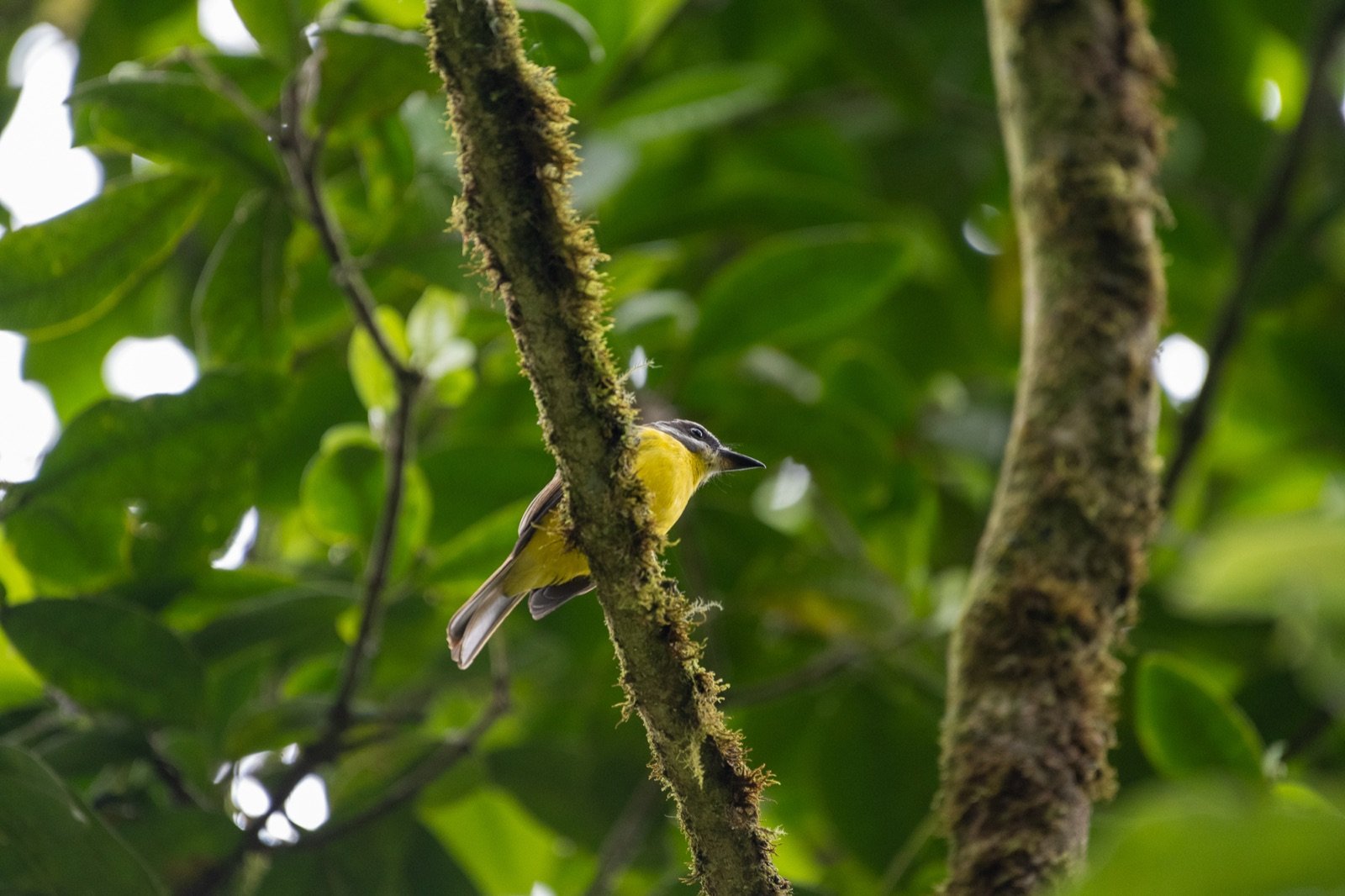
Family Tyrannidae
Golden-bellied Flycatcher
Myiodynastes hemichrysus
In Spanish: Mosquero Vientridorado (Pecho Amarillo)
- Resident
Noisy yellow-bellied flycatcher of cloud forest edges, with a dark stripe by the throat
The Golden-bellied Flycatcher (Mosquero Vientridorado) is a medium flycatcher about 20 cm long, with a bright yellow belly and a dark head marked by a white eyebrow. In Costa Rica it is a fairly common bird of wet mountain forest, and it stays in that forest all year.
The first scientific description of the species came from Los Frailes, Costa Rica. Until recently it was thought to live only in Costa Rica and western Panama.
Birders meet it in cooler middle-elevation places such as Tapantí National Park, the upper part of Braulio Carrillo National Park, the Monteverde area and the highlands of San Gerardo de Dota, where it pays to scan the high perches.
How to find it
Look along forest edges, streams, roads and clearings in middle-elevation wet forest, where the forest is more open. Scan high perches and the canopy. The bird usually sings from a perch in or near the forest canopy, so listen first and then look high up. Roads and clearings give the clearest view. Learn the squeaky skee-kit chatter and the harsh skeeew before you go. Watch for a pair rather than a single bird.
How to recognise it
Look for a bright yellow belly, a whitish chin, an olive back and a dark head with a white eyebrow. A yellow crown patch is hidden and rarely shows. Overall it is about 20 cm long.
The best clue is a dark stripe running between the whitish throat and the cheek, which sets it apart from other large yellow-bellied flycatchers. A Costa Rican source adds a thick blackish line from the lores to the ear coverts, edged by white lines.
Young birds lack the yellow crown patch. They look browner above and paler, slightly buffy, below.
What it sounds like
Behaviour and diet
This is a fairly noisy bird, usually found in pairs. It perches at mid height or high in trees and mostly snatches insects from foliage in short upward flights. It takes fruit the same way. Sometimes it hunts insects in flight from an exposed perch.
Pairs stay together all year, and family groups stay together for several months after the breeding season. A calling bird often has a mate nearby.
Where it lives
In Costa Rica it lives at about 800 to 1,800 m on the Caribbean slope. On the Pacific slope it reaches up to 2,300 m.
It uses the canopy and edges of wet cloud forest covered in epiphytes. It is especially common along streams, roads and clearings, and it also uses plantations and altered areas.
It occurs on the Caribbean slope from the Guanacaste range, at least as far north as Volcán Miravalles, south to Panama. It is also found locally on the high Pacific side of the northern ranges and up to 2,300 m in the Talamanca range.
When to see it
It is a year-round resident in Costa Rica and does not migrate. A Costa Rican natural history source says it breeds from March to May.
Similar birds
The dark stripe from the bill to the cheek (malar stripe) separates it from Great Kiskadee-type flycatchers. Dark stripes on each side of the white throat also tell it from Social and Gray-capped Flycatchers. The Streaked Flycatcher shares the nickname Pecho Amarillo, so check for the golden-bellied's plain yellow underparts and strong head stripes.
Names and lore in Costa Rica
The Costa Rican Spanish name is Mosquero Vientridorado, and Costa Rican lists also give the everyday name Pecho Amarillo, a nickname shared with the similar Streaked Flycatcher. Spanish sources call it bienteveo ventridorado in general, while mosquero vientridorado is the name used in Costa Rica and Panama.
Status and conservation
The AOCR lists it as a resident (R), and it is considered fairly common in Costa Rica.
Photography tips
The bird usually sings from a perch in or near the forest canopy, so look and listen high up. Use roads and clearings, where the forest edge gives a clear view.
How we know this 16 sources, each read on the date shown
- Wikipedia read 2026-11-04
https://en.wikipedia.org/wiki/Golden-bellied_flycatcher - BirdForum Opus read 2026-11-04
https://www.birdforum.net/opus/Golden-bellied_Flycatcher - STRI Research Portal read 2026-11-04
https://panamabiota.org/stri/taxa/index.php?taxauthid=1&taxon=3339&clid=6 - Flickr (Costa Rican natural history text) read 2026-11-04
https://www.flickr.com/photos/jobando/50338433391 - Wikipedia (Spanish) read 2026-11-04
https://es.wikipedia.org/wiki/Myiodynastes_hemichrysus - Cloudbridge Nature Reserve bird list read 2026-11-04
https://www.cloudbridge.org/wp-content/uploads/2020/04/Bird-Species-List-Costa-Rica-13-April-2020.pdf - Animalia.bio read 2026-11-04
https://animalia.bio/golden-bellied-flycatcher - Birds of the World read 2026-11-04
https://birdsoftheworld.org/bow/species/gobfly1/cur/introduction - Field Guides trip report, Costa Rica March 2025 read 2026-11-04
https://fieldguides.com/triplists/cos25/ - Birdquest Costa Rica tour report 2024 read 2026-11-04
https://www.birdquest-tours.com/birding-tour-reports/costa-rica-classic-2024/ - Costa Rica Focus read 2026-11-04
https://www.costaricafocus.com/birding-group-tours/birding-station-to-station/ - Always Bring Binoculars read 2026-11-04
https://www.alwaysbringbinoculars.com/costa-rica-2019-trails-above-savegre-hotel/ - EcoRegistros read 2026-11-04
https://www.ecoregistros.org/ficha/Myiodynastes-hemichrysus - Cloudbridge Nature Reserve bird list read 2026-11-04
https://www.cloudbridge.org/wp-content/uploads/2020/04/Especies-de-Aves-Costa-Rica-13-April-2020.pdf - Flickr (Costa Rican natural history text) read 2026-11-04
https://www.flickr.com/photos/jobando/48555558501 - Macaulay Library read 2026-11-04
https://macaulaylibrary.org/asset/209414