 Great Frigatebird
Family Fregatidae
Great Frigatebird
Fregata minor
In Spanish: Rabihorcado Grande (Tijereta)
- Resident
Tijereta, the 'little scissors' seabird of Isla del Coco
In Costa Rica the Great Frigatebird (Fregata minor) goes by Rabihorcado Grande, and in everyday speech by Tijereta, which means 'little scissors', a nod to the forked tail.
The birds that nest on Cocos Island belong to the eastern Pacific subspecies Fregata minor ridgwayi. Isla del Coco lies about 550 km southwest of the Costa Rican mainland, so this is a bird for travellers ready to go well offshore.
How to find it
Visitors reach Isla del Coco mainly through diving and snorkeling trips, since the park is known as a top dive destination. That is the practical route to the island where the Costa Rican birds nest.
Because the island's only residents are park rangers, the trip itself is the plan. Look for the forked tail and the dark males with the red throat pouch, and check the dominant trees where the nests sit.
How to recognise it
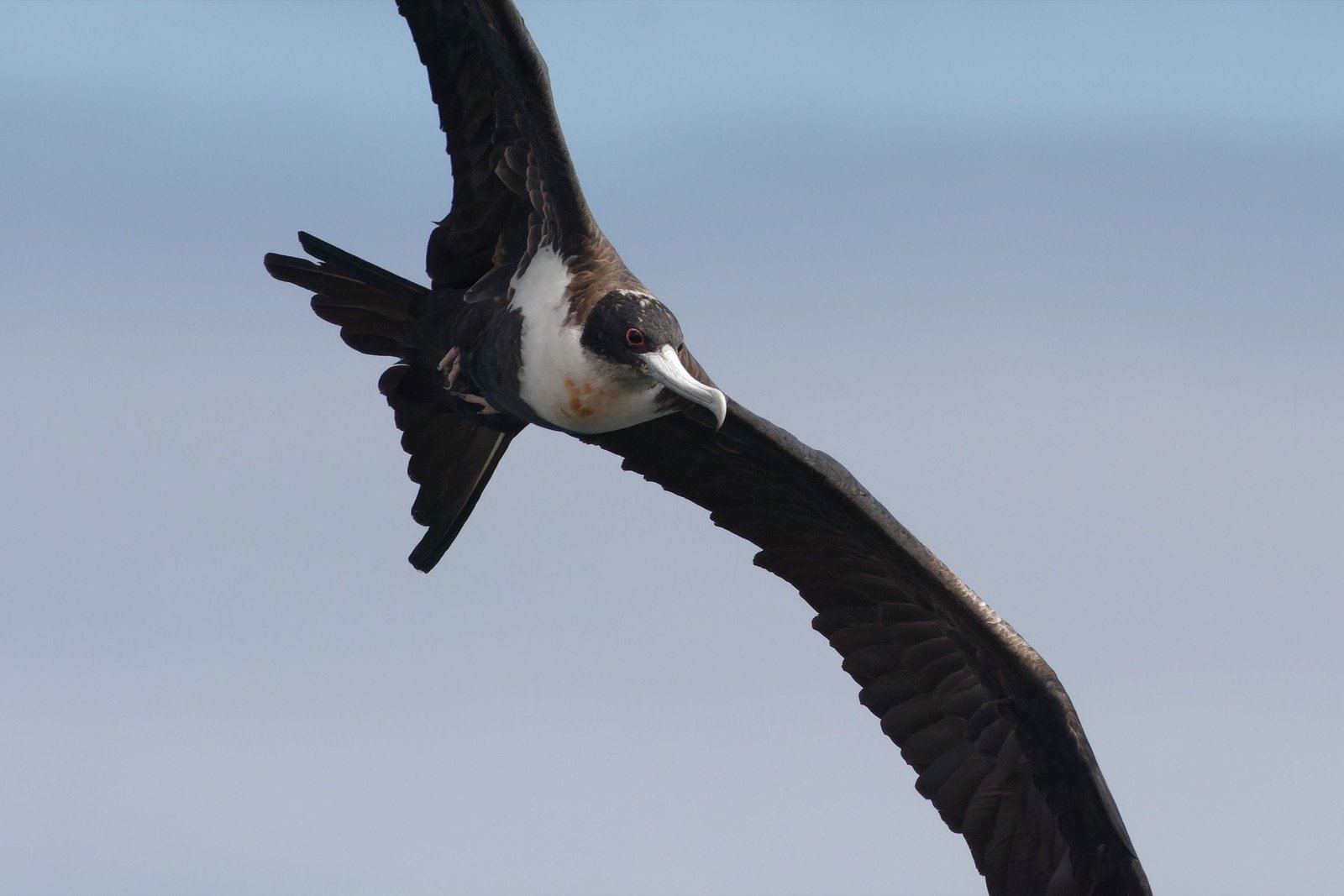
Males are all black, with a brownish bar across the upper wing, a forked tail and a hooked grey bill. Their red throat pouch sits under the bill and is the easiest mark to spot on a male.
Females have a white throat, chest and belly, which sets them apart from the all-dark males.
A forked tail is the shape to look for in both sexes, and it is the feature behind the name Tijereta.
Behaviour and diet
On Isla del Coco the nest is a compact platform of small twigs. A seabird study of the island puts the nests in the dominant trees of the main island, mainly Clusia rosea.
Range-wide, the species mostly eats flying fish and squid. It also takes seabird eggs and chicks, newly hatched turtles and scraps, and it steals food from other birds.
Where it lives
In Costa Rica this is a bird of Isla del Coco, a national park since 1978 that lies about 550 km southwest of the mainland. Its only residents are park rangers.
The nesting birds use the dominant trees of the main island, mainly Clusia rosea.
Names and lore in Costa Rica
The AOCR Spanish name is Rabihorcado Grande, with Tijereta as the everyday name. Tijereta means 'little scissors', a nod to the forked tail.
Status and conservation
The AOCR list gives the Great Frigatebird the status R.
How we know this 7 sources, each read on the date shown
- national-parks.org read 2026-11-04
https://national-parks.org/costa-rica/cocos-island-national-park/ - Wikipedia read 2026-11-04
https://en.wikipedia.org/wiki/Cocos_Island - Descubriendo Galápagos read 2026-11-04
https://descubriendogalapagos.ec/dg_species/fragata-real/ - Birdwatching in Costa Rica read 2026-11-04
https://birdwatchingincostarica.com/aves-oceanicas-en-costa-rica-un-pais-de-mar-un-tesoro-por-descubrir/ - Enjoy Costa Rica read 2026-11-04
http://www.enjoycostarica.org/isla-coco-costa-rica.php - Revista de Biología Tropical (Redalyc) read 2026-11-05
https://www.redalyc.org/pdf/449/44920231010.pdf - Aves de Chile read 2026-11-05
https://www.avesdechile.cl/236.htm