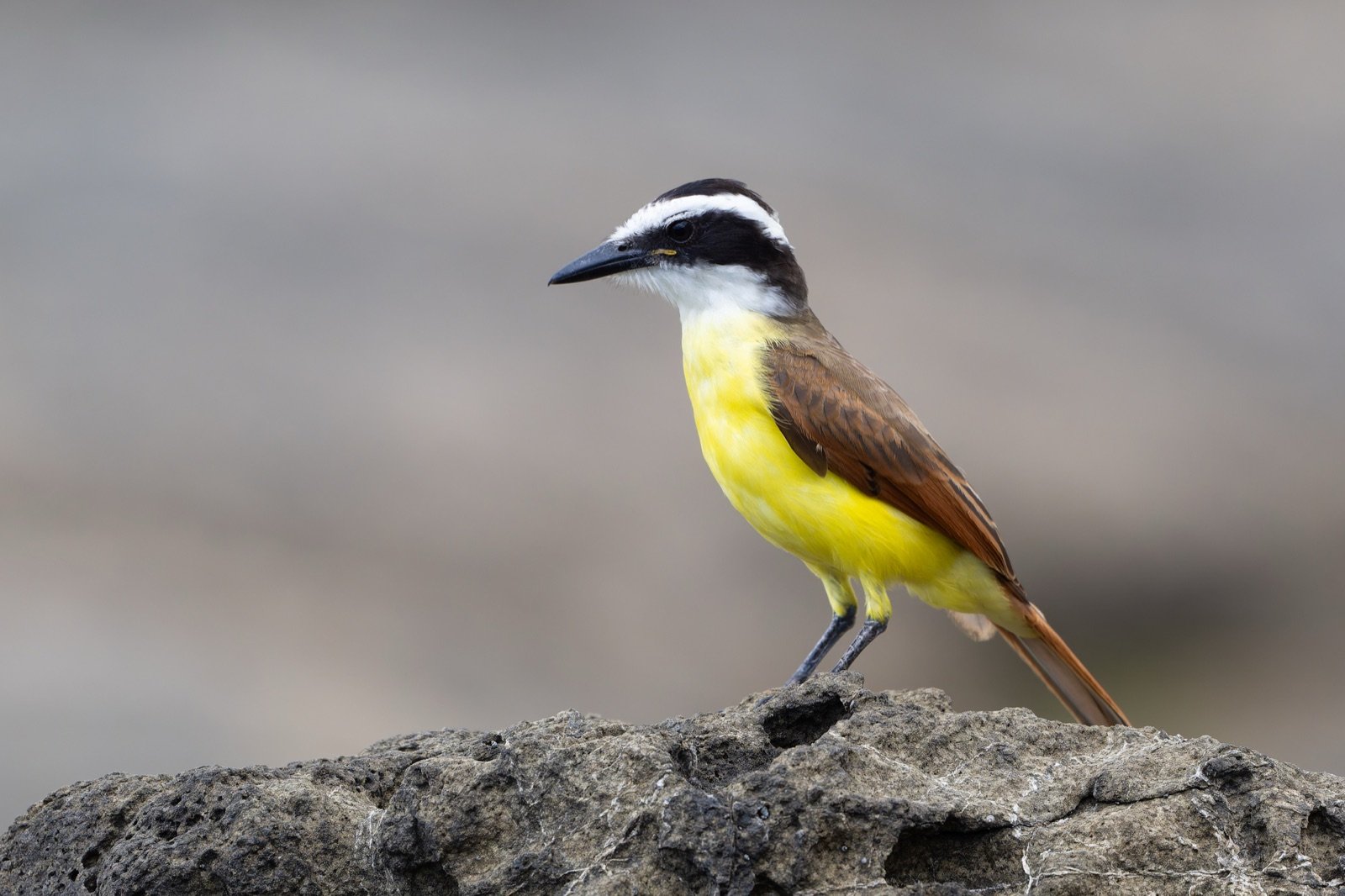
Family Tyrannidae
Great Kiskadee
Pitangus sulphuratus
In Spanish: Bienteveo Grande (Cristo Fue, Pecho Amarillo)
- Resident
Loud, bright yellow and common nearly everywhere, from gardens to river boats.
The Great Kiskadee (Bienteveo Grande, also called Cristo Fue or Pecho Amarillo) is one of the most often seen birds across Costa Rica. It turns up in gardens, on power lines and near towns, so no special trip is needed to meet it.
On a trip we build, it can be among the first birds of the stay: a common Central Valley yard bird on the first evening in a San José garden, or one of the first birds from the boat on the lower Río Tárcoles, alongside Wood Stork and Roseate Spoonbill.
It is also a gentle teacher. At La Selva Biological Station a guide used it beside Social, Gray-capped and White-ringed Flycatchers for a side-by-side lookalike comparison.
How to find it
Start with the places you will already be: gardens, power lines and the edges of towns. A tour report from the southern highlands and foothills called it abundant and widespread, so it is easy to find on almost any route. Open country near water is especially good. Around the Tárcoles River and Carara area, flycatchers were abundant and Great Kiskadee was listed on a boat trip, and a tour leader's notes say that trip is best at high tide. Listen early, since it calls about half an hour before first light.
How to recognise it
Look for a black crown and face crossed by a thick white eyebrow. The throat is white and the underparts are bright yellow, which is why Costa Ricans say pecho amarillo, yellow chest.
A yellow crown patch is hidden most of the time.
The back is olive-brown, with plenty of rufous in the wings and tail. That rufous is a good mark when you see the bird from behind or the side.
It is about 23 cm long and weighs about 68 g. The bill is sturdy but not swollen, and the top ridge is straight.
What it sounds like
Recording: Patrick Leary, CC BY 4.0, source, read 4 Nov 2026.
Behaviour and diet
It is noisy and bold. It harasses large birds of prey and sometimes raids the nests of small birds. It hunts from perches, flying out to catch insects in the air or pouncing on small animals, and it also dives into shallow water for aquatic prey.
In Costa Rica it breeds from February to June, and sometimes until October. The nest is a bulky domed structure with a side entrance, built from grasses and trash and placed 1.2 to 12 m up. Near Tárcoles, one nest was built on a power pole.
Where it lives
In Costa Rica it is a common to abundant resident from the lowlands up to about 1500 m, and sometimes higher. It prefers open areas with scattered trees, especially near water.
It lives along large rivers and streams, in savannas, pastures, marshes and mangroves, and in open woodland, gardens, parks, towns and suburbs, including the Central Valley.
It is recorded in nearly every conservation area of the country, including Guanacaste, Tempisque, Arenal, Tortuguero, Osa, the Central Pacific, the Central Volcanic range and Amistad, on both slopes.
When to see it
In Costa Rica it breeds from February to June, and sometimes until October.
Similar birds
From behind or the side, the Great Kiskadee shows rufous wings, while Social and Boat-billed Flycatchers have only dull brown wings. Size and the yellow crown patch also help. Social Flycatcher has a similar pattern but is clearly smaller. Boat-billed Flycatcher has a much heavier bill and an olive-brown back. A guided group once found a kiskadee and a Boat-billed Flycatcher perched fairly close together, which allowed a brief side-by-side study.
Names and lore in Costa Rica
Costa Ricans call it Bienteveo Grande, Cristofué and pecho amarillo, which means yellow chest. Across Latin America it has many other regional names that echo its call.
Status and conservation
The AOCR list marks it as a resident (R), common to abundant in Costa Rica, and the IUCN rates it Least Concern with a stable population.
Photography tips
Perches make it easy to photograph: look on power lines, fence posts and low branches in gardens and open country near water. Early morning, when it starts calling, is a good time to locate it.
How we know this 22 sources, each read on the date shown
- Flickr (Costa Rican natural history text, INBio-style species account) read 2026-11-04
https://www.flickr.com/photos/jobando/33532192663 - Retired in Costa Rica (Charlie Doggett) read 2026-11-04
https://www.charliedoggett.net/2021/11/01/fave-birds-great-kiskadee/ - Planetscott read 2026-11-04
https://www.planetscott.com/speciesdetail/4410/great-kiskadee-pitangus-sulphuratus - Retired in Costa Rica (Charlie Doggett) read 2026-11-04
https://www.charliedoggett.net/tag/great-kiskadee/ - Hotel Rivel read 2026-11-04
https://hotelrivel.online/the-great-kiskadee-costa-ricas-bold-and-boisterous-beauty/ - Cornell Birds of the World read 2026-11-04
https://birdsoftheworld.org/bow/species/grekis/cur/sounds - Wikipedia read 2026-11-04
https://en.wikipedia.org/wiki/Great_kiskadee - Birda read 2026-11-04
https://app.birda.org/species-guide/17766/Great_Kiskadee - A-Z Animals read 2026-11-04
https://a-z-animals.com/animals/great-kiskadee/ - Eagle-Eye Tours trip report 2026 read 2026-11-04
https://www.eagle-eye.com/blog/costa-rica-sampler-trip-report-feb-16-27-2026/ - Birds by Bijs trip report read 2026-11-04
https://birdsbybijs.com/2024/02/trip-report-costa-rica-central-sur-2024-birding-tour/ - Naturalist Journeys trip report 2024 read 2026-11-04
https://www.naturalistjourneys.com/pdf/trip-reports/1178-202402-central_america-costa_rica-trip_report.pdf - John Gordon, Listening to Birds read 2026-11-04
https://thecanadianwarbler.blogspot.com/2025/03/costa-rica.html - Field Guides tour report 2018 read 2026-11-04
https://fieldguides.com/triplists/cr118.html - Macaulay Library (media note) read 2026-11-04
https://macaulaylibrary.org/asset/204214761 - Naturalista Costa Rica (from Wikipedia) read 2026-11-04
https://costarica.inaturalist.org/taxa/16956-Pitangus-sulphuratus - Aves de Costa Rica read 2026-11-04
https://www.avesdecostarica.com/Pitangus-sulphuratus.html - Ecos del Bosque read 2026-11-04
https://ecosdelbosque.com/fauna/pitangus-sulphuratus - Nicoya Peninsula guide read 2026-11-04
https://nicoyapeninsula.com/wildlife/trogons/ - Macaulay Library (media note) read 2026-11-04
https://macaulaylibrary.org/asset/204214771 - Birding Craft read 2026-11-04
https://birdingcraft.com/wordpress/tag/great-kiskadee/ - BirdNote read 2026-11-04
https://www.birdnote.org/bird/great-kiskadee-pitangus-sulphuratus