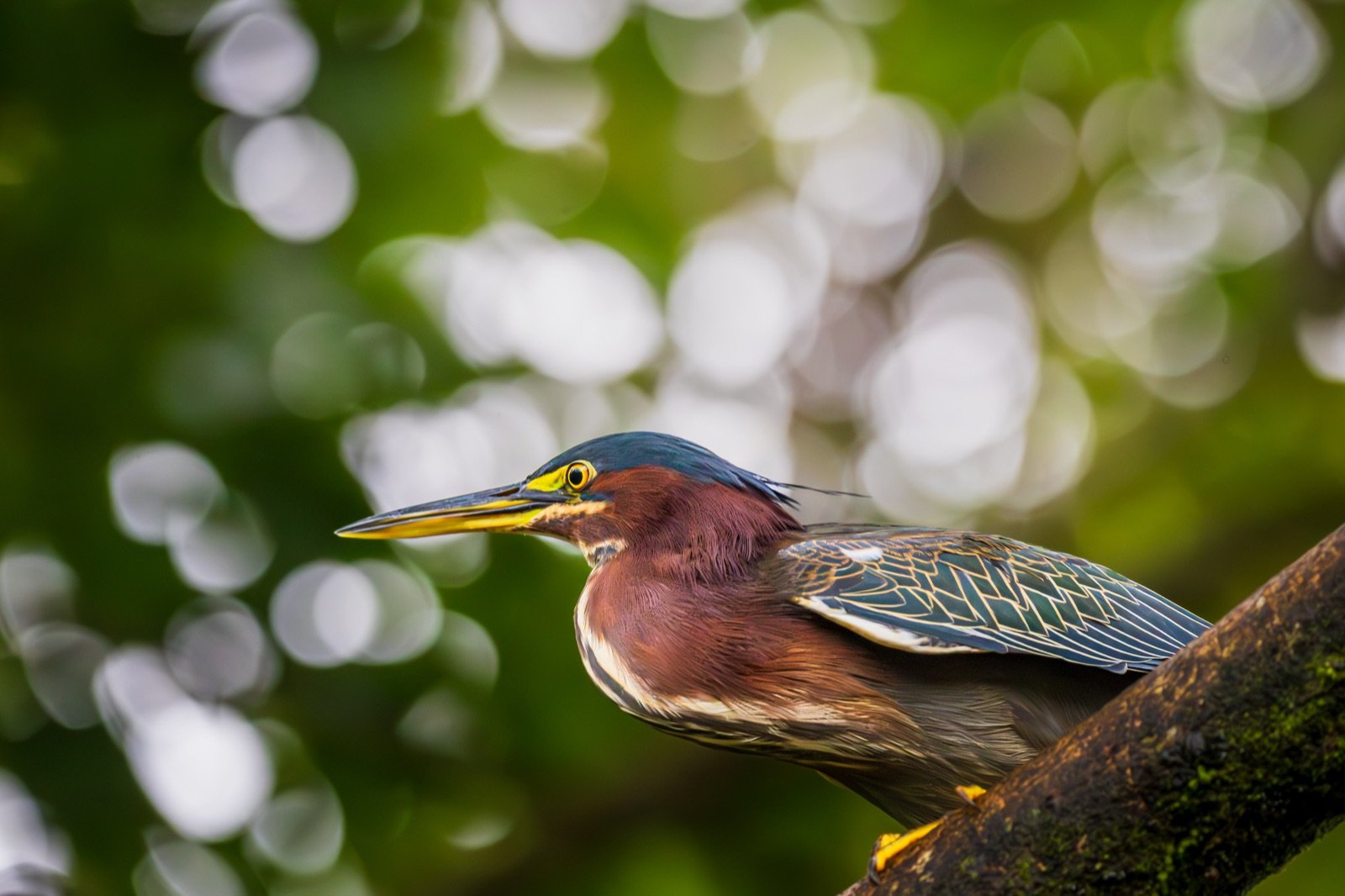
 Green Heron
Family Ardeidae
Green Heron
Butorides virescens
In Spanish: Garcilla Verde (Martín Peña)
- Resident
A small, patient heron that hides along water edges across the country.
The Green Heron, Garcilla Verde or Martín Peña to Costa Ricans, turns up across the country wherever there is water, from sea level up to about 1850 metres. It is a small, stocky heron with a chestnut neck and a dark green back, and it often stays out of sight in dense plants at the water's edge.
It is a very patient hunter that can wait a long time for the right moment to strike at a fish. That stillness is what a beginning birder learns to look for.
On a trip we build, a quiet canoe along the Tortuguero canals is one good way to meet it. Paddle close to the bank and look in the foliage, where many herons hunt along the canal edges.
How to find it
Look for it alone or in pairs wherever dense plants grow beside or in shallow water, such as ponds, river edges, swamps, streams and mangroves. Scan the bank edges slowly. If alarmed, it freezes with its crest raised and flicks its tail up and down, so watch for that movement. At Tortuguero, herons along the canal edges hunt without worrying about people, and a canoe lets you drift close to one hiding in the leaves. Mangrove estuaries such as Puntarenas suit its fishing, since calmer, steadier currents make prey easier to catch. Dawn and dusk are when it is most noticeable.
How to recognise it
This is a small, stocky heron. Look for:
- a dark green back and wings
- a chestnut face and neck
- a white line down the throat
- a gray belly
- short yellow legs and a dark bill
Young birds are duller than adults. Their head sides, neck and underparts are streaked brown and white, and the back is splotched with tan.
In southwestern Costa Rica and Panama, some Green Herons may look solid brown, so do not rule out a plainer bird there. Light changes the look of it too: in poor light the bird looks nearly black, while in good light the back shows deep green and the neck and breast show rich chestnut.
What it sounds like
Behaviour and diet
The Green Heron eats mainly small fish, frogs and water insects, and it sometimes drops bait on the water surface to lure fish. It stands motionless at the water's edge, on vegetation or on solid ground.
It is most noticeable at dawn and dusk and often rests in sheltered spots by day, though it feeds in daylight when hungry or feeding young. It can feed in open places, but when frightened it seeks cover and freezes with its crest raised, flicking its tail up and down.
Costa Rican females lay 2 pale bluish green eggs per clutch, in loose nest platforms 1 to 5 metres above the water.
Where it lives
In Costa Rica the Green Heron is found wherever there is water, from sea level up to about 1850 metres. Across its wider range it lives in small wetlands in low-lying areas and adapts to many kinds of aquatic habitat, moving easily through tangled plants growing in or near water.
It has been recorded in the Pacific lowlands, in the mangroves of the Tárcoles River and Puntarenas, on the Caribbean side at Tortuguero, in the Central Valley, and in the highlands at San Gerardo de Dota.
When to see it
The National Museum lists it among species with both resident and migratory populations in the Central Valley, though it gives no months.
Similar birds
The Striated Heron looks very like the Green Heron in size, shape, habits and voice. Adults of the Striated have a pale gray or buff neck, and their back is a paler, grayer green. It is only an accidental visitor in Costa Rica, resting on two old reports, so nearly all Costa Rican birds of this kind are Green Herons.
Names and lore in Costa Rica
The official Costa Rican Spanish name is Garcilla Verde, with Martín Peña as the local alternative. Martín Peña is also used for tiger-herons. Other Costa Rican sites call it garcita verdosa or garceta verde.
Status and conservation
The AOCR list marks the Green Heron as R,M, both resident and migrant, and the IUCN lists it as Least Concern.
Photography tips
The bird stands motionless at the water's edge, so it is a patient subject. In poor light it looks nearly black, so aim for good light, when the back shows deep green and the neck and breast show rich chestnut. When frightened it freezes with its crest up and its tail flicking, which is a useful cue to spot it.
How we know this 21 sources, each read on the date shown
- Zeledonia 17 (David Segura, via ResearchGate) read 2026-11-04
https://www.researchgate.net/publication/264158394_Colonia_de_garcillas_verdes_Butorides_virescens_en_Montes_de_Oca - Costa Rica Monkey Tours read 2026-11-04
https://costaricamonkeytours.com/costarica-travelguide/wildlife/birds/the-green-heron-of-costa-rica/ - AVoCet (Michigan State University) read 2026-11-04
https://avocet.integrativebiology.natsci.msu.edu/recordings/11763 - World Bird Photos read 2026-11-04
https://www.worldbirdphotos.com/photo/heron-green-butorides-virescens-adult-costa-rica/ - Nature Picture Library read 2026-11-04
https://www.naturepl.com/stock-photo-green-heron-butorides-virescens--tortuguero-national-park-costa-rica-image01467768.html - Contenido Tico read 2026-11-04
https://contenidotico.com/biodiversidad/aves/garcilla-verde/ - UNED repositorio read 2026-11-04
https://repositorio.uned.ac.cr/reuned/handle/120809/96 - JungleDragon read 2026-11-04
https://www.jungledragon.com/specie/198/green_heron.html - Anywhere Costa Rica (citing Skutch and Stiles) read 2026-11-04
https://www.anywhere.com/flora-fauna/bird/green-heron - Turismo de Observación read 2026-11-04
https://www.turismodeobservacion.com/foto/garcilla-verde-nombre-cientifico-butorides-virescens/30781/ - Ecos del Bosque (citing Aves de Costa Rica) read 2026-11-04
https://ecosdelbosque.com/fauna/butorides-virescens - Naturalicante, Viaje Ornitológico a Costa Rica 2009 read 2026-11-04
http://www.naturalicante.com/mochila/Cronicas/Viaje_Ornitologico_a_Costa_Rica_2009/Viaje_Ornitologico_a_Costa_Rica_2009.htm - Museo Nacional de Costa Rica read 2026-11-04
https://www.museocostarica.go.cr/nuestro-trabajo/investigaciones/historia-natural/gam/aves/ - Lista Oficial de las Aves de Costa Rica (AOCR) read 2026-11-04
https://listaoficialavesdecostarica.wordpress.com/lista-oficial/lista-oficial-online/ - Aves de Costa Rica read 2026-11-04
https://avesdecostarica.com/Butorides-striata.html - Wikipedia read 2026-11-04
https://en.wikipedia.org/wiki/Green_heron - Zoopicker read 2026-11-04
https://zoopicker.com/en/animals/14884 - Birds of Prince Edward Island read 2026-11-04
https://www.birdsofpei.info/p/green-heron.html - Ecosistemas de Costa Rica read 2026-11-04
https://ecosistemasdecostarica.blogspot.com/2012/08/aves.html - Animalia Encyclopedia read 2026-11-04
https://animaliaencyclopedia.fandom.com/wiki/Green_Heron - Costa Rica Birding Trips read 2026-11-04
https://www.costaricabirdingtrips.com/ardeidae/green-heron-butorides-virescens