Family Parulidae
Hermit Warbler
Setophaga occidentalis
In Spanish: Reinita Cabecigualda
- Migrant
A rare highland migrant warbler with a yellow head and black throat
The Hermit Warbler (Reinita Cabecigualda) is a visitor here, not a resident. The official Costa Rican bird list marks it M, a migrant that visits from elsewhere. It breeds along the west coast of the United States and winters in parts of Mexico and Central America.
In Costa Rica it is rare and found in mountain regions, where it lives in the forest canopy. That makes it a bird for a patient morning in highland forest, not one to expect at every stop.
A Costa Rican birding blogger lists it among the fall migrants he hopes to find in the country, which says a good deal about how it is regarded.
How to find it
These warblers feed high in trees, so they are hard to see. Walking a road that runs down a mountainside brings the treetops closer to eye level. Check through mixed flocks in highland forest, since the Hermit Warbler travels with them on its wintering grounds. Look in hedgerows and at forest edges, and watch conifers, especially Guatemalan cypress. Try to see the singer before you name it, because Hermit and Townsend's Warbler hybrids can sound like pure Hermit Warblers.
How to recognise it
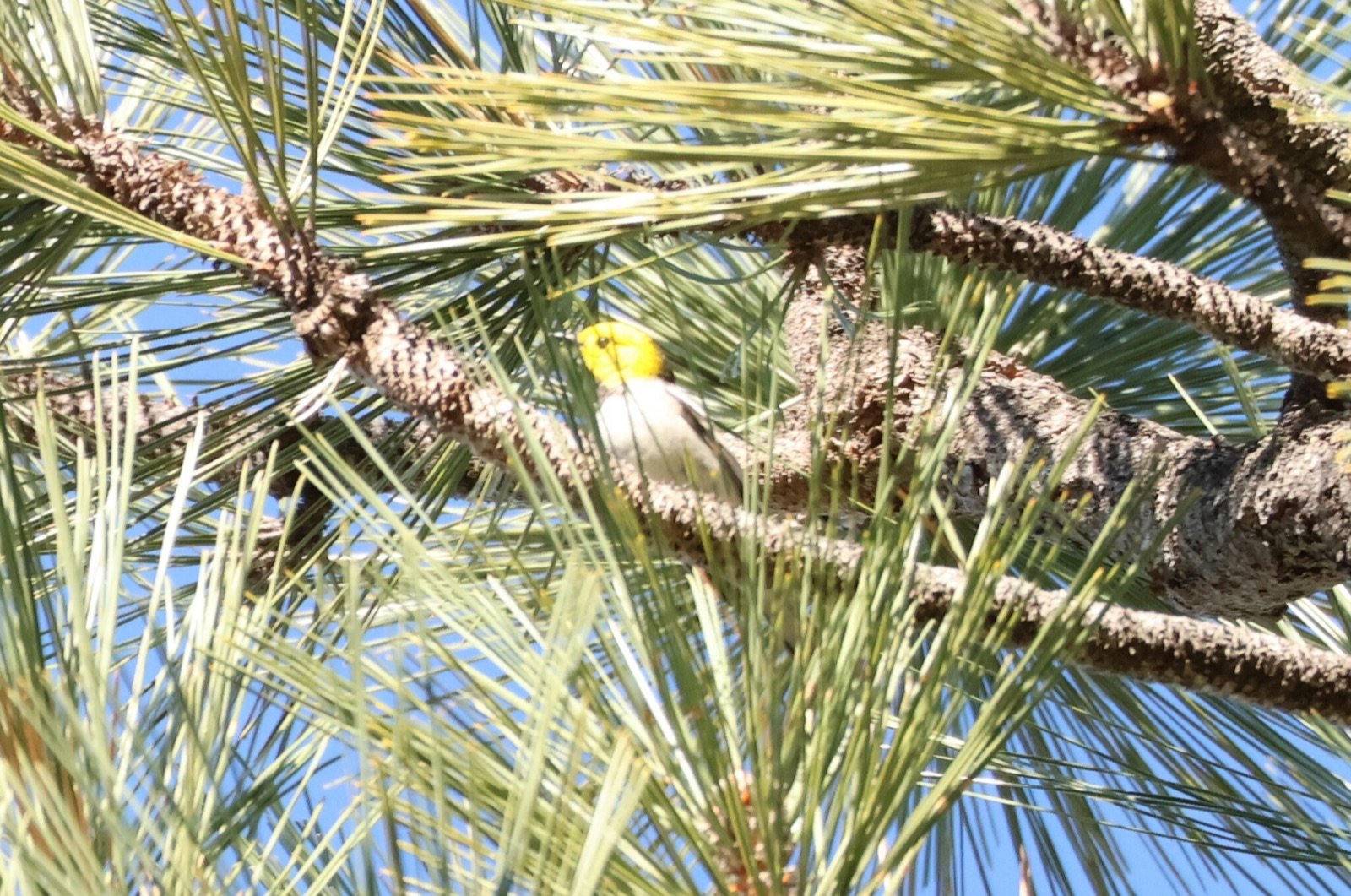
An adult male has a mostly yellow head with a black throat and nape. The underparts are white and the back is gray, with two white wing bars.
Females look like males but duller. They often have olive green on the nape and throat, and their black throat markings can be solid or missing.
Females and young birds are where the trouble starts, because they resemble other warblers. Against a Black-throated Green Warbler, the Hermit has grayer upperparts and yellow across more of the face, including the crown. Against a Golden-cheeked Warbler, look for a yellow forehead, little or no black streaking on the sides, and no black eye-stripe.
What it sounds like
Behaviour and diet
The Hermit Warbler is a foliage gleaner that feeds mainly on insects. It feeds high in trees, which is why it is hard to see.
On the wintering grounds it travels with big mixed flocks of woodpeckers, woodcreepers, flycatchers, vireos, tanagers and other warblers. In Mexico, Guatemala and Honduras it forages among those flocks, often just above eye level.
Where it lives
In Costa Rica and Nicaragua it is rare and found in mountain regions. It lives in the forest canopy, so the shrub layer matters little to it. In Costa Rica it is mostly found in hedgerows or at forest edge.
Across Mexico and Central America most birds winter high in the mountains, from about 4,000 to 11,000 feet, in pine, pine-oak and cloud forest. Those figures are range-wide, not measured for Costa Rica. It winters in relatively open mountain forest mixing conifers and broadleaf trees, unlike the dense closed conifer stands where it breeds.
When to see it
A tracking study defined its core winter period as 15 October to 15 March. A Costa Rican birder lists it among the fall migrants he hopes to find.
Similar birds
In Costa Rican highland forest the Black-throated Green Warbler is the common look-alike, and the one you will likely meet. In winter the Hermit often occurs with Townsend's Warbler too. Females and young birds can also recall a Golden-cheeked Warbler, so check the forehead, the sides and the eye-stripe.
Names and lore in Costa Rica
In Costa Rica and Nicaragua the species is called Reinita Cabecigualda. Other Spanish names include chipe ermitaño in Honduras, reinita ermitaña in Panama, and chipe cabeciamarillo or chipe coronado in Mexico.
Status and conservation
The official Costa Rican bird list marks the Hermit Warbler as M, a migrant that visits from elsewhere and is not a resident.
Photography tips
Walking a road that runs down a mountainside brings the treetops closer to eye level, which is the best chance of a clear frame. Mixed flocks can offer closer views when birds forage just above eye level.
How we know this 12 sources, each read on the date shown
- Lista Oficial de las Aves de Costa Rica (AOCR) read 2026-11-04
https://listaoficialavesdecostarica.wordpress.com/lista-oficial/lista-oficial-online/ - Wikipedia (Spanish) read 2026-11-04
https://es.wikipedia.org/wiki/Dendroica_occidentalis - Wild Atlas Guide read 2026-11-04
https://wildatlasguide.com/birds/hermit-warbler/hotspots/?wa_page=4 - Birds of the World (Cornell) read 2026-11-04
https://birdsoftheworld.org/bow/species/herwar/cur/appearance - All About Birds (Cornell Lab) read 2026-11-04
https://www.allaboutbirds.org/guide/Hermit_Warbler/overview - Wikipedia read 2026-11-04
https://en.wikipedia.org/wiki/Hermit_warbler - Cornell All About Birds read 2026-11-04
https://www.allaboutbirds.org/guide/Hermit_Warbler/sounds - Cornell All About Birds read 2026-11-04
https://www.allaboutbirds.org/guide/Hermit_Warbler/lifehistory - BC Conservation Data Centre read 2026-11-04
https://a100.gov.bc.ca/pub/eswp/speciesSummary.do;jsessionid=ry9KJ1XGqgFhpddtPRHPGpfKgH0D2ZgvnZf2GTJR7rKJHv1hHQh9!-231679769?id=22073 - Birdingcraft read 2026-11-04
https://birdingcraft.com/wordpress/2021/11/09/which-migrant-species-are-encountered-most-often-while-birding-in-costa-rica/ - Avian Conservation and Ecology read 2026-11-04
https://ace-eco.org/vol19/iss2/art6/ - Birdingcraft read 2026-11-04
https://birdingcraft.com/wordpress/2014/09/04/what-does-the-fall-bring-for-birding-in-costa-rica/