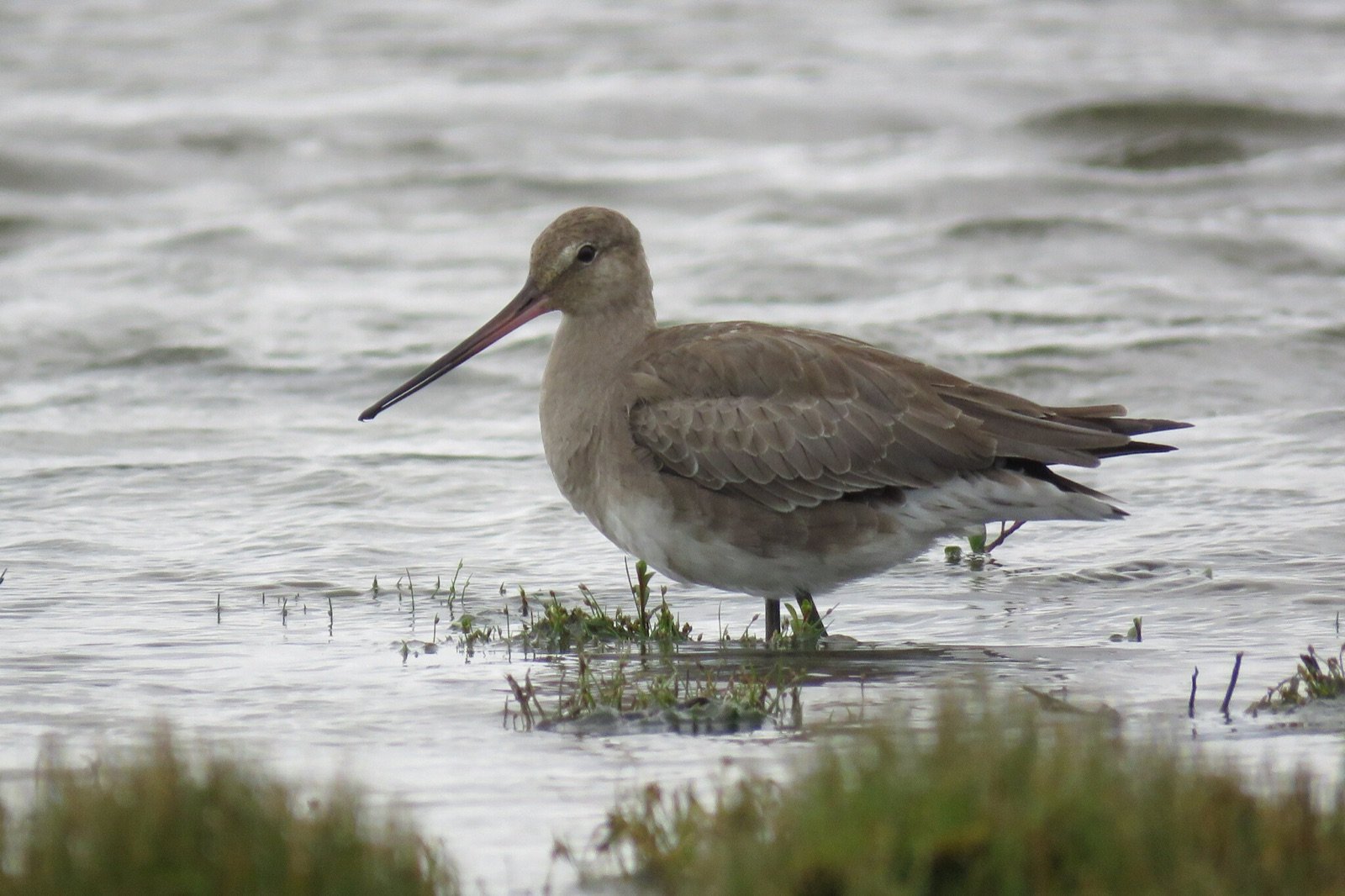
Family Scolopacidae
Hudsonian Godwit
Limosa haemastica
In Spanish: Aguja Lomiblanca
- Migrant
A rare spring migrant on the Gulf of Nicoya, usually just passing over
The Hudsonian Godwit, Aguja Lomiblanca on the official Costa Rican list, is marked M, a migratory species. A Costa Rican checklist labels it rare or accidental, and birders here say a few probably stop each April or May on spring migration while most fly over without landing.
It is an extreme long-distance migrant. It breeds in subarctic North America and flies nonstop in fall to wintering grounds in southern South America.
This page shows what to look for, where one has turned up and why you must move fast when a report comes in.
How to find it
Think of wet, open ground where you can see the water. Flooded rice fields can host this godwit, but only when they are very wet. Scan shallow water and mud for a long, pink-based bill probing deep. At Chomes and Punta Morales Marbled Godwits are the common godwit, often 20 to 80 birds, so look for the odd small, dark godwit in the flock. If a bird takes off, check for the white rump, black tail and blackish underwing. Birds may leave within a day, so timing matters more than anything else.
How to recognise it
Start with the bill: long, slightly upturned and pink at the base. Breeding adults are rich chestnut below with black barring. In non-breeding plumage the bird is grey overall with a white belly.
In flight the marks stand out:
- white rump and upper tail
- black tail
- white stripe in the wing
- blackish underwing, the best mark for telling it from other godwits
In the air it holds its legs out past the tail, with neck and bill stretched forward.
What it sounds like
Behaviour and diet
It feeds by walking through shallow water or mud, probing deep with its long, slightly upturned bill. That makes open, shallow wet ground the place to scan.
In flight it is swift and direct, with powerful wingbeats. The journey is the real story: tracking studies suggest most godwits cross Costa Rica in spring without landing, hopping from Colombia to lagoons on Mexico's Isthmus of Tehuantepec. The few that do stop are the ones birders get to enjoy.
Where it lives
On migration this godwit uses many kinds of freshwater and saltwater habitat. In Costa Rica the records come from wet, open places around the Gulf of Nicoya, such as the shrimp ponds of Paquera and the salt ponds at Punta Morales. Flooded rice fields can also host it, but only when they are very wet and the wet area is visible.
When to see it
Dated Costa Rican sightings all fall in spring: 24 April 2014 at Chomes, 16 May 2020 at Paquera and 21 May of a later year at Punta Morales. Birders say a few probably stop each April or May.
Similar birds
The Marbled Godwit is the bird to rule out. It is larger and buffier, with cinnamon wing linings and a brownish, barred pattern. The Hudsonian is smaller and darker, grey in non-breeding plumage, with a white rump and upper tail and a black tail. Its call is also higher pitched.
Names and lore in Costa Rica
The Costa Rican list uses Aguja Lomiblanca. Elsewhere other Spanish names are in use, including aguja café, aguja de Hudson, becasa de mar, barga aliblanca and picopando canelo.
Status and conservation
The official Costa Rican list marks it M, a migratory species, while the IUCN rates it Vulnerable worldwide because its population is small and its range is fragmented and localized.
Photography tips
Birds can leave on the very day they are found, so go quickly after a report, because the godwit may be gone by the next day. Look in open shallow wet ground, and watch for the pink-based bill probing deep.
How we know this 20 sources, each read on the date shown
- Lista Oficial de las Aves de Costa Rica (AOCR) read 2026-11-04
https://listaoficialavesdecostarica.wordpress.com/lista-oficial/lista-oficial-online/ - Avibase read 2026-11-04
https://avibase.bsc-eoc.org/checklist.jsp?region=CR - Wikipedia read 2026-11-04
https://en.wikipedia.org/wiki/Hudsonian_godwit - Birding Craft read 2026-11-04
https://birdingcraft.com/wordpress/tag/hudsonian-godwit-costa-rica/ - Birding Craft read 2026-11-04
https://birdingcraft.com/wordpress/2020/05/19/birding-costa-rica-may-2020-a-time-for-discoveries/ - 10,000 Birds read 2026-11-04
https://www.10000birds.com/gull-for-a-godwit-in-costa-rica.htm - Audubon Field Guide read 2026-11-04
https://www.audubon.org/field-guide/bird/hudsonian-godwit - Aves de Peru read 2026-11-04
https://avesdeperu.org/scolopacidae/aguja-de-mar-limosa-haemastica/ - Birdfact read 2026-11-04
https://www.birdfact.com/birds/hudsonian-godwit - South Dakota Birds read 2026-11-04
http://www.sdakotabirds.com/species/hudsonian_godwit_info.htm - Birds of the World read 2026-11-04
https://birdsoftheworld.org/bow/species/hudgod/cur/behavior - Avibase read 2026-11-04
https://avibase.bsc-eoc.org/species.jsp?avibaseid=930139644308C7B7 - Birding Craft read 2026-11-04
https://birdingcraft.com/wordpress/2014/05/ - Birding Craft read 2026-11-04
https://birdingcraft.com/wordpress/2022/12/30/my-best-costa-rica-birds-of-2022/ - Eufonias storymap read 2026-11-05
https://storymaps.arcgis.com/stories/eb9b15b14b3a4bd48be6eed8e0257671 - Birding Craft read 2026-11-05
https://birdingcraft.com/wordpress/2014/05/01/why-it-would-be-great-to-have-a-bird-monitoring-station-at-chomes-costa-rica/ - Birds of Passage read 2026-11-05
https://birdsofpassage.wordpress.com/2014/05/16/carara-caldera-chomes-lands-in-love-pocosol-and-fortuna-waterfall/ - GBIF read 2026-11-05
https://www.gbif.org/taxon/6QFCR - Biodiversidad Arequipa read 2026-11-05
https://biodiversidadaqp.com/registro_det/82 - Birds of the World read 2026-11-05
https://birdsoftheworld.org/bow/species/hudgod/cur/introduction?lang=es