Family Charadriidae
Killdeer
Charadrius vociferus
In Spanish: Chorlitejo de Dos Collares (Pijije, Tildío)
- Resident
A two-banded plover of open fields and muddy pond edges.
The Killdeer is a slender plover you look for on open ground. In Costa Rica it is locally common as a migrant and winter visitor, from the lowlands up to middle elevations on both the Caribbean and Pacific slopes.
Migrants arrive in late August and September and leave between April and May. A few birds stay all year and breed around Cartago, so this is a shorebird that can turn up well inland.
On a trip we build, guests can meet it in open lowland and mid-elevation farmland, pastures and pond edges. Scan short grazed ground for a single bird.
How to find it
Look in open, short, grazed or plowed ground, and on the muddy edges of ponds and pools. Birds seen in Costa Rica are solitary, so scan fields for single birds. Besides dry ground, check the edges of freshwater ponds and muddy lagoons. Listen for the far-carrying call, which also sounds overhead at night. Killdeer do not come to feeders, so go to the fields. The Cartago area is where a few birds stay and breed.
How to recognise it
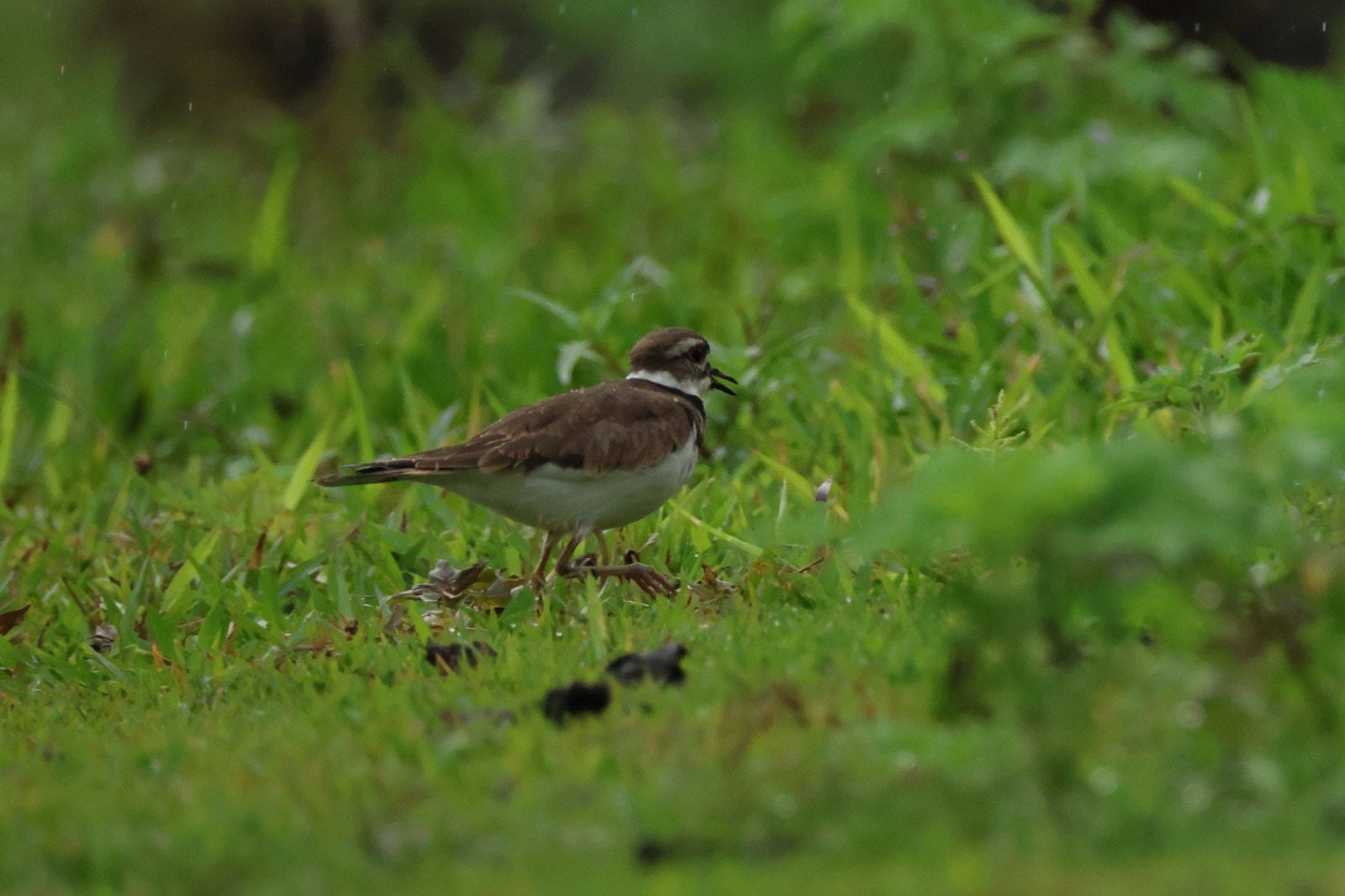
Start with the chest: two black bands across it.
The Killdeer is a relatively large, slim plover, about 25 cm long and about 95 g. Its field marks:
- Back grayish brown
- Rump and tail cinnamon orange
- Tail ending in a long black-and-white tip
- White forehead and a white collar edged in black
- White patch above and behind the eye
- Red eyelids and flesh-colored legs
- Black bill
In flight it shows a white wing stripe and a bright orange-red rump, often the easiest moment to pick it out of a field. Young birds look like adults, but the back feathers have dark subterminal marks and buff fringes.
What it sounds like
Behaviour and diet
Killdeer seen in Costa Rica have all been solitary birds, so expect to find them one at a time rather than in flocks. They fly very high.
On the ground they run in short spurts, then stop with a jolt now and then to check their progress or look for startled insects. Across its range the species eats mostly insects, other invertebrates and seeds.
Near nests and chicks it performs a broken-wing act to lure intruders away. During migration Killdeer occasionally climb as high as 3000 m in Costa Rica.
Where it lives
In Costa Rica the Killdeer lives in plowed fields, pastures, savannas and muddy flats beside ponds and pools. It will also use lawns, gravel roads and even rooftops, and short grass or bare ground suits it best.
It occurs from the lowlands up to middle elevations on both the Caribbean and Pacific slopes. A few individuals stay all year and breed around Cartago, and they probably also breed at other sites in the central mountains.
When to see it
Migrant Killdeer arrive in late August and September and leave between April and May, while a few birds stay all year. Breeding in Costa Rica is reported from May to June, with clutches of 3 to 4 buff eggs with dark blotches.
Similar birds
The double chest band separates the Killdeer from other plovers, which usually show a single band. The Semipalmated Plover has one band. Chicks and young birds can show only one band, so check the orange rump, the long tail and the white forehead and collar too.
Names and lore in Costa Rica
Costa Rican names for the Killdeer include Pijije, Tildío, Chorlitejo Tildío and Chorlitejo de Dos Collares.
Status and conservation
The official Costa Rican bird list gives the Killdeer as resident and migrant (R, M), and worldwide it is now rated Near Threatened after its population fell by more than 20% over three generations.
Photography tips
Birds feed almost only in fields, preferring short vegetation kept low by cattle and fields with standing water. Killdeer can be surprisingly hard to spot on green lawns despite their tawny color, so scan lawns and short fields and listen for the call. They may circle you in flight.
How we know this 15 sources, each read on the date shown
- Aves de Costa Rica read 2026-11-04
https://www.avesdecostarica.com/Charadrius-vociferus.html - Lista Oficial de las Aves de Costa Rica (AOCR) read 2026-11-04
https://listaoficialavesdecostarica.wordpress.com/lista-oficial/lista-oficial-online/ - Birda read 2026-11-04
https://app.birda.org/species-guide/6501/Killdeer - Tennessee Wildlife Resources Agency read 2026-11-04
https://www.tn.gov/twra/wildlife/birds/killdeer.html - BirdBuddy Wiki read 2026-11-04
https://app.mybirdbuddy.com/birds/killdeer/240582bf-e07d-4c2c-b5c9-482c57e3e9b5 - Bird Watching Costa Rica read 2026-11-04
https://www.birdwatchingcostarica.com/ave/killdeer/ - NatureMapping Foundation read 2026-11-04
https://naturemappingfoundation.org/natmap/facts/killdeer_712.html - Birds for Beer (Paul Pickering) read 2026-11-04
https://birdsforbeer.com/2016/01/05/my-first-killdeer-in-costa-rica/ - Animalia.bio read 2026-11-04
https://animalia.bio/killdeer - DIBird read 2026-11-05
https://dibird.com/species/killdeer/ - Focusing on Wildlife read 2026-11-05
https://focusingonwildlife.com/news/galleries/waders/killdeer-charadrius-vociferus/ - iNaturalist (Wikipedia text) read 2026-11-05
https://www.inaturalist.org/taxa/4793-Charadrius-vociferus - Hotel Rivel blog read 2026-11-05
https://hotelrivel.online/ein-hauch-des-nordens-in-unserer-mitte-der-killdeer/ - Cornell Birds of the World read 2026-11-05
https://birdsoftheworld.org/bow/species/killde/cur/introduction - All About Birds, Cornell Lab read 2026-11-05
https://www.allaboutbirds.org/guide/Killdeer/overview