Family Bucconidae
Lanceolated Monklet
Micromonacha lanceolata
In Spanish: Monjito Rayado
- Resident
A tiny streaked puffbird of Caribbean foothill forest, heard before it is seen.
The Lanceolated Monklet is a tiny, round, brown puffbird, 13 to 15 cm long, and a Costa Rican guide blog called it the hardest puffbird to see in the country. Its behaviour and uncommon status make it hard to spot, and guides often find it by hearing it first.
In Costa Rica it lives on the Caribbean slope, and its range there continues south into west central Panama. On trips we build around the Turrialba foothills, the Río Tuis valley below one lodge is where the guides go for it, and a guided day in the valley's forest reserve looks for tanagers and for the monklet if the guide's luck holds.
One Costa Rican birder describes it as a bird that hides in plain sight, and he searched one site for over ten years before getting perfect views.
Where to see it
How to find it
Guides often find the monklet by hearing it first, so listen for the rising, thin whistles. Costa Rican guides whistle an imitation of the song and listen for a reply, and one does this in foothill ravines and rivers and sometimes gets an answer. Scan mid-level perches at forest edges and clearings, since it hunts from about 4 to 8 m up. Because it sits still, extra pairs of eyes in a group help. A morning in the Río Tuis valley does not always succeed, so it helps to allow more than one try.
How to recognise it
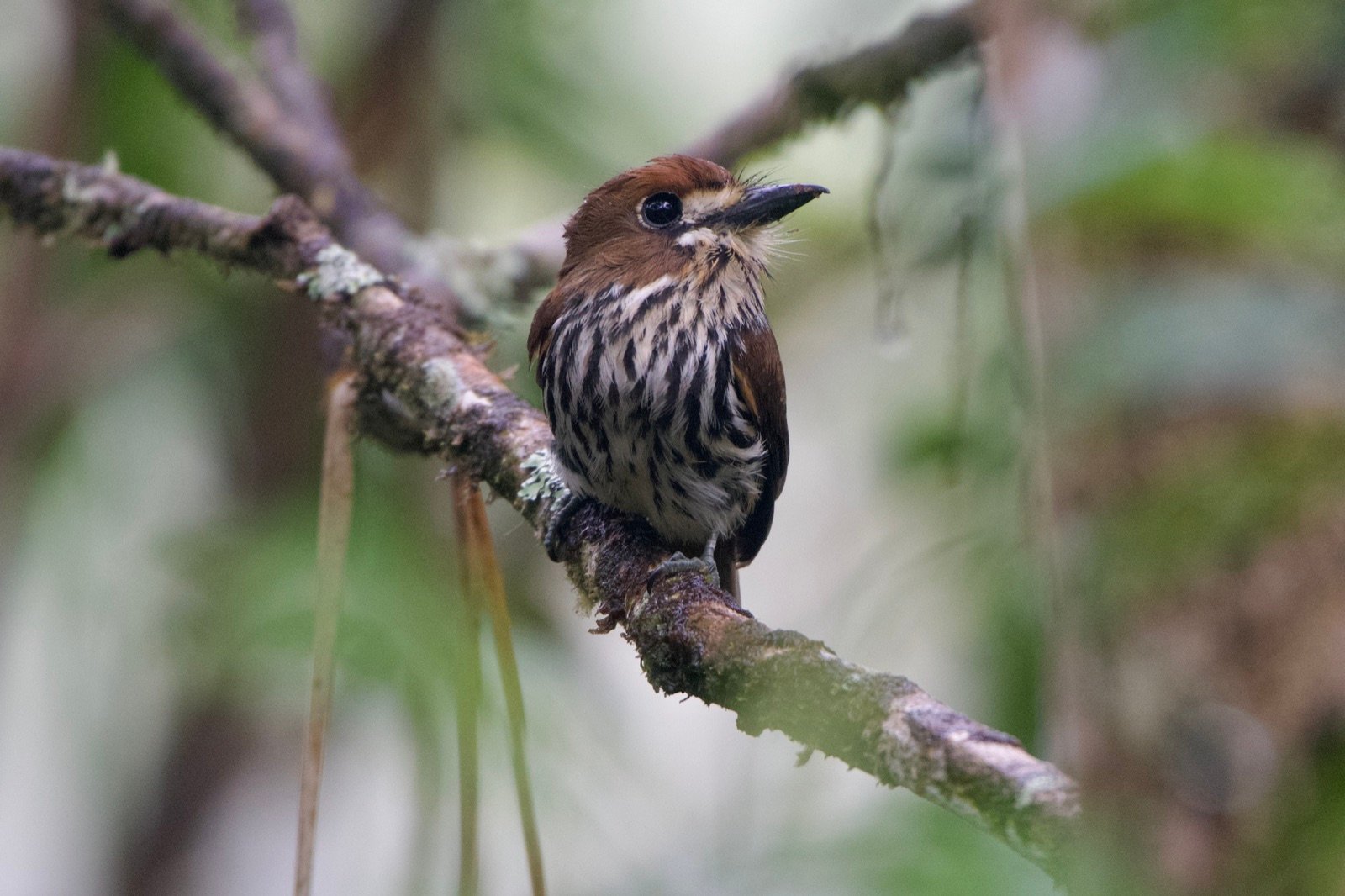
Look for a tiny, round, brown puffbird, 13 to 15 cm long. It has a stout black bill with white bristles and whisker tufts, and pale underparts boldly streaked with black. The forehead is white, and white lores look like spectacles. The centre of the belly is unstreaked, and the vent area has an ochre tinge. The tail is dull brown with a pale tip, dark brown above and gray below. The legs and feet are olive-gray. Overall it is a small, squat bird with a big head and brown upperparts, and a well-seen monklet is unlikely to be confused with other birds.
What it sounds like
Recording: Niels Krabbe, CC BY-SA 4.0, source, read 5 Nov 2026.
Behaviour and diet
The monklet perches quietly and can stay still for long periods. It is often seen loosely joining flocks in the sub-canopy, which makes it easy to overlook. It hunts from a perch about 4 to 8 m up, and from there it flies out to catch insects. It feeds on insects and berries. Like other puffbirds it sits still, and puffbirds also move the tail back and forth like owls do. Nesting has been documented in southeastern Peru, where it uses a tunnel dug into an earthen bank and lays two white eggs.
Where it lives
In Costa Rica the monklet favours wet forest at lower middle elevations, usually on the Caribbean slope. Across its whole range it mostly occurs between 300 and 1,500 m, and has been found as high as 2,100 m. Range-wide it uses forest edges, clearings in mature forest, small forest patches and shade coffee plantations, and it tends to stay in the middle and upper levels of the vegetation. Costa Rican guides look in foothill rainforest, along streams and in mossy forest.
Similar birds
Puffbirds can be mistaken for pygmy owls because of their shape and colour, and both move the tail back and forth. A well-seen monklet, though, shows the white spectacles, brown upperparts and thick black streaks on white underparts.
Names and lore in Costa Rica
Costa Ricans call this bird Monjito Rayado, the name on the official Costa Rican list. Other Spanish names used elsewhere include Monjilla Lanceolada, Buquito Rayado and Chacurú Chico.
Status and conservation
The AOCR list marks it as a resident (R), and the IUCN rates it Least Concern, with a large range.
Photography tips
One photographer shot a monklet at 600 mm, with the bird perched quietly near a forest edge or clearing. Look for it there and let the group's extra pairs of eyes help, since it stays still.
Trips that find it
- Bird Photography in Costa Rica9 nightsSee the trip
- Best of Birding in Costa Rica's Caribbean9 nightsSee the trip
- Caribbean Lowlands Birding Tour11 nightsSee the trip
- Birding in Costa Rica's Eco-Zones11 nightsSee the trip
Tell us when you are travelling and our team in Costa Rica builds the trip around the birds you want to see.
Plan my birding tripHow we know this 17 sources, each read on the date shown
- Wikipedia read 2026-11-04
https://en.wikipedia.org/wiki/Lanceolated_monklet - Tica Birding Adventure blog read 2026-11-04
http://ticabirdingadventure.blogspot.com/2017/12/costa-rica-birding-challenge-at-rancho.html - Bird Watching Costa Rica read 2026-11-04
https://www.birdwatchingcostarica.com/ave/lanceolated-monklet/ - Animalia.bio read 2026-11-04
https://animalia.bio/lanceolated-monklet - Birda read 2026-11-04
https://app.birda.org/species-guide/10956/Lanceolated_Monklet - Wilson Journal of Ornithology read 2026-11-04
https://www.tandfonline.com/doi/full/10.1676/1559-4491-128.3.593 - Birding Craft read 2026-11-04
https://birdingcraft.com/wordpress/2013/12/ - Birding Craft read 2026-11-04
https://birdingcraft.com/wordpress/category/costa-rica-bird-finding-guide/ - Cornell Birds of the World read 2026-11-04
https://birdsoftheworld.org/bow/species/lanmon1/cur/introduction - Birding Craft read 2026-11-04
https://birdingcraft.com/wordpress/tag/white-whiskered-puffbird/ - Birding Craft read 2026-11-04
https://birdingcraft.com/wordpress/2015/02/05/a-monklet-says-hello-in-costa-rica/ - Birding Craft read 2026-11-04
https://birdingcraft.com/wordpress/tag/snowcap/ - Avibase read 2026-11-04
https://avibase.bsc-eoc.org/species.jsp?avibaseid=BF43193044ACDB9A - Macaulay Library read 2026-11-04
https://macaulaylibrary.org/asset/543350431 - Birding Craft read 2026-11-04
https://birdingcraft.com/wordpress/tag/costa-rica/page/27/ - FotoNat read 2026-11-04
https://fotonat.org/foto/123192-monjecito-lanceolado-micromonacha-lanceolata - Ecosistemas de Costa Rica read 2026-11-04
https://ecosistemasdecostarica.blogspot.com/2012/08/aves.html