Family Passerellidae
Lark Sparrow
Chondestes grammacus
In Spanish: Sabanero Arlequín
- Migrant
A harlequin-faced sparrow that strays into Costa Rica only now and then.
The Lark Sparrow, Sabanero Arlequín in Costa Rica, is one of the great long shots of our birding. A Costa Rican records paper calls it a very rare migrant, and the species was only recently found in the country.
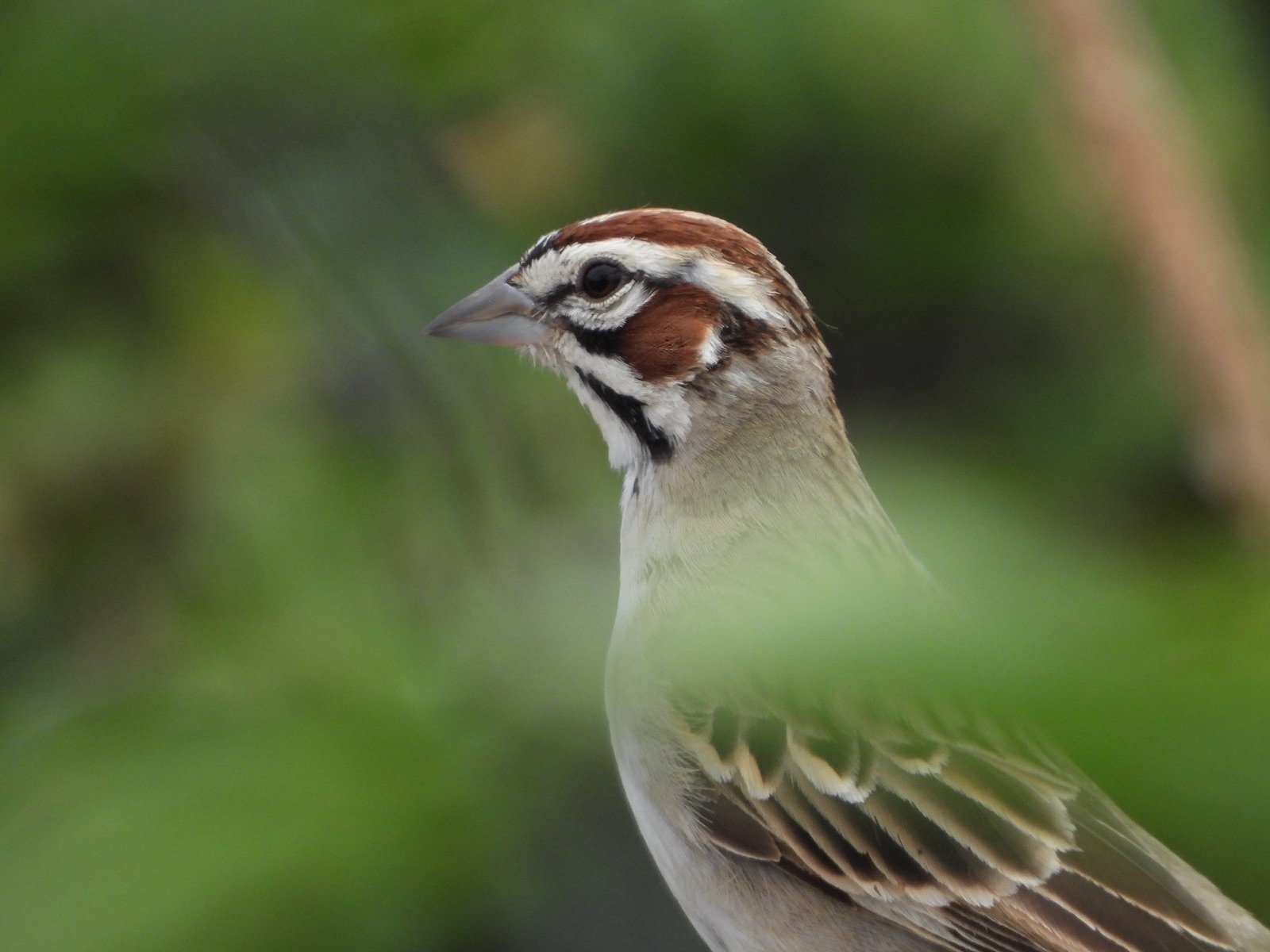
It is a fairly large sparrow with chestnut ear patches and a face striped in black and white. Records have come from the Caribbean lowlands and from Guanacaste.
One sat right on the main road to Palo Verde National Park in December 2021, and a Costa Rican guide called it the first Costa Rican bird that birders could easily twitch. On a trip we build through Guanacaste, that is the kind of open country worth scanning.
How to find it
Treat this bird as a bonus, not a target. Scan open, tree-poor country such as pastures, fields and roadsides in Guanacaste and the Caribbean lowlands. Check sparrow flocks for the face pattern and the white tail corners, and listen for the thin sit flight call. A Costa Rican guide notes that unbirded fields and pastures may hide more of them than we know. Because most records are one-day birds, a bird found by someone else may be gone the next day.
How to recognise it
Look for a fairly large sparrow, 15 to 17 cm long, with a striking face pattern.
- Chestnut ear patches and chestnut crown stripes
- White and black stripes framing the face
- Whitish breast with one dark central spot
- Long, rounded tail, dark with bright white corners
In flight the white corners look almost like a white band at the tail tip, so watch for it when a bird flushes from the ground.
Juveniles look like adults but have coarse dark streaks on the breast and flanks, and their upperparts show bolder black markings. The Savegre bird was in breeding plumage, so a sharp face pattern is what to expect on an adult.
What it sounds like
Recording: Michele Jones, CC BY 4.0, source, read 4 Nov 2026.
Behaviour and diet
Across its range the Lark Sparrow migrates in flocks of its own kind, or in mixed flocks with other sparrows, so a sparrow flock is worth a careful look. It forages on the ground or in low bushes.
In Costa Rica it is not a flock bird. The records are of single birds, and a Costa Rican guide says most were one-day birds that were not seen again. The Savegre bird sat 2 m up in a bush at the edge of secondary forest.
Where it lives
It lives in open areas with few trees. In Costa Rica it has been recorded in such country, in Guanacaste and the Caribbean lowlands.
Across its range it likes open country with scattered trees and shrubs, with pastures, farms and roadsides as typical spots.
The records reach beyond those two regions. One bird was at Savegre on Cerro de la Muerte, at 2,320 m, one in Puntarenas, and two in the Central Valley at Valle del Sol in San José.
When to see it
Rare and lost birds can turn up in Costa Rica in almost any month, and a local guide says November and December are the best months for them. Reported dates include 2 October 2007, November 2008 and December 2021.
Names and lore in Costa Rica
Costa Rica's official Spanish name is Sabanero Arlequín. A Costa Rican natural history site calls it Gorrión arlequín, and elsewhere it is also called Chingolo arlequín.
Status and conservation
The AOCR list marks the Lark Sparrow as M, a migrant, and a very rare one here; worldwide the IUCN rates it Least Concern.
Photography tips
The 2021 bird on the Palo Verde road was cooperative, so it allowed birders to see it. Because most Costa Rican records are single birds that do not stay, be ready to move quickly when a report comes in.
How we know this 18 sources, each read on the date shown
- Aves de Costa Rica read 2026-11-04
https://avesdecostarica.com/Chondestes-grammacus.html - Cuadernos de Investigación UNED read 2026-11-04
https://revistas.uned.ac.cr/index.php/cuadernos/article/download/197/123 - Flickr (Costa Rica natural history notes, Bagaces) read 2026-11-04
https://www.flickr.com/photos/jobando/51786511144 - Cornell Birds of the World read 2026-11-04
https://birdsoftheworld.org/bow/species/larspa/cur/appearance - Wikipedia read 2026-11-04
https://en.wikipedia.org/wiki/Chondestes_grammacus - Wikimedia Commons (IUCN status) read 2026-11-04
https://commons.wikimedia.org/wiki/Category:Chondestes_grammacus - Flickr (Costa Rican natural history entry, Bagaces photo) read 2026-11-04
https://www.flickr.com/photos/jobando/51785524196 - Avibase read 2026-11-04
https://avibase.bsc-eoc.org/species.jsp?avibaseid=78509A5D6015C509 - Sandoval et al., Recent records of new and rare bird species in Costa Rica (ResearchGate) read 2026-11-04
https://www.researchgate.net/publication/236176245_Recent_records_of_new_and_rare_bird_species_in_Costa_Rica - Birding Craft read 2026-11-04
http://birdingcraft.com/wordpress/2024/11/27/its-rare-bird-time-in-costa-rica/ - Birding Craft read 2026-11-04
http://birdingcraft.com/wordpress/2021/12/08/costa-rica-birding-news-december-2021/ - Birding Craft read 2026-11-04
https://birdingcraft.com/wordpress/2023/10/03/october-the-most-exciting-month-for-birding-in-costa-rica/ - Birding Craft read 2026-11-04
https://birdingcraft.com/wordpress/2021/ - Wikipedia text via iNaturalist read 2026-11-04
https://www.inaturalist.org/taxa/10479-Chondestes-grammacus - Featherbase read 2026-11-05
https://www.featherbase.info/es/species/chondestes/grammacus - Lista Oficial de las Aves de Costa Rica (AOCR) read 2026-11-05
https://listaoficialavesdecostarica.wordpress.com/lista-oficial/lista-oficial-online/ - Grokipedia read 2026-11-05
https://grokipedia.com/page/Lark_sparrow - Birda species guide read 2026-11-05
https://app.birda.org/species-guide/34619/Lark_Sparrow