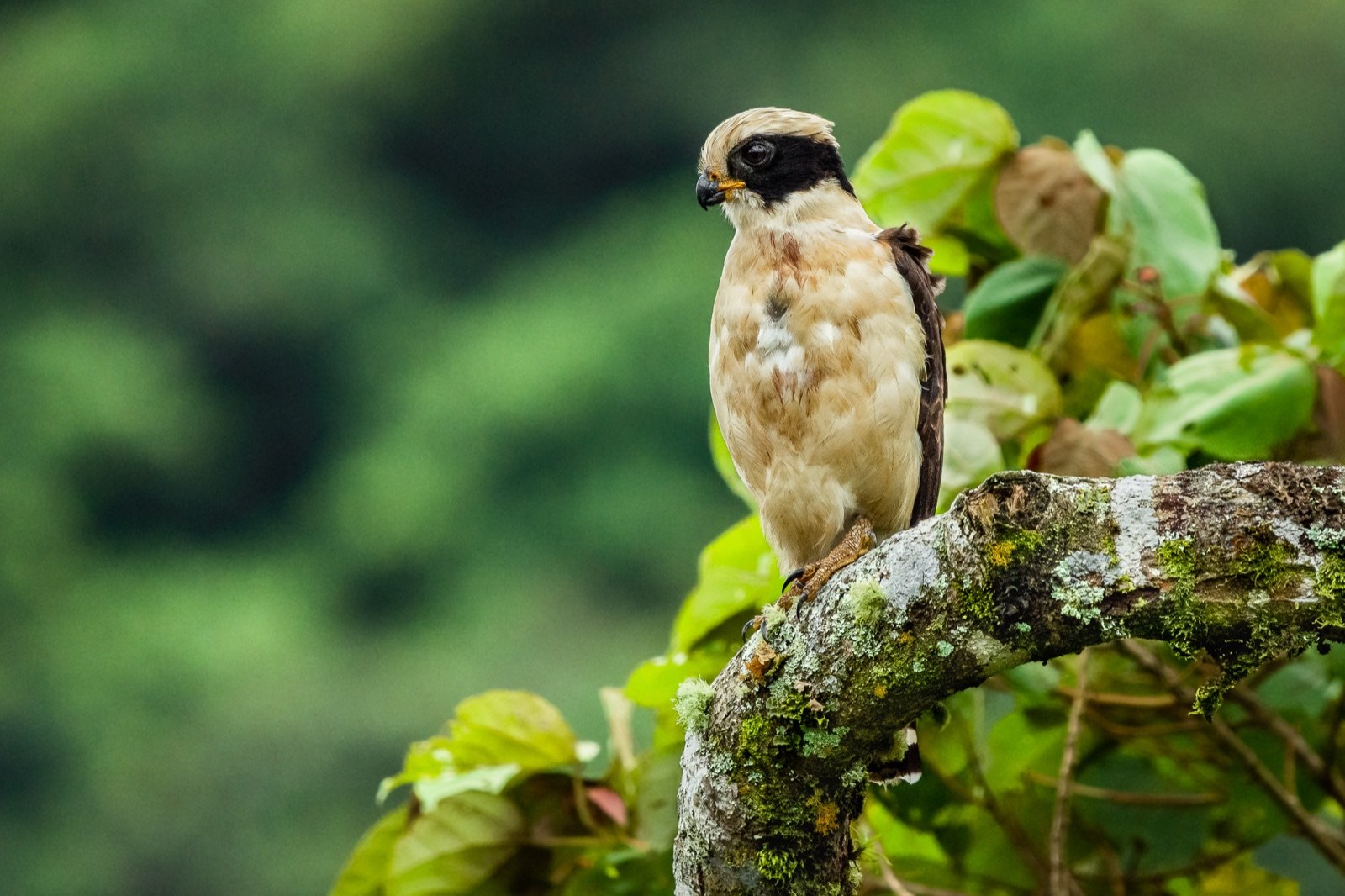
 Laughing Falcon
Family Falconidae
Laughing Falcon
Herpetotheres cachinnans
In Spanish: Guaco
- Resident
A black-masked snake hunter whose booming laugh carries across open country.
The Laughing Falcon is a resident in Costa Rica and one of the easier raptors for a beginning birder to meet, because it calls loudly out in the open instead of hiding in dense cover. Its Spanish name, Guaco, imitates that call.
It is found across most of the country and is fairly common in the lowlands on both the Pacific and Caribbean slopes, except where people hunt it. Look for it on a high, bare branch over a pasture or along a forest edge.
Around Turrialba it is the falcon seen and heard most regularly, among about seven falcon and caracara species a visitor can reasonably expect there. On a trip we build, listen first, then scan the treetops.
How to find it
Listen for the call first. If the bird is close, you may then find it on a high, open branch. Scan the upper branches of trees along pastures and forest edges, since the falcon often sits high and watches the ground for food. Dawn and dusk are the times to try, and the open habitat can make it tricky to spot. The call is heard most often at dusk. On a drive toward Sarapiqui it is one of the possible rainforest raptors, along with Crested Caracara, Gray Hawk and Roadside Hawk.
How to recognise it
This is a medium-sized falcon, about 53 cm long, with a stocky body, a big head, short rounded wings and a long rounded tail.
Look for these marks:
A pale cream head and underparts on adults.
A broad black mask across the eyes that wraps around the neck as a narrow collar.
A small bushy crest on the crown.
Dark brown to blackish back and wings.
A dark tail with pale bands.
A black bill with a yellow base, and yellowish legs.
Males and females look alike. Young birds have a richer buff head and underparts, a scaled-looking back and narrower pale tail bands.
What it sounds like
Behaviour and diet
The Laughing Falcon is usually solitary. It perches for a long time on high, exposed branches with a good view of its surroundings, often in plain view on one branch for hours, upright and alert. It may flick its tail, nod, or shuffle along the perch with slow steps.
It flies slowly with short, shallow wingbeats and glides gently. After a long watch it drops suddenly and grips prey with strong feet. Snakes make up most of its diet, and it also eats rodents and lizards. Two birds sometimes duet.
Where it lives
In Costa Rica it occurs locally up to about 1,850 m and rarely climbs higher. Elsewhere in Central America it usually stops near 1,500 m. It is fairly common in the lowlands of both the Pacific and Caribbean slopes.
It likes forest edges, broken or fragmented forest, semi-open country, second growth and lone savanna trees, including the edges of dry and evergreen forest. It tends to avoid mature forest and often sits in the few trees left in pastures.
When to see it
Dawn and dusk are suggested as the best times to look. Around Turrialba a local birder says it is very active in the early morning and around dusk, and stays active well into the evening. Eggs are laid early in the dry season, in February and March, in Guatemala and Costa Rica.
Similar birds
Collared Forest-Falcon's call is sometimes likened to the Laughing Falcon's, but the Laughing Falcon's call is much faster and has a gwa sound. When a second Laughing Falcon joins in, it turns into a cackle. Costa Rican forest-falcons stay in dense cover and call from hiding, while the Laughing Falcon calls loudly out in the open, so it is the far easier one to see.
Names and lore in Costa Rica
Costa Ricans call it guaco, and also halcón guaco or halcón reidor. Other local names listed for it include halcón risueño, valdivia and guaicurú. Village people use the name Guaco because it echoes the bird's eerie, obsessive call, and the naturalist Skutch wrote about it in a chapter called the snake hunter.
Folk belief holds that a guaco bitten by a venomous snake eats the guaco vine (bejuco de guaco) to avoid dying. One account says the Huetar people saw it as a protector against venomous snakes, because it visited caves hunting them, and saw its call as a sign of new life or a death. A popular legend says that when the guaco sings, someone will die, though a Costa Rican guide's post calls this only a myth.
Status and conservation
The AOCR list marks it as a resident (R), and the IUCN lists it as Least Concern, with a very large range.
Photography tips
Perched birds can be far off and poorly lit: one photographer in La Fortuna noted the bird was a little distant and in shade. Another shot a roadside perched bird near San Miguel at 10:34 am with a fast shutter, 1/1600 s, and plus 2/3 exposure compensation.
How we know this 21 sources, each read on the date shown
- Aves de Costa Rica read 2026-11-04
https://www.avesdecostarica.com/Herpetotheres-cachinnans.html - Wikipedia read 2026-11-04
https://en.wikipedia.org/wiki/Laughing_falcon - Redes de aprendizaje (MEP Costa Rica) read 2026-11-04
https://mep.janium.net/janium/Documentos/huaco.pdf - World Bird Photos read 2026-11-04
https://www.worldbirdphotos.com/photo/falcon-laughing-herpetotheres-cachinnans-adult-taking-off-costa-rica/ - Nigel Forrow Photography read 2026-11-04
https://www.nigelforrow.co.uk/laughing-falcon-perched-costa-rica - Tico Times read 2026-11-04
https://ticotimes.net/2023/08/11/costa-rica-wildlife-meet-the-laughing-falcon - The Peregrine Fund read 2026-11-04
https://peregrinefund.org/explore-raptors-species/falcons/laughing-falcon - Hotel Rivel blog read 2026-11-04
https://hotelrivel.online/the-laughing-falcon-hearty-hunter-with-a-hilarious-call/ - Montes de Oro (Costa Rica) read 2026-11-04
https://montesdeoro.go.cr/el-guaco/ - El Norte Hoy read 2026-11-04
https://elnortehoycr.com/2023/07/27/60389/ - Birding Insider read 2026-11-04
https://birdinginsider.com/wild-birds/collared-forest-falcon-guide/ - Birding Craft read 2026-11-04
https://birdingcraft.com/wordpress/tag/collared-forest-falcon/ - Historias Zoologicas read 2026-11-04
https://historiaszoologicas.blogspot.com/2014/12/el-macagua-o-guaco-un-halcon-que-rie.html - Birds for Beer read 2026-11-04
https://birdsforbeer.com/2019/03/10/falcons-and-caracaras-in-turrialba/ - Birding Craft read 2026-11-04
https://birdingcraft.com/wordpress/2010/09/07/where-are-the-raptors-when-birding-costa-rica/ - Birding Craft read 2026-11-04
https://birdingcraft.com/wordpress/tag/raptors/ - Pinterest (Aves de Costa Rica note) read 2026-11-04
https://www.pinterest.com/pin/563794447079817893/ - TikTok (Costa Rican nature accounts) read 2026-11-04
https://www.tiktok.com/discover/pajaro-guaco-cantando - iVoox, Podcast Naturaleza Aves read 2026-11-04
https://www.ivoox.com/en/canto-guaco-o-halcon-reidor-herpetotheres-cachinnans-audios-mp3_rf_1002950_1.html - Flickr (Rosa Gamboias) read 2026-11-04
https://www.flickr.com/photos/rgamboias/33715449633 - Ecos del Bosque (quoting Stiles and Skutch) read 2026-11-04
https://ecosdelbosque.com/fauna/herpetotheres-cachinnans