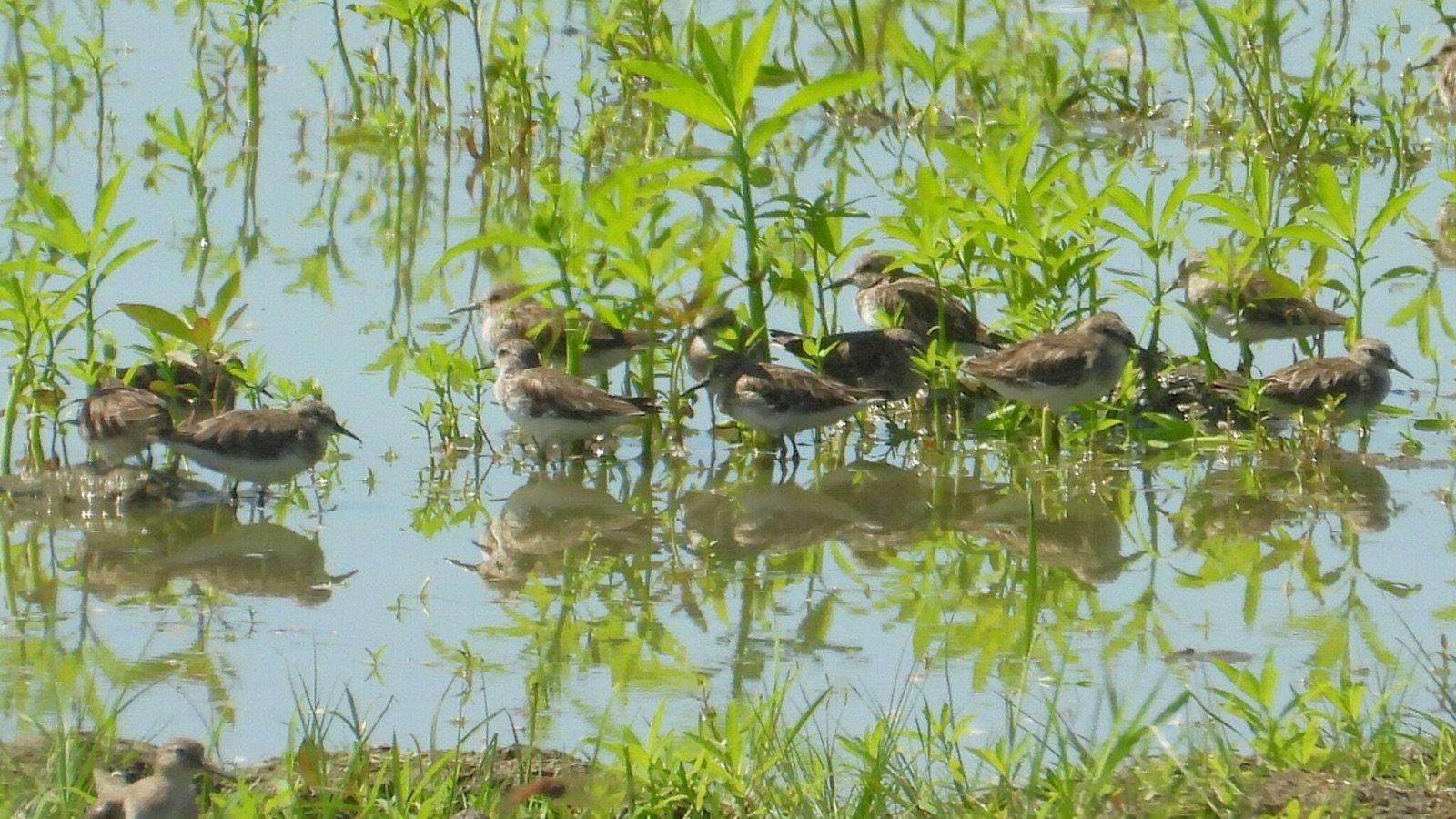
Family Scolopacidae
Least Sandpiper
Calidris minutilla
In Spanish: Correlimos Menudo (Patudo, Becacina)
- Migrant
Tiny brown sandpiper, a Pacific coast migrant around the Gulf of Nicoya
The Least Sandpiper is a very small, slim, brown sandpiper, about 14 cm long. In Costa Rica it is mainly a winter visitor on the Pacific coast, where it is fairly common.
It is most numerous around the Gulf of Nicoya and much scarcer on the Caribbean coast, so a Pacific mudflat or wetland is the place to start. As a migrant it is common and sometimes locally abundant, which makes it a good first small shorebird to learn.
Shorebirds can look like a blur of similar brown birds at first. This one rewards a little attention, because its size, leg color and feeding habits give you clear things to check.
How to find it
Start on the Pacific side and give the Gulf of Nicoya priority. Scan the higher, drier parts of a mudflat or pond edge rather than only the wet margins, because this species tends to feed there. Check any flock of Western Sandpipers, since the two often mix. Listen for the two-part kree-eet when birds flutter up on short, weak flights. If the legs look dark, wait for the bird to move onto cleaner ground.
How to recognise it
Think small, slim and brown. The bird is about 14 cm long.
Look for these marks:
- a fairly short dark bill
- yellowish legs
- whitish eyebrows
- white sides to the rump
- a narrow white wing stripe
On the mud it can seem a plain brown dot, so the leg color is the mark to check. Mud can hide it, so do not rely on the legs alone and look at the other marks too. Next to Semipalmated and Western Sandpipers it is browner and darker, and also smaller, with a shorter bill and shorter legs.
What it sounds like
Recording: Linzy L., CC BY-SA 4.0, source, read 4 Nov 2026.
Behaviour and diet
The Least Sandpiper walks hunched over and probes for tiny crustaceans, insects and other invertebrates. It tends to feed higher on mudflats, or along the drier edges of inland ponds, than other Calidris sandpipers.
At a Chomes pool in August, Least Sandpipers were seen running around the drier parts of the pool, while dowitchers and Western Sandpipers probed the muddy margins nearby. In flight it flutters, with shorter, weaker flights than Western Sandpiper. In fall and winter it flocks with Western and Semipalmated Sandpipers, Sanderlings and Dunlin.
Where it lives
In Costa Rica this is mainly a bird of the Pacific coast, with the Gulf of Nicoya holding the largest numbers. It is much scarcer on the Caribbean coast.
On its wintering grounds the species uses lagoons, mangroves, wet ditches, swamps, wet fields, mudflats, saltmarshes and the edges of lakes, ponds and rivers. It is not strictly coastal: in Costa Rica it can locally climb as high as 1500 m, and it is on the Palo Verde National Park bird checklist.
When to see it
Passage runs from mid August to mid November and again from March to early May. A few non-breeding birds are occasional on the Pacific coast in summer.
Similar birds
Semipalmated and Western Sandpipers are the usual look-alikes. The Least is browner, darker and smaller, with a shorter bill and shorter, yellowish legs. Next to a Sanderling it is smaller and has yellow legs where the Sanderling's are dark, and it prefers muddy estuaries to open sand.
Names and lore in Costa Rica
Costa Rican names for it include becacina, patudo, correlimos menudo and menudillo. The AOCR name is Correlimos Menudo.
Status and conservation
The AOCR list marks it as M, a migrant, and Avibase lists it on the Costa Rica checklist as Near-threatened.
How we know this 9 sources, each read on the date shown
- Aves de Costa Rica read 2026-11-04
https://avesdecostarica.com/Calidris-minutilla.html - Cornell Birds of the World read 2026-11-04
https://birdsoftheworld.org/bow/species/leasan/cur/identification - Flickr (Jose R. Castello) read 2026-11-04
https://www.flickr.com/photos/36314595@N04/27349492802/ - Avibase read 2026-11-04
https://avibase.bsc-eoc.org/checklist.jsp?region=CR - Exotic Birding read 2026-11-04
https://www.exoticbirding.com/costarica/paloverde/checklist.html - Birding Craft read 2026-11-04
http://birdingcraft.com/wordpress/2012/08/ - 10,000 Birds read 2026-11-05
https://www.10000birds.com/buff-breasted-sandpiper-overload-and-other-fall-birding-highlights-in-costa-rica.htm - Perfect Costa Rica read 2026-11-05
https://perfectcostarica.com/sanderling-costa-rica-photography-guide/ - All About Birds (Cornell) read 2026-11-05
https://www.allaboutbirds.org/guide/Least_Sandpiper/lifehistory