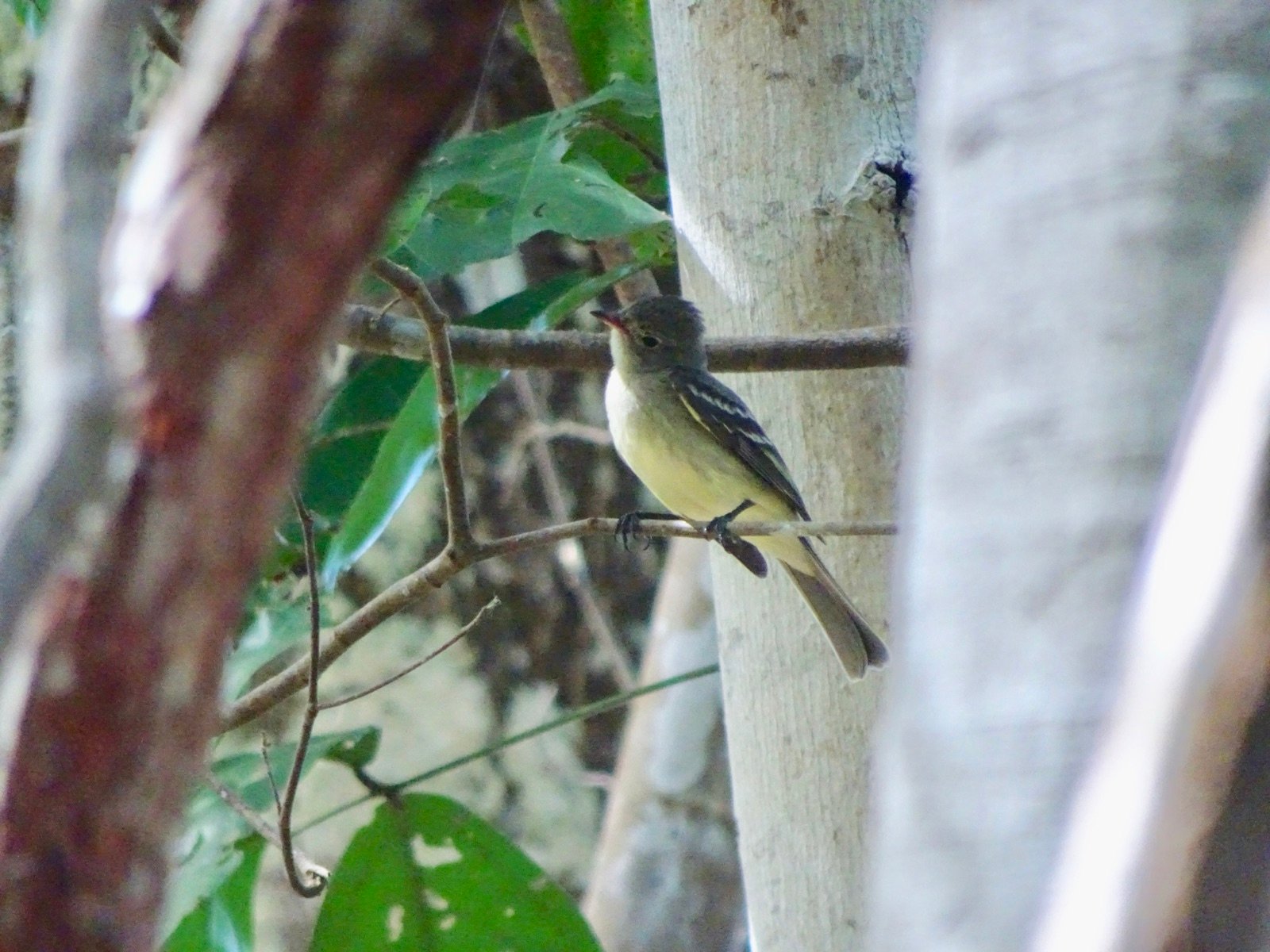
Family Tyrannidae
Lesser Elaenia
Elaenia chiriquensis
In Spanish: Elainia Sabanera (Tontillo)
- Resident
A plain olive flycatcher of open, bushy country, best told by voice.
The Lesser Elaenia (Elainia Sabanera, also called Tontillo) is a plain olive flycatcher with a white eyering and two white wingbars. It looks much like other elaenias, so it rewards the birder who listens as well as looks.
In Costa Rica it lives in the tropical zone of the southwest and in scattered spots inland, at the northern end of the species' range. It is fairly common on the Pacific slope but uncommon in the center of the country.
For a beginning birder it is a good lesson in patience. Elaenias are hard to name by sight, and voice is the usual way to separate the species.
How to find it
Look in open, grassy country with scattered bushes, not in forest. Scan low bushes in grassy areas, where it usually perches. Because it is fairly common on the Pacific slope but uncommon in the center of the country, the Pacific side is the better place to concentrate. Learn the burry two-part call before you go, since calls are the best way to separate it from other elaenias. Listen early for the hurried dawn song as well.
How to recognise it
Look for a plain olive flycatcher with these marks:
A white eyering.
Two white wingbars.
A grayish throat, an olive chest and a whitish yellow belly.
That is the whole palette, and it looks much like other elaenias, so no single mark names it.
The useful comparison in Costa Rica is the Yellow-bellied Elaenia. The Lesser is a bit smaller, a bit less yellow and less crested. The Yellow-bellied has a grayish breast, pale lores and a large bushy crest, while the Lesser carries a smaller crest.
These differences are subtle, so look at the whole bird and let the voice help you decide.
What it sounds like
Recording: agujaceratops, CC BY 4.0, source, read 4 Nov 2026.
Behaviour and diet
This is a small bird that eats both fruit and insects. It is an open-country bird that usually perches on low bushes in grassy areas.
That tells you where to point your binoculars: at bush tops and low perches in open ground, not into forest. It is a quiet, plain bird, easy to overlook, so listening for the calls is often how you find it.
Where it lives
Across its range the Lesser Elaenia lives in overgrown clearings and other open areas with scattered vegetation, below 2000 meters elevation. Natural habitats include dry savanna, dry shrubland, seasonally wet or flooded lowland grassland and heavily degraded former forest. It also uses scrub, light woodland, secondary forest, brushy streamsides, plantations and hedgerows in farmland.
In Costa Rica the local form lives in the tropical zone of the southwest. It also occurs in scattered places in the interior and on the Pacific slope from San José Province south into Panama.
When to see it
Breeding in Costa Rica begins in March, so the dawn song is likely easier to hear around then.
Similar birds
The common lookalike in Costa Rica is the Yellow-bellied Elaenia (Elainia Copetona). Elaenia flycatchers are hard to tell apart, and some are tricky even when held in the hand, so beginners should expect confusion. Size, yellow tone and crest help, but voice is the usual way to settle it.
Names and lore in Costa Rica
The official Costa Rican name is Elainia Sabanera, and Tontillo is given as an alternate name. Sabanera points to savanna, the open grassy country where this bird lives. Tontillo is also used for the Yellow-bellied Elaenia, so the nickname covers more than one elaenia. Elsewhere it has other Spanish names, such as fiofío belicoso in Paraguay and Argentina, elenia or elaenia menor in Panama, Ecuador and Colombia, and fío-fío menor in Peru. Only Costa Rica uses elainia sabanera.
Status and conservation
The AOCR list marks it as a resident (R); it is fairly common on the Pacific slope, uncommon in the center of the country, and rated Least Concern by the IUCN.
Photography tips
Look for it on low bushes in grassy areas, where it usually perches, and not in forest. Because it is quiet and easy to overlook, listen for the burry two-part call to locate a bird before you raise the camera.
How we know this 16 sources, each read on the date shown
- Cornell Birds of the World read 2026-11-04
https://birdsoftheworld.org/bow/species/lesela1/cur/introduction - Wikipedia read 2026-11-04
https://en.wikipedia.org/wiki/Lesser_elaenia - ResearchGate (Hosner 2020 summary) read 2026-11-04
https://www.researchgate.net/publication/339694123_Lesser_Elaenia_Elaenia_chiriquensis - Zootaxa (2015) read 2026-11-04
https://www.mapress.com/zootaxa/2015/f/z04032p263f.pdf - Animalia.bio read 2026-11-04
https://animalia.bio/lesser-elaenia?taxonomy=3005 - Birds of Costa Rica (birdsofcolombia.org) read 2026-11-04
https://www.birdsofcolombia.org/costarica/Elaenia.html - Birds of the World: Tyrannidae (carolinabirds.org) read 2026-11-04
https://carolinabirds.org/HTML/Flycatcher_Tyrannidae_05.htm - Bird Finding read 2026-11-04
https://birdfinding.info/caribbean-elaenia/ - Lista Oficial de las Aves de Costa Rica (AOCR) read 2026-11-04
https://listaoficialavesdecostarica.wordpress.com/lista-oficial/lista-oficial-online/ - Wikipedia (es) read 2026-11-04
https://es.wikipedia.org/wiki/Elaenia_chiriquensis - Birdingcraft read 2026-11-04
https://birdingcraft.com/wordpress/2013/07/09/birding-costa-rica-around-buenos-aires/ - Revista Geográfica (savanna natural history) read 2026-11-04
https://www.revistasipgh.org/index.php/regeo/article/download/861/1323/4449 - Wikipedia (Elaenia) read 2026-11-04
https://en.wikipedia.org/wiki/Elaenia - Costa Rica Birding Trips read 2026-11-05
https://www.costaricabirdingtrips.com/south-pacific/wilson-botanical-garden - Wikipedia read 2026-11-05
https://en.wikipedia.org/wiki/Elaenia_chiriquensis - Cloudbridge Nature Reserve bird list read 2026-11-05
https://cloudbridge.org/wp-content/uploads/2019/05/Bird-Species-List-Costa-Rica-23-May-19.pdf