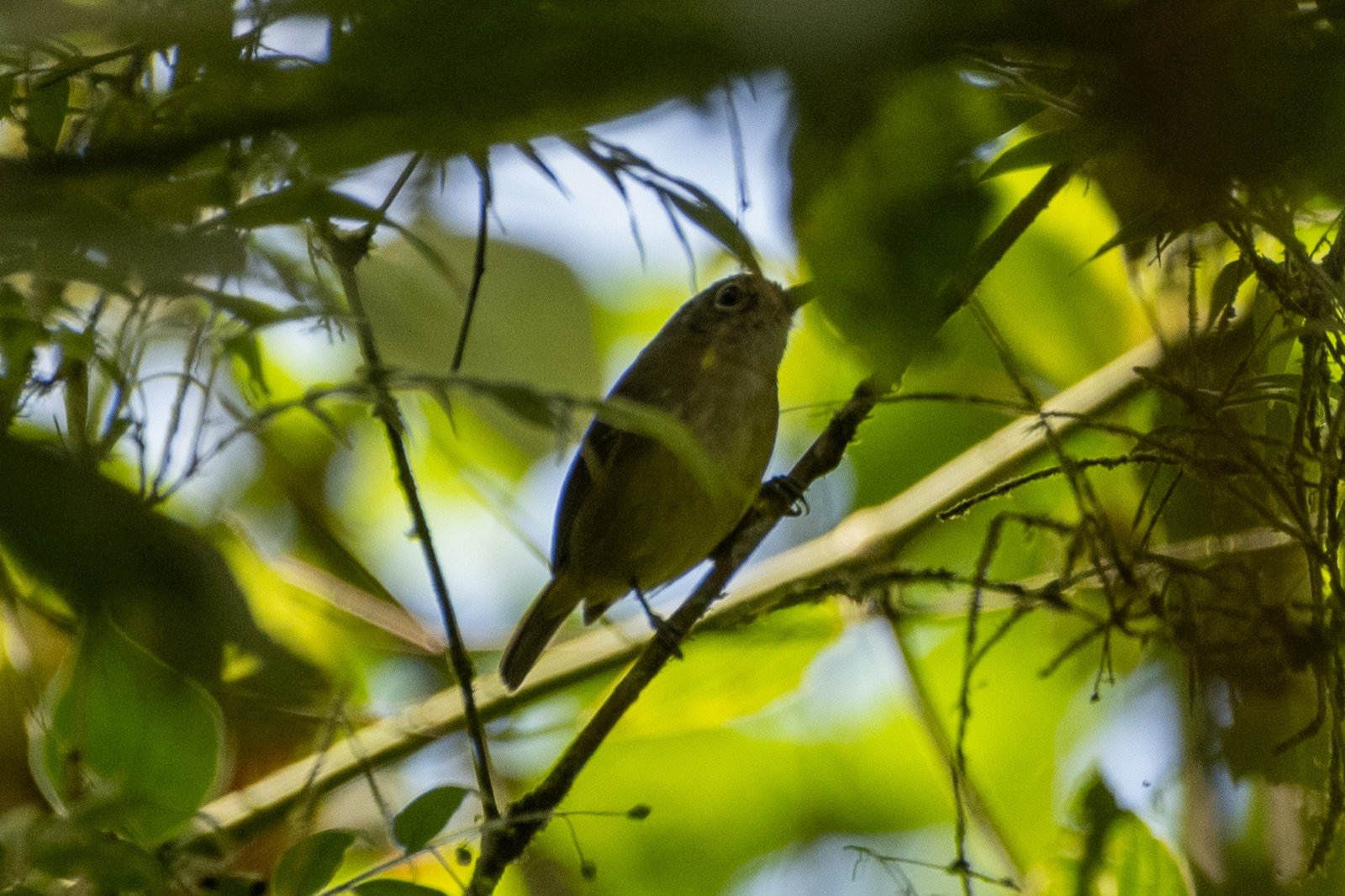
Family Vireonidae
Lesser Greenlet
Pachysylvia decurtata
In Spanish: Verdillo Menudo
- Resident
A small grey-headed canopy vireo, often heard long before it is seen.
The Lesser Greenlet, Verdillo Menudo to Costa Ricans, is a small vireo of the forest canopy and forest edge. It is a resident, common to abundant, across the lowlands and foothills of both the Caribbean and Pacific slopes.
A Costa Rica birding guide calls it easy to overlook but common and often heard, and advises learning its vocalization so you can find it by ear. A tour group that heard it quite often found it seldom front and center, so a little patience pays off.
This page covers how to recognise it, where it has been recorded in Costa Rica, and how to give yourself the best chance of a good look.
How to find it
Check mixed-species flocks in the canopy and at forest edges, where it often travels with other small birds. Learn its song and calls before you go, since it is far more often heard than seen. Then look up, because it is often high in the trees. A tour group called it a challenging species to see well for that reason. In Carara, where it is abundant, check which greenlet you have, as another species also lives there.
How to recognise it
This is a small vireo with a fairly short tail. Across its whole range it is about 10 cm long and weighs about 9 g.
Look for these marks:
- a pale grey head
- a whitish eye ring
- a pale line before the eye
- an olive brown back, wings and tail, the olive green back contrasting with the grey head
- dull whitish underparts with an olive yellow tint
It is a modest bird, so the grey cap against the olive back is the clearest sign when one finally shows itself.
What it sounds like
Behaviour and diet
The Lesser Greenlet is a tireless forager. It searches green foliage, pokes into curled leaves and sometimes hangs upside down. It eats insects and spiders. It lives in pairs and often joins mixed flocks with gnatcatchers, honeycreepers and warblers, so a busy band of small birds in the canopy is worth a careful look. The nest is a deep hanging cup of dead leaves and spider web, placed 10 to 14 m up.
Where it lives
In Costa Rica it is a resident of the lowlands and foothills on both the Caribbean and Pacific slopes. It ranges from sea level to about 900 m in the north and about 1,200 m in the south. It lives in the forest canopy and forest edge, and it also uses treetops in tall second growth. Sometimes it drops down to feed in shrubs in open areas. Conservation areas where it occurs include Amistad Caribe, Arenal, the Central Volcanic Range, Guanacaste, Osa, Central Pacific, Tempisque, Tortuguero, Amistad Pacific and Huetar Norte.
When to see it
Breeding in Costa Rica runs from February to May.
Similar birds
Another Costa Rican greenlet, the Tawny-crowned Greenlet, is also heard and seen in Carara and nearby Villa Lapas, so check which greenlet you have. Across its range the song is slower and more melodious than that of the Yellow-green Vireo, which helps separate the two by ear.
Names and lore in Costa Rica
In Costa Rica and Nicaragua the Spanish name is verdillo menudo. Other countries use other names, such as verdillo menor in Honduras, Mexico and Peru, and verderón chico in Colombia.
Status and conservation
The AOCR list marks it as a resident (R), common to abundant in Costa Rica, and the IUCN rates it Least Concern.
Photography tips
Expect to look up. It is often high in the trees, and one tour group heard it quite often but seldom saw it front and center. They did get views at La Selva. Scanning the canopy and forest edges around a mixed flock gives the best chance of a clear look.
How we know this 12 sources, each read on the date shown
- Flickr (Costa Rican natural history text, Historia Natural) read 2026-11-04
https://www.flickr.com/photos/jobando/32790069024 - PlanetScott read 2026-11-04
http://www.planetscott.com/speciesdetail/5572/lesser-greenlet-(pachysylvia-decurtata) - Ecoregistros read 2026-11-04
https://www.ecoregistros.org/sheet/Pachysylvia-decurtata - Birda read 2026-11-04
https://app.birda.org/species-guide/21374/Lesser_Greenlet - Animalia.bio (from Wikipedia) read 2026-11-04
https://animalia.bio/lesser-greenlet - Birding Craft read 2026-11-04
https://birdingcraft.com/wordpress/2021/11/24/which-bird-vocalizations-to-study-for-birding-in-costa-rica/ - Wikipedia (es) read 2026-11-04
https://es.wikipedia.org/wiki/Pachysylvia_decurtata - Exotic Birding, Carara checklist read 2026-11-04
https://www.exoticbirding.com/costarica/carara/checklist.html - Field Guides trip list 2024 read 2026-11-04
https://fieldguides.com/triplists/cos24PRINT.html - Field Guides trip list 2017 read 2026-11-04
https://fieldguides.com/triplists/cos17.html - Birds & Wildlife tour page read 2026-11-04
https://birdswildlife.com/costa-rica-the-ultimate-tour-march-21st-07th-april-2026/ - Avibase read 2026-11-04
https://avibase.bsc-eoc.org/species.jsp?avibaseid=3F3E18AA