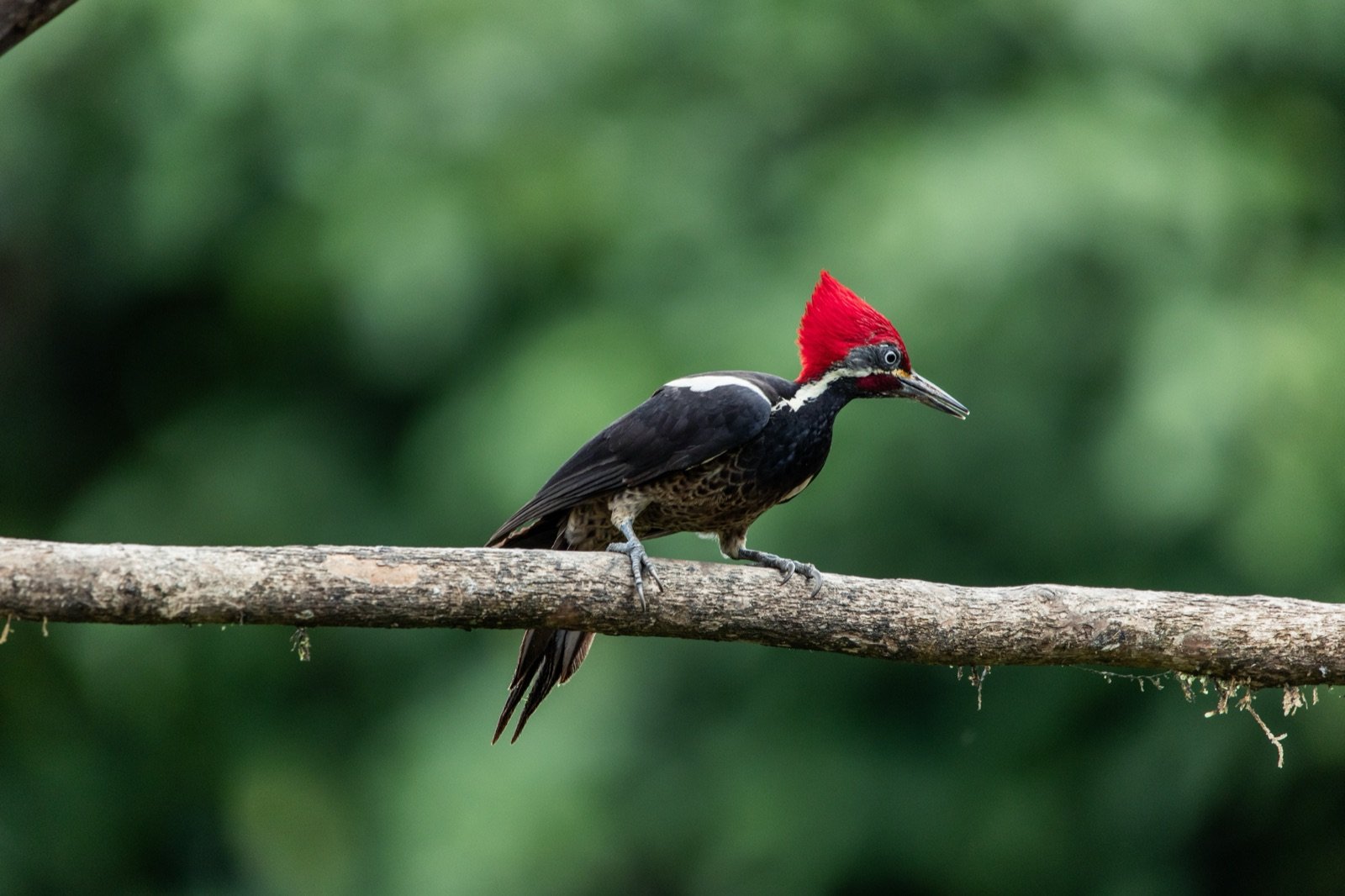
 Lineated Woodpecker
Family Picidae
Lineated Woodpecker
Dryocopus lineatus
In Spanish: Carpintero Lineado
- Resident
A big, red-crested woodpecker that laughs its way through forest edges.
The Lineated Woodpecker, Carpintero Lineado to Costa Ricans, is one of the largest woodpeckers in the country. It is mostly black, with bold white stripes on the face and neck and a bright red crest.
It is described as common and widespread, and one of the easier woodpeckers to see. That makes it a friendly first big woodpecker for a beginning birder.
Check edge habitats and gardens at lowland and middle elevations, where you will usually find one or two birds, and listen for the loud laugh that often gives it away before you see it.
How to find it
Check edge habitats and gardens at lowland and middle elevations, where you will usually find one or two birds. Listen first, since the laughing call and the drumming carry a long way. Then scan trunks and thick branches in farms and rural areas with large trees. This is a wary bird of open and semi-open woodland, so approach slowly. Cecropia trunks are worth a look, because it pecks them for ants.
How to recognise it
Start with size and pattern. This is one of the largest woodpeckers in Costa Rica, mostly black, with a bright red crest and bold white stripes on the face and neck.
A white stripe runs from the bill across the cheek and down the side of the neck. Two white stripes on the back are well separated.
The sexes differ. Adult males have a red crown, crest and malar stripe. Females have a black forehead and a black malar stripe.
The bill changes across the country. It is yellowish ivory in the north, blackish in the south, and in between in the central areas of both slopes, so do not be thrown if the bill differs from a field guide picture.
What it sounds like
Behaviour and diet
The Lineated feeds mostly on ants and their larvae, and also on beetles. It forages on trunks and large branches, digging deep into rotten wood and lifting bark to open holes in search of ants or beetles and their larvae.
It often pecks at Cecropia trunks for the ants living in them, and it also eats heliconia fruits. Birds sometimes forage in small groups of five or six in the trees. Across its range, both parents dig the nest cavity in a dead tree.
Where it lives
It favours forest edges, secondary forest, pasture and scattered trees in semi-open country. It seldom enters dense, very wet forest.
In Costa Rica and Guatemala it lives from sea level to about 900 to 1000 m, and occasionally reaches 1500 m. Spanish-language Costa Rican sources describe a resident ranging from uncommon to fairly common across the lowlands of both slopes.
When to see it
Costa Rican nesting is said to run from January to May, with 3 or 4 eggs.
Similar birds
The Pale-billed Woodpecker is the bird to rule out. The Lineated is slimmer, with a more pointed crest and a striped face. The white line across the lower head is what separates the two, since the Pale-billed has white on the neck but not on the head.
Names and lore in Costa Rica
Costa Ricans use the name Carpintero Lineado. Across its range other Spanish names include carpintero real, carpintero crestirrojo (listed for Nicaragua) and picamaderos listado. A Costa Rican local paper compares its red crest to a Roman helmet and likens the bird to the cartoon woodpecker of the fable "El Pájaro Loco".
Status and conservation
The AOCR list marks it as a resident (R), and Costa Rican sources describe it as common and widespread.
Photography tips
Look for it on trunks and thick branches in farms and rural areas with large trees, where its loud calls and drumming give away its position from a distance. It is wary, so let it settle. In poor light or with the head in shade, the red malar stripe of a male is hard to see, and immature birds are hard to sex without good light.
How we know this 15 sources, each read on the date shown
- Birdingcraft read 2026-11-04
https://birdingcraft.com/wordpress/2012/04/24/what-woodpeckers-are-you-going-to-see-when-birding-costa-rica/ - Aves de Costa Rica read 2026-11-04
https://avesdecostarica.com/Dryocopus-lineatus.html - Costa Rica Journeys read 2026-11-04
https://www.costaricajourneys.com/lineated-woodpecker/ - Mistico Park read 2026-11-04
https://misticopark.com/blog/nature/where-to-find-woodpeckers-in-costa-rica/ - Flickr (text from INBio species account) read 2026-11-04
https://www.flickr.com/photos/jobando/32820123462 - Guía de Aves de Misiones read 2026-11-04
https://guiadeavesdemisiones.com/category/picidae/dryocopus/cgestriada/ - Birds for Beer read 2026-11-04
https://birdsforbeer.com/2021/09/17/lineated-woodpecker/ - Retired in Costa Rica read 2026-11-04
https://www.charliedoggett.net/tag/dryocopus-lineatus/ - Ropero Aventuras read 2026-11-04
https://roperoaventuras.com/2016/02/26/carpintero-real-o-listado-dryocopus-lineatus/ - El Jornal CR read 2026-11-04
https://eljornalcr.com/un-carpintero-diferente/ - Wikipedia read 2026-11-04
https://en.wikipedia.org/wiki/Lineated_woodpecker - Birding Craft read 2026-11-04
https://birdingcraft.com/wordpress/category/costa-rica-bird-finding-guide/ - AvesTikas read 2026-11-04
https://avestikas.com/2022/04/20/dryocopus-lineatus/ - Cornell Birds of the World read 2026-11-04
https://birdsoftheworld.org/bow/species/linwoo1/cur/behavior - Birding Craft read 2026-11-04
https://birdingcraft.com/wordpress/2014/04/18/pale-billed-woodpecker-action-in-costa-rica/