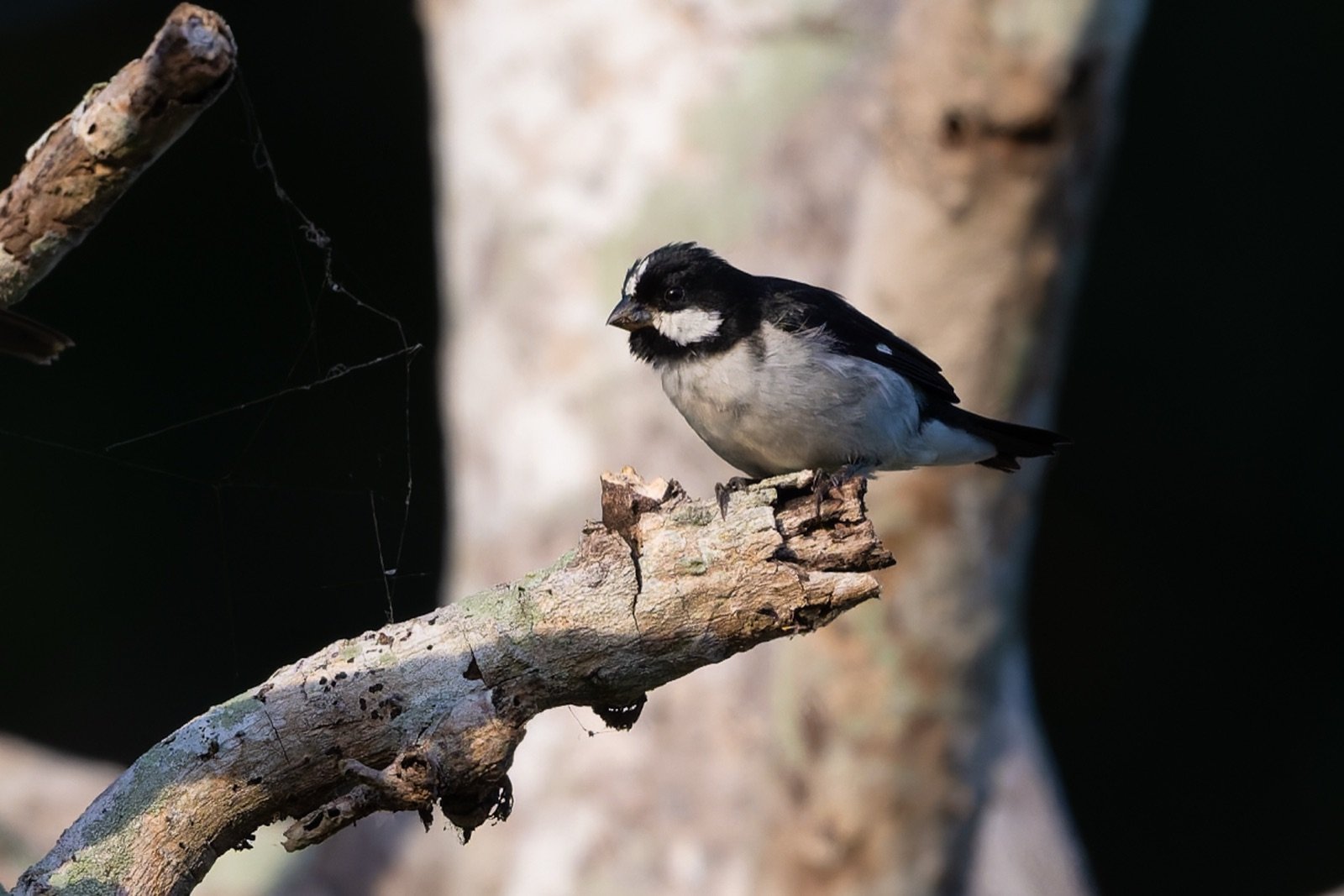
Family Thraupidae
Lined Seedeater
Sporophila lineola
In Spanish: Espiguero Bigotudo (Setillero)
- A
A tiny black and white seedeater, recorded once near Quepos in 2013.
The Lined Seedeater (Sporophila lineola), known here as Espiguero Bigotudo or setillero, is a very rare visitor to Costa Rica. Its home is South America, where it breeds, and Costa Rica sits well outside its normal winter range.
The country's one record comes from a rice field at Playa El Rey near Quepos, Puntarenas, found by Johan Chaves. A single adult male was seen on 5 October 2013, and the bird was accepted onto the official national list that same year.
For a beginning birder this is less a bird to plan a trip around than a lesson in careful seedeater identification. Learn the one mark that matters: the male's white stripe down the middle of the crown.
How to find it
Look in grassy areas, since that is where this species feeds. Watch for birds perched on grass stems and reaching for seeds, alone or in small loose groups. Rice fields and tall grass near water are the places to scan, as at Playa El Rey. Check every male seedeater for the white stripe down the middle of the crown. Treat any search as a long shot, because this is an accidental vagrant here.
How to recognise it
This is a tiny seedeater, about 10 to 11 cm long. Its Latin species name, lineola, refers to a thin white line on the crown.
The male shows these marks:
- black above
- a white stripe down the middle of the crown
- white cheek stripes (malars)
- a small white wing patch
The crown stripe is the key mark to check on any seedeater in Costa Rica, because the male Lesson's Seedeater lacks it. Morelet's Seedeater, another black and white species, instead has a white collar and white wingbars.
Females of the Lined and Lesson's Seedeaters cannot be told apart in the field, so only males can be identified safely.
What it sounds like
Recording: agujaceratops, CC BY 4.0, source, read 4 Nov 2026.
Behaviour and diet
Lined Seedeaters are usually alone or in small loose groups. They feed by perching on grass stems and reaching for seeds.
The Costa Rican male perched in trees and fed all day in a rice field.
The species breeds in the south of South America and moves north to northern South America in the austral winter. That movement explains why it turns up only as a rare vagrant so far to the north.
Where it lives
Outside the breeding season the species uses open grassy savanna, shrubby clearings and semi-open areas with tall grass. It is usually found near water.
In Costa Rica the only known place is a rice field at Playa El Rey near Quepos, on the central Pacific side in Puntarenas. The finder described the site as a marshland, which fits the open, damp, grassy habitat the species favours. No other Costa Rican site is known.
When to see it
The one Costa Rican sighting we can date was on 5 October 2013, at mid-morning, by a local birding group at Playa El Rey. Birders returned on 6 October with a Committee member, and others confirmed the bird.
Similar birds
Lesson's Seedeater is the close lookalike, and males of both are black and white. Only the Lined Seedeater has a white stripe down the middle of the crown. Females of the two cannot be told apart in the field.
Names and lore in Costa Rica
In Costa Rica it is called Espiguero Bigotudo, and also setillero in the press. Colombia and Venezuela use espiguero bigotudo too. Elsewhere it is semillero overo or corbatita overo (Argentina, Paraguay), and espiguero lineado in Ecuador, Peru and Panama.
Status and conservation
The AOCR list places it in category A (Accidental), accepted unanimously on the 2013 update of the official list, and Spanish sources also call it an accidental vagrant in Costa Rica and Panama.
How we know this 15 sources, each read on the date shown
- Lista Oficial de las Aves de Costa Rica (blog) read 2026-11-04
https://listaoficialavesdecostarica.wordpress.com/2013/10/07/nueva-especie-para-costa-rica-sporophila-lineola/ - Wikipedia (Spanish) read 2026-11-04
https://es.wikipedia.org/wiki/Sporophila_lineola - Birds Colombia read 2026-11-04
https://birdscolombia.com/2020/10/28/espiguero-bigotudo-lined-seedeater-sporophila-lineola/ - La Nación read 2026-11-04
https://www.nacion.com/ciencia/aplicaciones-cientificas/gaviotas-pato-y-ciguena-se-unen-al-club-oficial-de-aves-de-costa-rica/3GQALQQLMVHNFIHJR4ZYDIG2CU/story/ - Cornell Birds of the World read 2026-11-04
https://birdsoftheworld.org/bow/species/lessee2/cur/introduction - Cornell Birds of the World read 2026-11-04
https://birdsoftheworld.org/bow/species/linsee1/cur/introduction - Avipedia read 2026-11-04
https://avipedia.org/bird-species/lined-seedeater - BirdForum read 2026-11-04
https://www.birdforum.net/threads/new-bird-for-cr-list-lined-seedeater.269020/ - Research Square preprint read 2026-11-04
https://www.researchsquare.com/article/rs-8225100/v1 - Lista Oficial de las Aves de Costa Rica (AOCR) read 2026-11-05
https://listaoficialavesdecostarica.wordpress.com/nuevos-registros/ - AOU Classification Committee proposal 2014-B read 2026-11-05
https://americanornithology.org/wp-content/uploads/2020/02/2014-B.pdf - Manuel Antonio birding by Johan Chaves read 2026-11-05
https://manuelantoniobirding.wordpress.com/page/12/ - Bulletin of the British Ornithologists' Club read 2026-11-05
https://bioone.org/journals/bulletin-of-the-british-ornithologists-club/volume-142/issue-4/bboc.v142i4.2022.a11/First-record-of-Lessons-Seedeater-Sporophila-bouvronides-in-Costa-Rica/10.25226/bboc.v142i4.2022.a11.full - First record of Lesson's Seedeater in Costa Rica (Academia.edu) read 2026-11-05
https://www.academia.edu/99515741/First_record_of_Lessons_Seedeater_Sporophila_bouvronides_in_Costa_Rica?uc-sb-sw=59662081 - Avibase read 2026-11-05
https://avibase.bsc-eoc.org/species.jsp?avibaseid=7B104DA6