
Family Pipridae
Long-tailed Manakin
Chiroxiphia linearis
In Spanish: Saltarín Toledo (Toledo)
- Resident
Guanacaste's dry forest, Palo Verde to Santa Rosa. All year, easiest December to April.
Most birds court alone. This one brings a partner: two males dance side by side for one female, and that dance is why birders go looking for it in the dry forest.
The partnership lasts. Males pair up, or form a trio, for the long term, and they sing in time with each other as well as dance.
Where to see it
- Hotspot page
- Named place
- Nearby lodge (numbers match the cards)
- Palo Verde National Park and the Tempisque Riverin the dry forest, with the Turquoise-browed Motmot on the fence posts and the White-throated Magpie-Jay.
- Rincón de la Vieja National Parkone of the birds of the whole dry side, around the ranch.Not on the map above: it sits too far away to show at this zoom.
- Santa Rosa and Guanacaste National Parksone of the dry-forest birds that are easy to see when the trees are bare.Not on the map above: it sits too far away to show at this zoom.
Nearby lodges
Within 20 km of a place on the map, in the same zone.
- 1
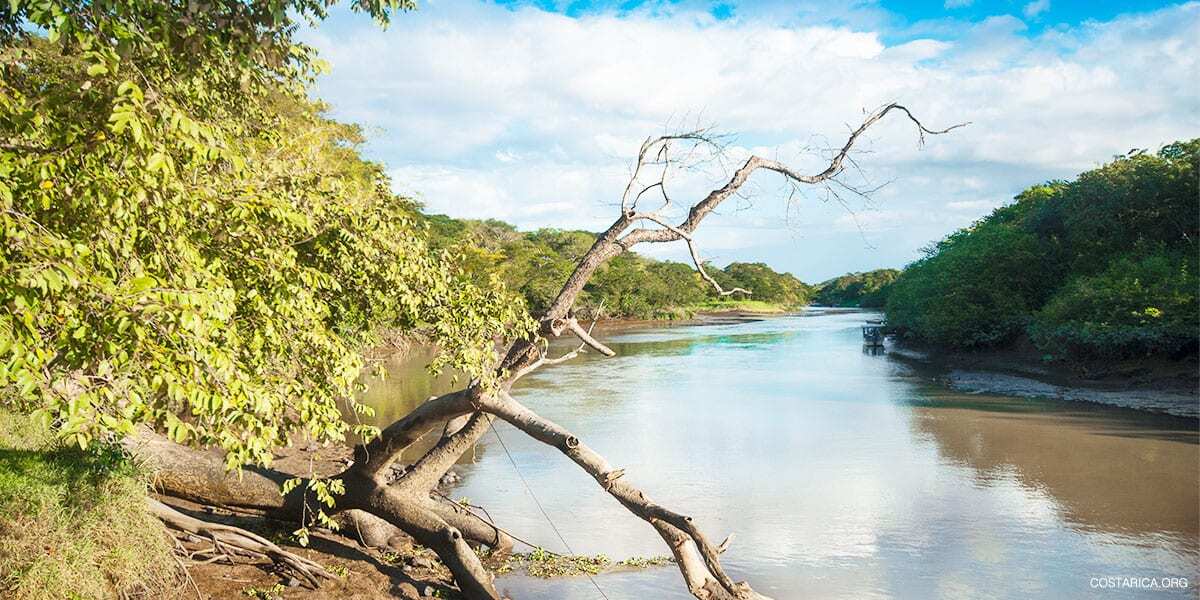 Rancho Humo Estancia5.9 km from Palo Verde National ParkSee the lodge
- 2
 Hacienda Guachipelin4.0 km from Rincón de la Vieja National Park (off the map)See the lodge
How to recognise it
Tiny: about 10 cm and 18 g, shorter than a new pencil. The male is mostly a rich black, with a bright red crown, the top of the head, red legs and a bright blue back. Then there is the tail. Its two central feathers are narrow and greatly lengthened, so a long, thin streamer trails behind a very small bird, and that settles it. The female is olive green, paler below and on the chin and throat; some carry a little red in the crown. If you hear two males singing together, look for the pair.
Where it lives
Dry forest, moist lowland forest, and old forest that has been heavily cut. In Costa Rica it is one of the dry-side birds, the species that do not reach the wet side, so we look for it in Guanacaste in the Northern Pacific lowlands: at Palo Verde, around Rincón de la Vieja, and in Santa Rosa.
When to see it
All year, as a resident. The dry season, December to April, is when the trees are barest and the birding easiest.
Trips that find it
- Costa Rica Classic Birding, All Inclusive8 nightsSee the trip
- Birding in Costa Rica's Nicoya Peninsula11 nightsSee the trip
- Birding in Costa Rica's Northern Zone11 nightsSee the trip
Tell us when you are travelling and our team in Costa Rica builds the trip around the birds you want to see.
Plan my birding tripHow we know this 1 sources, each read on the date shown
- Wikipedia: Long-tailed manakin read 4 November 2026
https://en.wikipedia.org/wiki/Long-tailed_manakin