Family Parulidae
Louisiana Waterthrush
Parkesia motacilla
In Spanish: Reinita Acuática Piquigrande (Menea Cola, Tordo de Agua)
- Migrant
A tail-bobbing winter visitor to fast, forested hill streams.
The Louisiana Waterthrush is a migrant in Costa Rica, not a resident. It breeds in eastern North America and winters in the West Indies and Central America, so here it is a winter bird of fast, forested streams in hilly and highland country.
A study of wintering birds found it widespread and moderately common in Costa Rica. Look for a brown-and-white bird walking, not hopping, along the water while its tail bobs.
It holds a territory on a stream, so on a trip we build around the right water it is a bird you can look for with patience.
How to find it
Walk along streams and rivers in humid forest at middle elevations, where it is fairly common in the winter months. Black Phoebe and Buff-rumped Warbler share the same water. Choose fast, forested streams in the hills rather than flat water. Scan the rocky edges for a brown-and-white bird walking and bobbing its tail. A sharp chip often gives it away. The stream survey in Costa Rica took place in January, when the birds were settled on territories.
How to recognise it
This is a fairly large warbler, 14 to 17 cm long, weighing about 16 to 21 g.
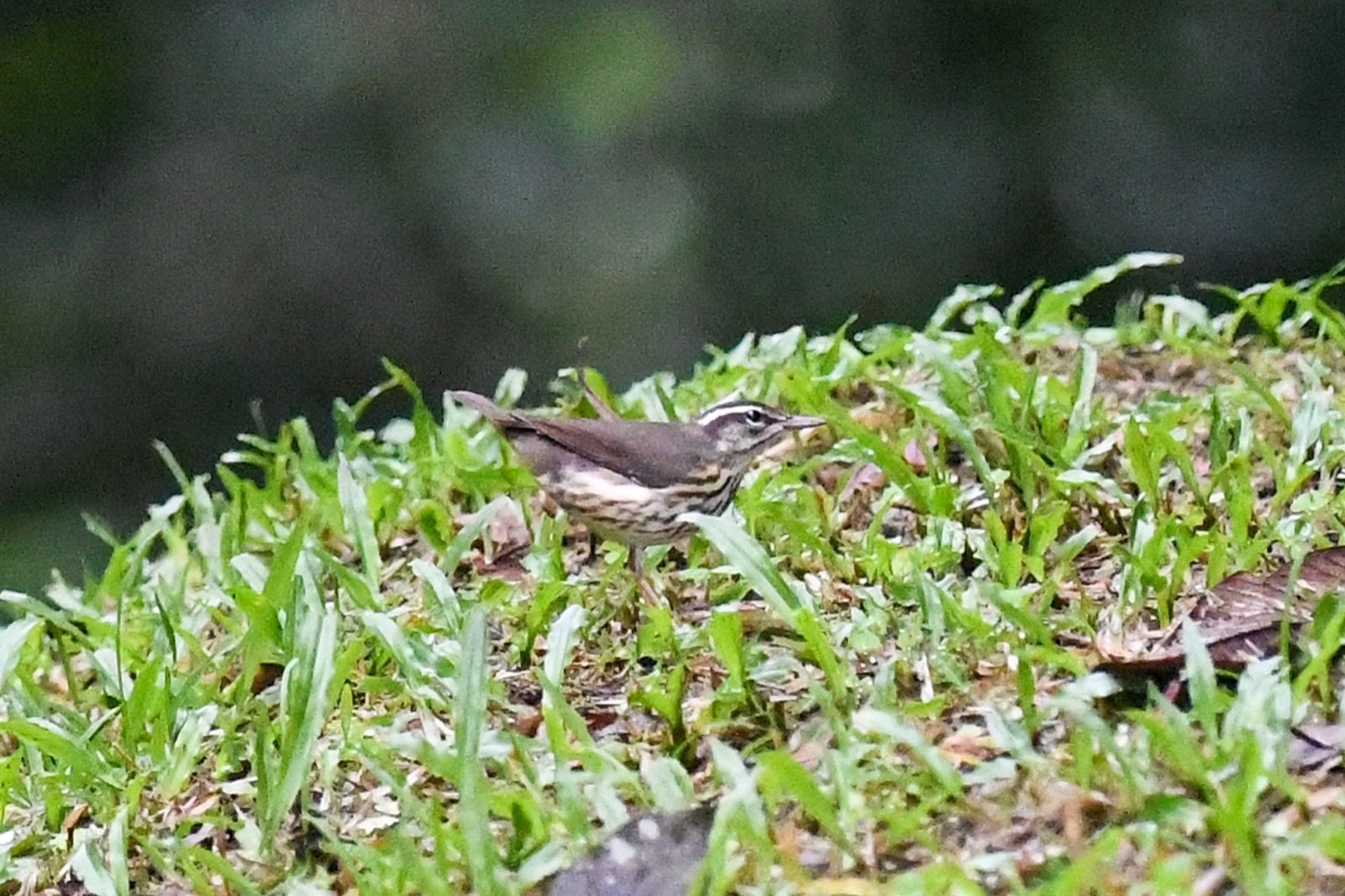
Plain brown above. White below, with black streaks. Buff flanks and a buff undertail.
Compared with Northern Waterthrush it has a whiter base colour below, brighter pink legs and a broader white eyebrow.
The best clue is movement: it walks rather than hops, and it bobs its tail and rear end constantly along rocky stream edges.
What it sounds like
Behaviour and diet
It walks along rocky stream edges and forages in running water for aquatic insects, molluscs and crustaceans. It sometimes takes beetles and ants from the ground, or flies in the air.
Wintering birds are territorial in Costa Rica. Researchers saw chipping, chases and countersinging between waterthrushes on three streams. If alarmed, it flies off into the forest, giving a sharp call.
Where it lives
In Costa Rica it frequents fast, forested streams in hilly and highland areas. Birders see it regularly on foothill and middle elevation streams in humid forest. One author notes that few reach the country, and those that do mostly stay in highland habitats.
A study of wintering birds found it using habitat much like its breeding habitat. Range-wide it prefers streams and their surroundings, and other wet areas.
When to see it
It is one of the earliest migrants to reach its wintering grounds, sometimes arriving in July or August. A Costa Rican birder describes it leaving mountain streams in early spring, around March, departing at night with no farewell calls. In the late dry season, before leaving, wintering birds call more often along forest streams.
Similar birds
Northern Waterthrush looks very similar. It has white flanks and undertail, a streaked throat, a slightly smaller bill, a shorter eyebrow stripe and duller pink legs. The Louisiana's song starts with notes that slur downward, while the Northern's first notes stay level. On Costa Rican streams Louisiana prefers fast hill water, while Northern is more at home in mangroves and slower water, though both may overlap, especially in migration.
Names and lore in Costa Rica
Costa Rica and Panama use the name Reinita Acuática Piquigrande. The Costa Rican list also gives two nicknames, Menea Cola and Tordo de Agua. Menea Cola means tail wagger, and Northern Waterthrush shares both nicknames.
Status and conservation
The official Costa Rican bird list marks it M, a migrant, so it is a winter visitor and not a resident.
Photography tips
Stay at a rocky stream edge and watch for the walking, bobbing bird rather than waiting for song. Streams with thick canopy and little silt are the most promising.
How we know this 19 sources, each read on the date shown
- Lista Oficial de las Aves de Costa Rica (AOCR) read 2026-11-04
https://listaoficialavesdecostarica.wordpress.com/lista-oficial/lista-oficial-online/ - Birds of the World (Cornell) read 2026-11-04
https://birdsoftheworld.org/bow/species/louwat/cur/introduction - Birding Craft blog read 2026-11-04
https://birdingcraft.com/wordpress/2011/01/27/the-costa-rican-riverbird-flush/ - 10,000 Birds read 2026-11-04
https://www.10000birds.com/the-wintering-wood-warblers-of-costa-rica.htm - Cloudbridge Nature Reserve bird list read 2026-11-04
https://www.cloudbridge.org/wp-content/uploads/2020/04/Bird-Species-List-Costa-Rica-13-April-2020.pdf - Animalia.bio (from Wikipedia) read 2026-11-04
https://animalia.bio/louisiana-waterthrush - iNaturalist (Wikipedia text) read 2026-11-04
https://www.inaturalist.org/taxa/73148-Parkesia-motacilla - Spanish Wikipedia read 2026-11-04
https://es.wikipedia.org/wiki/Parkesia_motacilla - Climate Action Tool read 2026-11-04
https://climateactiontool.org/species/louisiana-waterthrush - Aves y Ventanas Costa Rica read 2026-11-04
https://avesyventanascostarica.wordpress.com/2020/10/09/aves/ - Birds Caribbean read 2026-11-04
https://www.birdscaribbean.org/tag/louisiana-waterthrush/ - Wikipedia read 2026-11-04
https://en.wikipedia.org/wiki/Louisiana_waterthrush - South Dakota Birds read 2026-11-04
https://www.sdakotabirds.com/species/louisiana_waterthrush_info.htm - McCuration (quoting eBird description) read 2026-11-04
https://mccuration.com/louisiana-waterthrush-gallery/ - Missouri Department of Conservation read 2026-11-04
https://mdc.mo.gov/discover-nature/field-guide/louisiana-waterthrush - USDA Forest Service read 2026-11-04
https://research.fs.usda.gov/treesearch/31890 - Cornell All About Birds read 2026-11-04
https://www.allaboutbirds.org/guide/Louisiana_Waterthrush/lifehistory - Birdingcraft read 2026-11-04
https://birdingcraft.com/wordpress/2024/03/03/early-spring-migrants-on-the-move-in-costa-rica/ - Costa Rica Focus read 2026-11-04
https://www.costaricafocus.com/spring-bird-migration-in-costa-rica-what-to-expect/