Family Parulidae
Magnolia Warbler
Setophaga magnolia
In Spanish: Reinita Colifajeada
- Migrant
A small yellow and black winter migrant that keeps low in second growth.
The Magnolia Warbler is a migrant in Costa Rica, marked M on the official list of the country's birds. It does not breed here. It is a winter visitor, regular in second growth and some forested areas, though pretty uncommon.
It rewards a patient look. It usually stays fairly low and avoids the high canopy, and the pattern on its spread tail is distinctive at every age.
Around Turrialba it is an infrequent winter visitor, but still possible to find. For a beginning birder it is a good lesson in separating a small, active warbler from a lookalike by one clear mark.
How to find it
Look low rather than high, in shrubs, short trees and second growth. Scan the outer edge of trees, where it forages, and watch for birds searching under leaves. Check mixed flocks of many species, since it forages inside them. Listen for a sharp tslip or a chickadee-like call from a flock. When a small yellow warbler turns away from you, watch for white tail patches framing a dark T. Around Turrialba it is infrequent, so be ready for a quiet day.
How to recognise it
This is a small warbler, 11 to 13 cm long. These marks describe the species in general, so a winter bird here may look different from a breeding male.
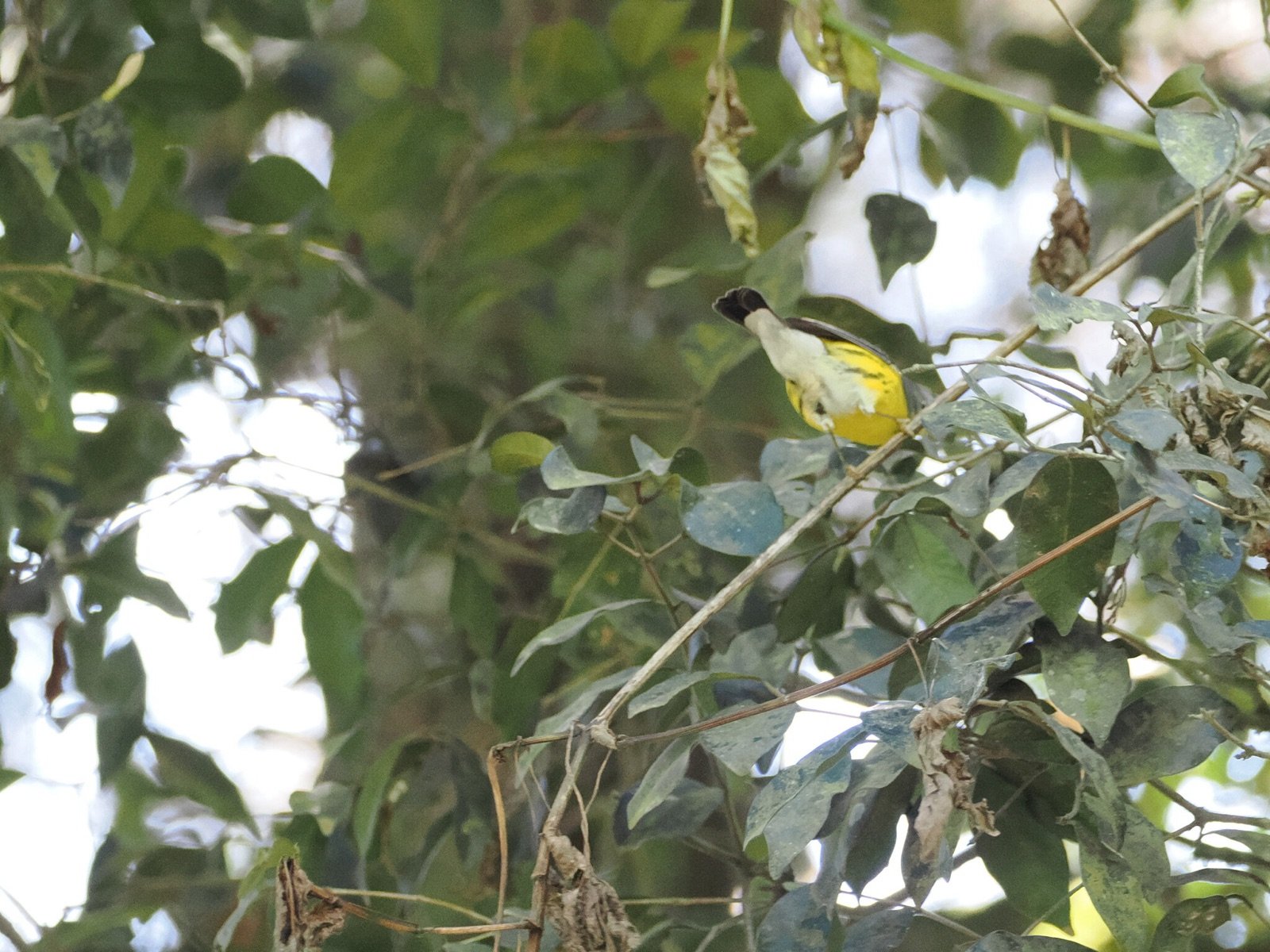
The tail is the best clue, distinctive at all ages. Seen from above, white patches on the dark tail frame a dark T shape, easiest to see when the tail is spread.
Breeding males are bright yellow and black, with white wing and tail patches and dark streaks on the back and flanks. Spring and summer adults have a black face, a white line above the eye and a grey crown.
A black necklace on yellow underparts fits both this bird and the Canada Warbler, so check the back and tail as well.
What it sounds like
Recording: Liren Varghese, CC BY 4.0, source, read 4 Nov 2026.
Behaviour and diet
The Magnolia Warbler usually stays fairly low and avoids the high canopy. It is small and very active, but often more cooperative than other warblers, because it tends to stay low in shrubs and short trees. It forages on the outer edge of trees and looks for insects under leaves, often flashing its black and white tail.
On migration and in winter quarters it adds small fruits and berries to its insect diet. In winter each bird keeps its own territory, with males and females holding separate ones, and it also forages inside mixed flocks of many species.
Where it lives
In Costa Rica it is regular in second growth and some forested areas, but pretty uncommon, and it may be less uncommon than in the past. A Costa Rica birding writer places it among the species that prefer warm, lower places.
Records come from the Caribbean foothills at Turrialba and from the Chirripó area of southern Costa Rica.
Across its winter range it uses cacao plantations, shade coffee farms, orchards, mixed forest and thickets, from sea level up to about 5,000 feet. That figure is for the species in general, not Costa Rica alone.
When to see it
It is a winter visitor, not a breeder. One local observer places the latest spring record for the Turrialba area in mid-April, so most leave by then.
Similar birds
Canada Warbler also has a black necklace on yellow underparts, but its upperparts are plain grey. The Magnolia has dark streaks on the back and the distinctive tail pattern. Canada is the more common of the two in Costa Rica, so a necklaced warbler is more often a Canada.
Names and lore in Costa Rica
In Costa Rica the bird is called Reinita Colifajeada, the same name used in Nicaragua and Panama. Another Spanish name is Reinita Cejiblanca, which refers to the white line above its eye. Mexico uses chipe names instead, and Puerto Rico and Venezuela say reinita manchada.
Status and conservation
The official list of Costa Rican birds marks it M, a migrant, and it is pretty uncommon in second growth and some forested areas.
Photography tips
It is small and very active, but often more cooperative than other warblers. It tends to stay low in shrubs and short trees, so it is easier to watch. It often flashes its black and white tail, which helps you pick it out. Look along the outer edge of trees, where it forages.
How we know this 13 sources, each read on the date shown
- Birds for Beer (Paul Pickering) read 2026-11-04
https://birdsforbeer.com/2018/05/26/from-costa-rica-to-minnesota-12-migrant-warblers/ - Birds for Beer (Paul Pickering) read 2026-11-04
https://birdsforbeer.com/2017/05/25/magnolia-warbler-very-late-migration-date/ - 10,000 Birds read 2026-11-04
https://www.10000birds.com/the-wintering-wood-warblers-of-costa-rica.htm - Lista Oficial de las Aves de Costa Rica (AOCR) read 2026-11-04
https://listaoficialavesdecostarica.wordpress.com/lista-oficial/lista-oficial-online/ - Cloudbridge Nature Reserve read 2026-11-04
https://www.cloudbridge.org/wp-content/uploads/2020/04/Especies-de-Aves-Costa-Rica-13-April-2020.pdf - Chipes.org read 2026-11-04
https://chipes.org/portfolio/reinita-de-magnolia-chipe-cola-fajeada/ - Wikipedia (Spanish) read 2026-11-04
https://es.wikipedia.org/wiki/Dendroica_magnolia - Cloudbridge Nature Reserve bird list read 2026-11-04
https://www.cloudbridge.org/wp-content/uploads/2020/04/Bird-Species-List-Costa-Rica-13-April-2020.pdf - Earthlife read 2026-11-04
https://earthlife.net/magnolia-warblers/ - Audubon Field Guide read 2026-11-04
https://www.audubon.org/field-guide/bird/magnolia-warbler - Smithsonian National Zoo read 2026-11-04
https://nationalzoo.si.edu/animals/magnolia-warbler - A-Z Animals read 2026-11-04
https://a-z-animals.com/animals/magnolia-warbler/ - Birdfact read 2026-11-04
https://www.birdfact.com/birds/magnolia-warbler