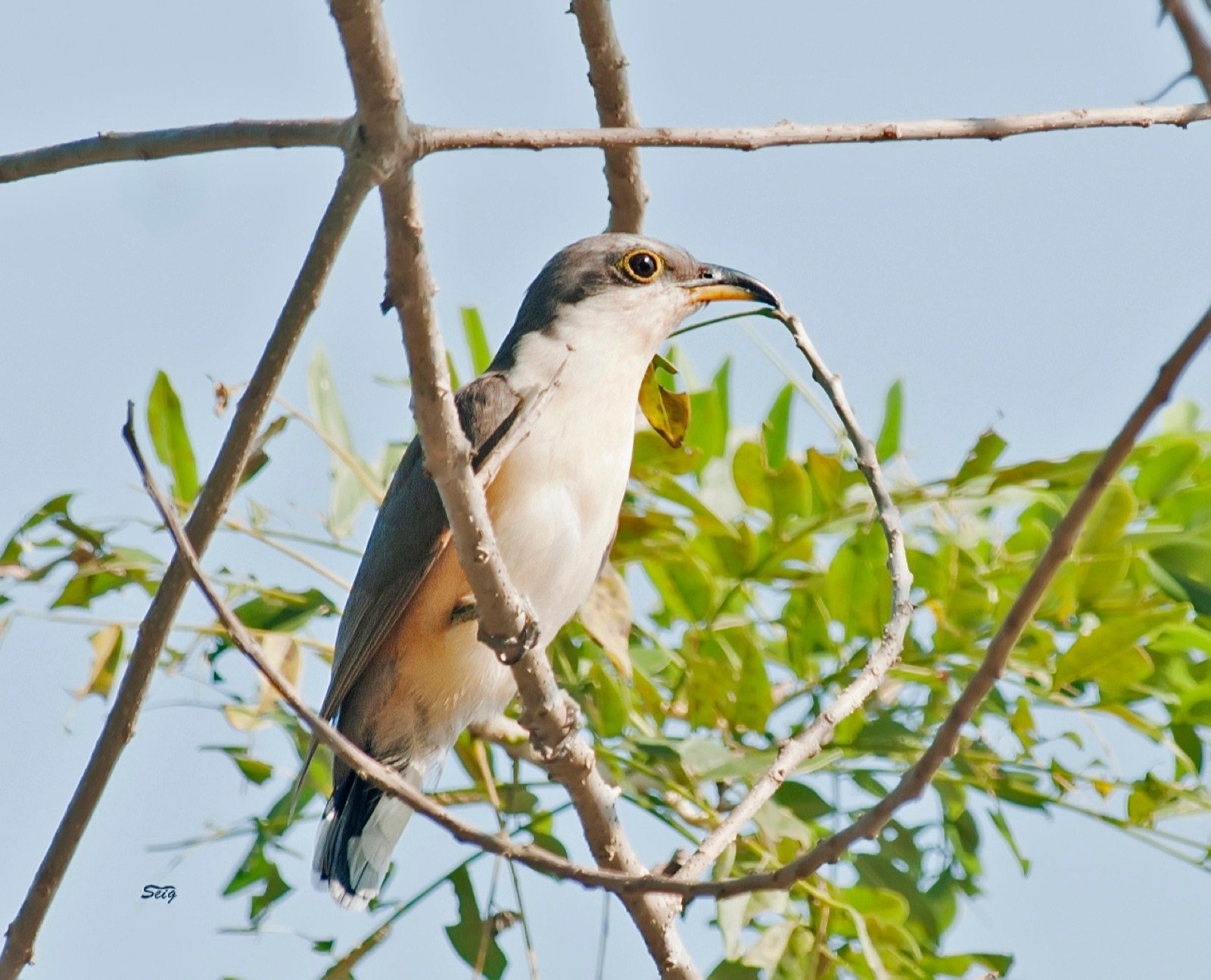
Family Cuculidae
Mangrove Cuckoo
Coccyzus minor
In Spanish: Cuclillo de Antifaz
- Resident
Secretive masked cuckoo of Pacific mangroves and dry forest, here December to June.
The Mangrove Cuckoo (Cuclillo de Antifaz) is a large cuckoo with a black face mask and buffy underparts. In Costa Rica it is uncommon to fairly common in some lowland and foothill spots of the northern Pacific slope, and it is treated as a non-breeding visitor from December to June.
A Costa Rican bird guide site calls it secretive and local, found in mangrove habitats. Cuckoos tend to be quiet, wary birds that are heard more than seen, so this one rewards good ears and patience.
Palo Verde National Park, where mangrove swamps line the Tempisque River, is a natural place to start looking on a dry-season trip.
How to find it
Listen first. The voice is loud but given only now and then, so the gawk series is your best clue. Then scan the canopy slowly, since the bird forages high up. Check forest edges and small openings, where it may cross in view. Look in mangroves, gallery forest and dry forest thickets on the northern Pacific slope. Be patient with stillness, because it can sit motionless for long periods.
How to recognise it
Start with the face: a black mask, usually darker and bigger than the mask of a Yellow-billed Cuckoo. Then check the rest in turn.
- Underparts: buffy, also described as peachy.
- Back: grayish brown.
- Bill: black upper, yellow lower, so it reads as black over yellow.
- Size: a large cuckoo.
- In flight: no rufous flash in the wings, which the Yellow-billed shows.
Costa Rican birds come in both light and dark individuals, and both are found anywhere in the country. A paler or darker bird than you expected is not cause for doubt.
What it sounds like
Behaviour and diet
This cuckoo often walks quietly from branch to branch instead of flying. It also stays still for long periods while it peers around, and both habits make it hard to notice.
It forages in the tree canopy and may come to forest edges or cross small openings, which are the best moments to catch sight of it. Its voice is loud but given only now and then.
It eats large, slow insects and lizards.
Where it lives
In Costa Rica it uses the canopy and edges of forest, young secondary forest, scrub, gallery forest, dry forest thickets and mangroves.
It is uncommon to fairly common in some lowland and foothill spots of the northern Pacific slope, and rare farther south along the coast and around the Golfo Dulce area. In some places, such as the west of the Central Valley, it reaches about 1100 m. On the Caribbean side it is regular only in the far northwest.
When to see it
It is treated as a non-breeding visitor present from December to June, not as a year-round bird here. Palo Verde is best visited in the dry season, which a Costa Rican tour site gives as December to April.
Similar birds
Yellow-billed Cuckoo has white underparts and an all-yellow lower bill, while the Mangrove Cuckoo has peachy or buffy underparts and a black-over-yellow bill. The Mangrove's mask is usually darker and bigger. Cocos Cuckoo looks much like it but lives only on Cocos Island, Costa Rica, and some authors treat the two as one species.
Names and lore in Costa Rica
Costa Rican sources give several names for this bird: Cuclillo de Antifaz, Cuclillo de Orejinegro and Cuclillo de Manglar.
Status and conservation
The AOCR official list marks it as possibly resident (R?) and a migrant (M), and it is treated here mainly as a December to June visitor.
How we know this 17 sources, each read on the date shown
- Asociación Ornitológica de Costa Rica (Cuculidae page) read 2026-11-04
https://avesdecostarica.weebly.com/cuculidae.html - Flickr (Costa Rica natural history species card, PN Palo Verde) read 2026-11-04
https://www.flickr.com/photos/jobando/23335511146 - AOCR Lista Oficial de las Aves de Costa Rica read 2026-11-04
https://listaoficialavesdecostarica.wordpress.com/lista-oficial/lista-oficial-online/ - Bird Watching Costa Rica read 2026-11-04
https://www.birdwatchingcostarica.com/ave/mangrove-cuckoo/ - Birds of Costa Rica (birdsofcolombia.org) read 2026-11-04
https://www.birdsofcolombia.org/costarica/Coccyzus.html - iNaturalist (Wikipedia text) read 2026-11-04
https://www.inaturalist.org/taxa/1964-Coccyzus-minor - Cornell Birds of the World read 2026-11-04
https://birdsoftheworld.org/bow/species/mancuc/cur/systematics - Cornell Birds of the World read 2026-11-04
https://birdsoftheworld.org/bow/species/mancuc/cur/sounds - All About Birds, Cornell Lab read 2026-11-04
https://www.allaboutbirds.org/guide/Mangrove_Cuckoo/sounds - UWI St. Augustine species account read 2026-11-04
https://sta.uwi.edu/fst/lifesciences/sites/default/files/lifesciences/documents/ogatt/Coccyzus_minor%20-%20Mangrove%20Cuckoo.pdf - All About Birds, Cornell Lab read 2026-11-04
https://www.allaboutbirds.org/guide/Mangrove_Cuckoo/species-compare/ - Bird Finding (birdfinding.info) read 2026-11-04
https://birdfinding.info/mangrove-cuckoo/ - EcoRegistros read 2026-11-04
https://www.ecoregistros.org/ficha/Coccyzus-minor - Wikipedia (es), Aves de Costa Rica read 2026-11-04
https://es.wikipedia.org/wiki/Aves_de_Costa_Rica - Manchester Birding Forum read 2026-11-04
https://manchesterbirding.activeboard.com/mobile.spark?p=topic&topic=64349768 - Visit Costa Rica read 2026-11-04
https://www.visitcostarica.com/where-to-go/protected-areas/palo-verde-national-park - Private Costa Rica read 2026-11-04
https://privatecostarica.com/nature/paloverde