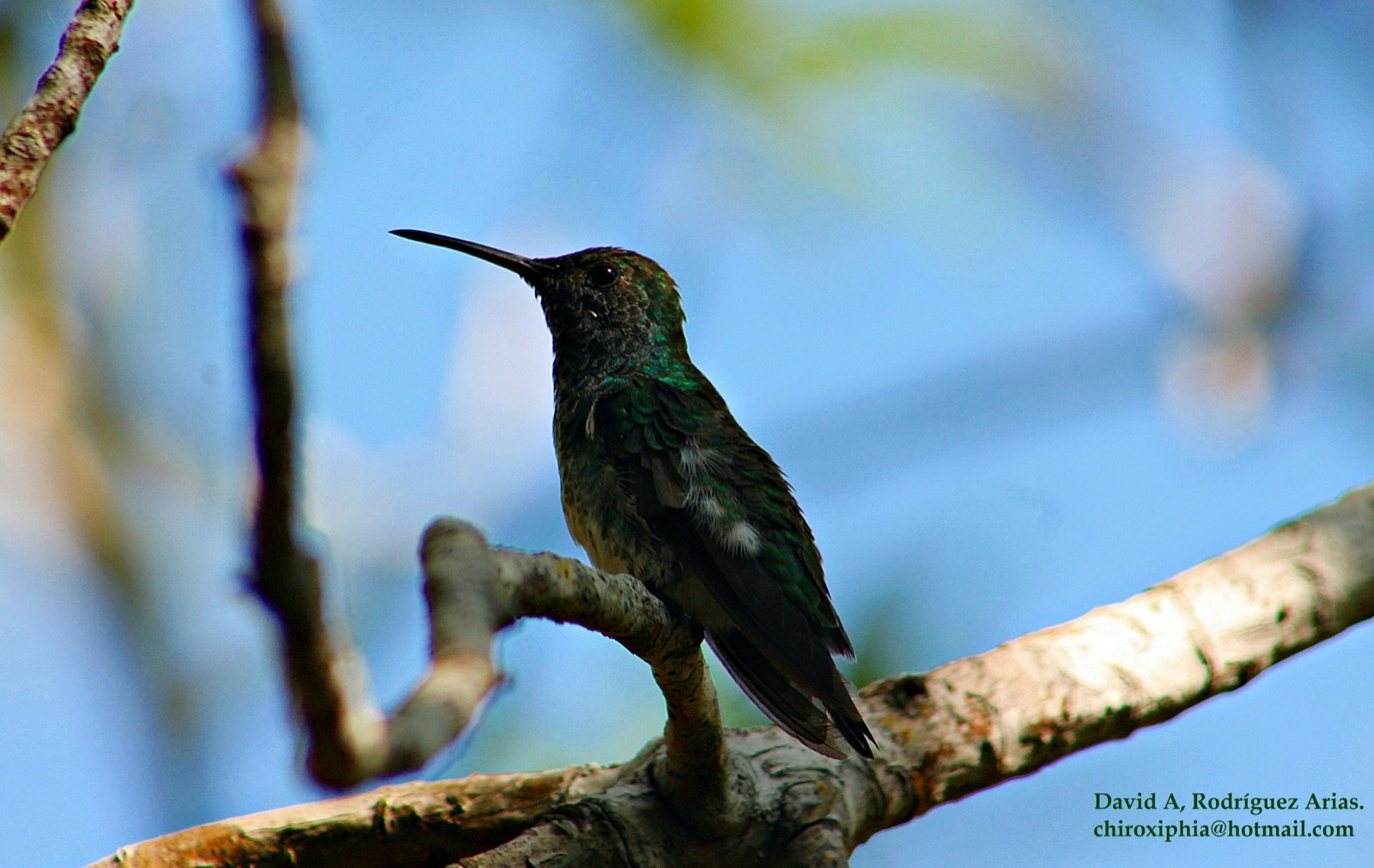
Family Trochilidae
Mangrove Hummingbird
Chrysuronia boucardi
In Spanish: Colibrí de Manglar (Gurrión)
- Resident
- Regional endemic
A Pacific mangrove endemic that follows the tea mangrove flowers.
The Mangrove Hummingbird (Colibrí de Manglar) lives only on Costa Rica's Pacific coast, and only in mangroves. Its range runs from the outer Nicoya Peninsula south to Golfo Dulce. One travel site calls it the country's rarest hummingbird, and it is one of only two hummingbirds found nowhere else, the other being the Coppery-headed Emerald.
Finding it is a matter of finding the right trees, because it feeds on tea mangrove nectar and nests in the same trees.
On a trip we build to Palo Verde, it is one of the birds to look for on the Tempisque River, alongside Jabiru, Wood Stork and Bare-throated Tiger-Heron.
Where to see it
How to find it
Look for stands of tea mangrove, since the bird feeds on its nectar and is hard to find away from it. Early morning is the time guides choose: on the Osa Peninsula they run trips into nearby mangroves to look for it. A boat trip on the Tárcoles River near Carara National Park is suggested as a good chance to see and photograph it. Expect to work for it, because the plumage blends with the foliage. One birding plan for a one-day hummingbird challenge puts it in the mangroves near Tárcoles and Bajamar, and calls it uncommon there and one of the day's toughest birds.
How to recognise it
This is a small hummingbird, about 10 cm long. Field marks for the male:
- Blue-green throat and chest
- White belly
- Forked tail
- Green crown and upperparts, with a bronze tint on the rump and tail
- Dark bill with a reddish lower half
The female is similar but mostly white below, with small green spots on the throat and sides. These details come from the species in general, not only from Costa Rican birds. One local tour source describes the plumage as dull gray-green, blending well with mangrove foliage, so it can be hard to pick out among the leaves.
Behaviour and diet
It feeds mainly on nectar from the flowers of the tea mangrove, called piñuela. It also takes nectar from other trees, vines and epiphytes. Unlike many hummingbirds, it is usually not territorial. It does not migrate: it is sedentary, so the same mangrove stands are the place to look through the year.
Where it lives
It lives in large stands of tea mangrove, and sometimes in nearby second growth. It is found only in mangroves and occasionally in habitats next to them. Its distribution is patchy, not continuous.
In Costa Rica that means the Pacific coast from the outer Nicoya Peninsula to Golfo Dulce, including the Térraba-Sierpe National Wetland. The National Museum says it is most plentiful near the Osa Peninsula. It has spread to the Nicoya area over time, but it always stays close to mangroves and the coast.
When to see it
One Costa Rica tour source puts peak activity from January to April and runs early morning mangrove outings in that period. Nesting has been recorded from October through February for the species in general.
Similar birds
The Coppery-headed Emerald, the other Costa Rican endemic hummingbird, has a similar call, but the Mangrove Hummingbird's is faster. Habitat helps too, since this species stays with mangroves.
Names and lore in Costa Rica
Other Spanish names in use include amazilia de manglar, amazilia manglera, colibrí manglero and diamante de los mangles. The tea mangrove it depends on is known as piñuela.
Status and conservation
The AOCR list marks it as a resident endemic (R-END), and the IUCN lists it as Endangered, as it has since 2000.
Photography tips
The Tárcoles River boat trip near Carara National Park is suggested as a good chance to see and photograph it. Because its dull gray-green plumage blends with mangrove foliage, early morning outings near flowering tea mangrove are the sensible plan.
Trips that find it
- Costa Rica Classic Birding, All Inclusive8 nightsSee the trip
- Dry Forest and the Gulf of Nicoya6 nightsSee the trip
- Birding in Costa Rica's Nicoya Peninsula11 nightsSee the trip
- Birding in Costa Rica's Northern Zone11 nightsSee the trip
Tell us when you are travelling and our team in Costa Rica builds the trip around the birds you want to see.
Plan my birding tripHow we know this 15 sources, each read on the date shown
- EcoRegistros read 2026-11-04
https://www.ecoregistros.org/ficha/Chrysuronia-boucardi - EcuRed read 2026-11-04
https://www.ecured.cu/Amazilia_boucardi - Costa Rica Focus read 2026-11-04
https://www.costaricafocus.com/best-spots-for-spotting-hummingbirds-in-costa-rica/ - EcoRegistros read 2026-11-04
https://www.ecoregistros.org/site_en/imagen.php?id=593597 - Wikipedia read 2026-11-04
https://en.wikipedia.org/wiki/Mangrove_hummingbird - Birds of the World (Spanish summary) read 2026-11-04
https://birdsoftheworld.org/bow/species/manhum1/cur/introduction?lang=es - Avibase (from Wikipedia) read 2026-11-04
https://avibase.bsc-eoc.org/species.jsp?avibaseid=837E6B04 - Copa de Arbol read 2026-11-04
https://www.copadearbol.com/costa-rica-hummingbirds/ - Museo Nacional de Costa Rica read 2026-11-04
https://www.museocostarica.go.cr/divulgacion/articulos-educativos/colibries/ - Birdingcraft read 2026-11-04
http://birdingcraft.com/wordpress/2013/08/01/how-many-hummingbird-species-can-you-see-in-costa-rica-in-just-one-day-a-plan-of-attack/ - Áreas y Parques read 2026-11-04
https://areasyparques.com/peligroextincion/colibri-de-manglar/ - Wikipedia (es) read 2026-11-04
https://es.wikipedia.org/wiki/Amazilia_boucardi - 10,000 Birds read 2026-11-04
https://www.10000birds.com/15-hummingbirds-that-can-only-be-seen-in-or-near-costa-rica.htm - The Flains Travel read 2026-11-04
https://theflainstravel.com/hummingbirds-in-costa-rica/ - OWS Costa Rica read 2026-11-04
https://owscostarica.weebly.com/mangrove-hummingbird.html